
1. Company identity
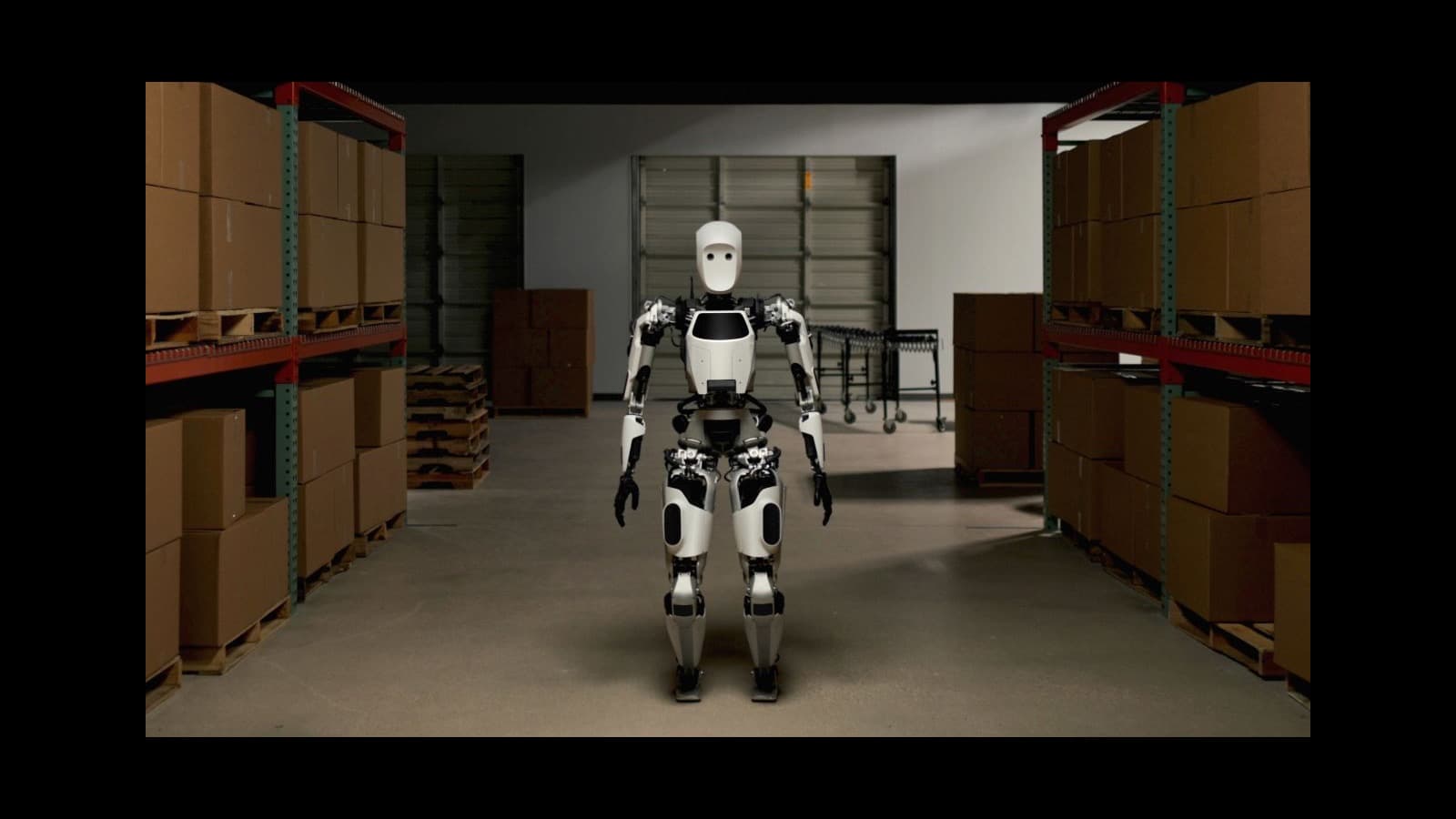
Apptronik is an Austin robotics company developing general-purpose humanoid systems for manufacturing, logistics and, eventually, other human environments. Its current platform is Apollo 2, offered with bipedal or wheeled mobility and used primarily for pilots, task development and real-world data collection.
The company’s story is not a sudden response to the humanoid investment boom. Its founders worked on NASA’s Valkyrie robot and developed a succession of actuators, exoskeletons, manipulators and legged machines before unveiling Apollo in 2023. What changed after that was scale: Apptronik secured industrial partners, made Apollo a hardware platform for Google DeepMind’s Gemini Robotics models, and expanded its Series A to more than $935 million.
2. Basic information
| Field | Detail |
|---|---|
| Founded | 2016 |
| Origin | University of Texas at Austin Human Centered Robotics Lab |
| Headquarters | Austin, Texas |
| Co-founder and CEO | Jeff Cardenas |
| Co-founder and CTO | Dr. Nick Paine |
| Main platform | Apollo 2 |
| Software and operations | Artemis and Fleet Connect |
| Training program | Robot Park |
| Capital raised | Nearly $1 billion, according to the company in February 2026 |
| Current stage | Scaled pilots, data collection and development of a commercial successor |
3. Founding team and leadership
Apptronik emerged from the Human Centered Robotics Lab at the University of Texas at Austin. Members of the founding group were selected to work with NASA on Valkyrie during the DARPA Robotics Challenge. That program exposed the team to the practical difficulty of building a large robot that could walk, manipulate objects and operate in spaces designed for people.
Jeff Cardenas, co-founder and CEO, leads commercialization and strategy. Co-founder and CTO Nick Paine worked on series-elastic actuators and actuator-level control for Valkyrie. The current executive team also includes CFO Kay Sheils Kingsbury, chief commercial officer Barry Phillips, chief product officer Daniel Chu and chief operating officer Steve O’Dea. Their backgrounds span finance, autonomous vehicles, warehouse robotics and complex hardware production—disciplines needed to move Apollo beyond research hardware.
4. Products and programs
Apollo 2 is Apptronik’s current humanoid platform. The bipedal version is intended for human-designed spaces, while a wheeled-base configuration trades stairs and humanlike movement for stability and efficiency in structured industrial settings. Apptronik says both versions use its actuator technology and can support manipulation, mobility and interaction tasks.
Artemis is the software layer coordinating perception, planning, controls, safety, task execution and human-robot interaction. Fleet Connect is the operational layer for monitoring robots, assigning work, collecting deployment data and managing fleets. Together, these products signal that Apptronik intends to sell a managed automation system rather than isolated hardware.
Robot Park is the company’s data-collection and training program. Apptronik announced an expanded 90,000-square-foot Austin facility in June 2026 and said Apollo 2 fleets also collect data at partner and customer sites. Teleoperation and simulation generate task experience for Gemini Robotics models.
Apptronik has also discussed Apollo 3 as the next commercial generation. CEO Jeff Cardenas described Apollo 2 to Forbes as a prototype for scaled pilots and data collection, while calling its successor the product intended to scale to market. A shipping date, final specifications and price have not been published.
5. Core technology
Apptronik’s hardware foundation is actuation. Years of work on series-elastic and electric linear actuators informed a robot designed to be force-controlled, maintainable and manufacturable. Apollo’s modularity allows mobility bases, hands and other components to change as customer tasks become clearer. Swappable batteries are intended to support extended industrial operation.
The AI strategy relies heavily on Google DeepMind. Gemini Robotics converts visual and language inputs into robot actions, while Gemini Robotics-ER supplies spatial reasoning that can connect to lower-level controllers. DeepMind has demonstrated versions of its models on Apollo, including whole-body tasks and cross-embodiment learning. Its published results also show that difficult multi-finger manipulation remains inconsistent across tasks.
Robot Park links the hardware and model strategies. Apollo 2 collects real-world demonstrations and task outcomes; simulation supplements the physical data; improved models return to the fleet. This is a credible training loop, but a training platform should not be mistaken for a production robot already meeting customer speed, reliability and cost targets.
6. Financing history
Before its large institutional round, Apptronik said it had raised $28 million. In February 2025, it announced a $350 million Series A co-led by B Capital and Capital Factory with Google participating. The company expanded that round to $403 million in March 2025.
Apptronik’s February 2026 announcement describes the pre-extension Series A as $415 million, indicating further additions after the $403 million disclosure. It then added a $520 million Series A-X with participation from existing investors including B Capital, Google, Mercedes-Benz and PEAK6 and new investors including AT&T Ventures, John Deere and Qatar Investment Authority. The company says the combined Series A exceeded $935 million and total capital raised approached $1 billion.
Because these are extensions of one round, the amounts should not be added as separate Series A financings. Apptronik did not disclose the final valuation, although Reuters reported roughly $5 billion and TechCrunch reported approximately $5.3 billion post-money.
7. Partnerships and deployment
Mercedes-Benz is Apptronik’s most visible industrial partner. The automaker confirms testing Apollo in production-related environments, initially for intralogistics such as moving components and performing basic quality checks. Mercedes-Benz also disclosed a low double-digit-million-euro investment and said employees used teleoperation and augmented reality to transfer task knowledge. This is a serious development program, but it remains testing and training rather than fleet-scale autonomous production.
GXO announced an early-stage proof of concept in 2024. Its release said the companies were evaluating Apollo in a laboratory before possible deployment to a US distribution center. Jabil’s 2025 agreement is broader: Jabil serves as a manufacturing partner and a validation environment for tasks including sorting, kitting, inspection, lineside delivery and subassembly.
Google DeepMind is a research and model partner rather than a robot customer. The partnership gives Apollo access to frontier embodied-AI research and gives DeepMind a full humanoid platform for model development. None of these relationships publicly establishes the size of a paid production fleet.
8. Business model
Apptronik appears to be building an enterprise robotics platform around hardware, intelligence and fleet operations. Apollo provides the physical system; Artemis coordinates robot behavior; Fleet Connect manages deployed machines; training and integration adapt tasks to customer sites. Jabil supplies manufacturing scale while Robot Park builds the data required for new capabilities.
Initial use cases are repetitive material movement and light manufacturing tasks where customers can define a bounded workflow and measure output. A wheeled configuration may reach those jobs sooner because it avoids the reliability and safety burden of bipedal locomotion. The bipedal robot remains strategically important for environments where stairs, tight human spaces or repositioning across varied work areas matter.
Apptronik has not published a purchase price, subscription terms, service model, deployment cost, revenue or unit economics. It is therefore not possible to determine whether current pilots can become profitable recurring contracts.
9. Development timeline
- 2013: Future Apptronik team members work with NASA on Valkyrie during the DARPA Robotics Challenge.
- 2016: Apptronik is founded from the University of Texas at Austin robotics ecosystem.
- 2016–2022: The company develops actuators and multiple robot platforms, including exoskeleton and humanoid systems.
- 2023: Apptronik unveils the first Apollo humanoid.
- 2024: Mercedes-Benz and GXO announce industrial development programs; Apptronik formalizes its Google DeepMind partnership.
- 2025: Apptronik raises and expands its Series A, partners with Jabil and begins broader Apollo pilots and data collection.
- 2026: The Series A grows beyond $935 million; Apollo 2, Artemis, Fleet Connect and the expanded Robot Park become the current platform; Apollo 3 is described as the future commercial generation.
10. Evidence ledger
Confirmed
- Apptronik was founded in 2016 from work associated with the University of Texas at Austin.
- Co-founders worked on NASA’s Valkyrie program.
- The company announced more than $935 million in combined Series A financing.
- Mercedes-Benz confirms Apollo testing, task training and an investment in Apptronik.
- GXO confirms an early-stage proof of concept.
- Jabil confirms manufacturing and validation collaboration.
- Google DeepMind confirms that Gemini Robotics models run on Apollo hardware.
Company claim
- Total capital raised is nearly $1 billion.
- Apollo’s actuator design can reach more than 90% energy efficiency and support mass manufacturing.
- Robot Park operates fleets across multiple locations and customer sites.
- Apollo can ultimately address a wide range of manufacturing, logistics and later consumer tasks.
- Apollo 3 will become the scalable commercial product.
Unknown
- Number of Apollo robots in customer facilities and share operating autonomously.
- Current customer revenue, contract values and repeat orders.
- Apollo price, deployment cost, service fees and gross margin.
- Production volume and Jabil manufacturing capacity assigned to Apollo.
- Apollo 3 launch date, specifications and commercial availability.
- Reliability, cycle time and uptime in sustained customer operations.
11. Editorial assessment
Apptronik has three advantages: deep hardware experience, credible industrial partners and direct access to Google DeepMind’s robotics models. The modular Apollo 2 strategy is also practical. Wheels can serve structured facilities while bipedal systems continue maturing, and the same software and data infrastructure can support both.
Its biggest risk is the distance between capital and commercial proof. Nearly $1 billion can finance manufacturing, data collection and product development, but it also raises expectations for speed and scale. Public evidence still centers on pilots, training fleets and partnership announcements. Even Apptronik’s CEO has framed Apollo 2 as a prototype for the product that follows.
The decisive milestone will not be another demonstration. It will be a disclosed customer workflow in which Apollo meets required speed, safety, uptime and economics for long enough to justify repeat purchases. Apptronik has assembled many of the components needed to reach that point; it has not yet publicly shown the complete operating model.
12. Update history
- 2026-09-02: Initial profile published with company, product, financing, partnership and Robot Park information through the research date.
13. Related reporting
No related Embodied AI Insights articles have been assigned to this profile.
14. Sources & evidence
This profile uses Apptronik’s product, leadership, financing and Robot Park disclosures; Google DeepMind research announcements; and direct statements from Mercedes-Benz, GXO and Jabil. Reported valuation and Apollo 3 positioning are attributed to external publications. Detailed source mapping and evidence treatment appear in sources.md and research-ledger.md.
Sources — Apptronik company profile
Accessed: 2026-09-02
-
Leadership
Publisher: Apptronik
URL: https://apptronik.com/company/leadership
Publication date: Not stated
Supports: executive roles, founder backgrounds and NASA Valkyrie experience. -
Meet Apollo 2
Publisher: Apptronik
URL: https://apptronik.com/apollo/apollo-2
Publication date: Not stated
Supports: mobility configurations, actuators, battery strategy, Artemis, Fleet Connect and safety design. -
Welcome to Robot Park
Publisher: Apptronik
URL: https://apptronik.com/news-collection/welcome-to-robot-park-where-apptroniks-apollo-goes-to-work
Publication date: 2026-06-30
Supports: Robot Park, Apollo 2 data collection, teleoperation, simulation and partner-site workflows. -
Apptronik Closes Over $935 Million Series A
Publisher: Apptronik
URL: https://apptronik.com/news-collection/apptronik-closes-over-935-million-series-a
Publication date: 2026-02-11
Supports: Series A-X, combined Series A, total capital, investors and employee count. -
QIA Participates in Apptronik Series A Funding Round
Publisher: Qatar Investment Authority
URL: https://qia.qa/en/Newsroom/Pages/QIA-Participates-in-Apptronik-Series-A-Funding-Round-to-Support-Scaled-Production-and-Global-Deployment-of-Apollo%E2%84%A2-Humanoid-Robots.aspx
Publication date: 2026-02-11
Supports: independent investor confirmation of the $520 million extension and $415 million earlier Series A. -
Apptronik Raises $350 Million in Series A Funding
Publisher: Apptronik
URL: https://apptronik.com/news-collection/apptronik-raises-350-million-in-series-a-funding
Publication date: 2025-02-13
Supports: initial close, previous funding and investors. -
Gemini Robotics Brings AI into the Physical World
Publisher: Google DeepMind
URL: https://deepmind.google/blog/gemini-robotics-brings-ai-into-the-physical-world/
Publication date: 2025-03-12
Supports: Apptronik partnership and Gemini Robotics specialization for Apollo. -
Gemini Robotics 2 Brings Whole-Body Intelligence to Robots
Publisher: Google DeepMind
URL: https://deepmind.google/blog/gemini-robotics-2-brings-whole-body-intelligence-to-robots/
Publication date: 2026
Supports: whole-body Apollo 2 demonstrations and disclosed task limitations. -
AI and Humanoid Robots at Mercedes-Benz Digital Factory Campus
Publisher: Mercedes-Benz Group
URL: https://group.mercedes-benz.com/unternehmen/produktion/produktionsnetzwerk/mbdfc-humanoide-roboter.html
Publication date: 2025-03-18
Supports: Apollo testing, tasks, teleoperation training and Mercedes-Benz investment. -
GXO Advances Humanoid Strategy with Apptronik
Publisher: GXO Logistics
URL: https://gxo.com/news_article/gxo-announces-multi-phase-r-d-initiative-with-apptronik/
Publication date: 2024-06-20
Supports: early proof-of-concept status, lab evaluation and intended warehouse use. -
Apptronik and Jabil Collaborate to Scale Production of Apollo
Publisher: Jabil
URL: https://www.jabil.com/news/apptronik-jabil-collaborate.html
Publication date: 2025-02-25
Supports: manufacturing relationship, validation environment and proposed tasks. -
Apptronik Announces Robot Park and Teases New Robot
Publisher: Forbes
URL: https://www.forbes.com/sites/johnkoetsier/2026/06/30/apptronik-announces-robot-park-a-90000-square-foot-humanoid-data-factory-teases-new-robot/
Publication date: 2026-06-30
Supports: CEO characterization of Apollo 2 and Apollo 3, fleet-count nondisclosure and product roadmap. -
Humanoid Robot Startup Apptronik Has Now Raised $935M
Publisher: TechCrunch
URL: https://techcrunch.com/2026/02/11/humanoid-robot-startup-apptronik-has-now-raised-935m-at-a-5b-valuation/
Publication date: 2026-02-11
Supports: independently reported post-money valuation context.