
What happened
On August 17, 2026, warehouse-automation company Robust AI appointed Marin Tchakarov as chief executive. Co-founder and outgoing CEO Anthony Jules moved into the newly emphasized role of Chief Innovation Officer, with responsibility for physical-AI initiatives around the company’s robotics platform.
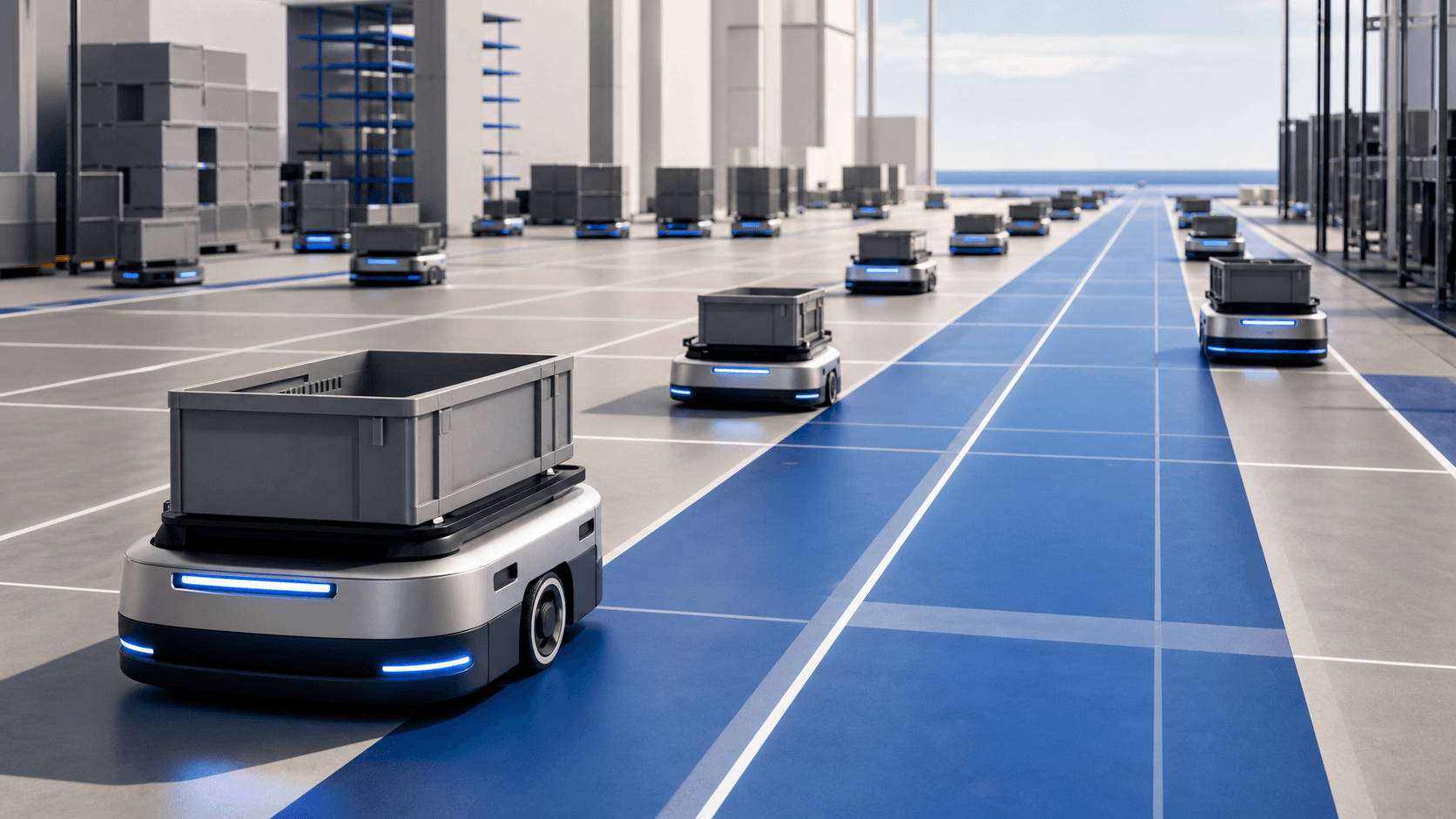
The leadership change arrived alongside a commercial milestone: Robust AI said it had deployed more than 100 Carter collaborative mobile robots. The company also said deployments were doubling every six months and named DHL Supply Chain, O’Neill Logistics, ShipLab and Saddle Creek Logistics Services among its customers.
Tchakarov previously led Fox Robotics before its acquisition by Symbotic and Kindred Systems before its acquisition by Ocado Group. Robust AI’s board is therefore installing an executive associated with commercial growth and robotics transactions at the moment the company says it is moving beyond its first hundred deployed machines.
Confirmed facts
| Fact | Evidence status |
|---|---|
| Marin Tchakarov became CEO of Robust AI. | Confirmed by Robust AI’s August 17 announcement. |
| Anthony Jules moved from CEO to Chief Innovation Officer. | Confirmed by Robust AI and subsequent reporting from the Association for Advancing Automation. |
| Robust AI reported more than 100 Carter robots deployed. | Company disclosure; CTO Rodney Brooks separately discussed the 100th deployed unit in a named interview. |
| Carter is used for warehouse tasks including picking, tote movement, putaway and point-to-point transport. | Supported by company deployment announcements and named customer statements. |
| O’Neill Logistics agreed to receive 24 Carter robots at two sites with a Q4 2026 go-live plan. | Confirmed as a future deployment plan in the July 28 announcement, not counted here as completed installation. |
| ShipLab began with a phased pilot and performance-gated expansion model. | Confirmed by Robust AI and a named ShipLab executive. |
The public material does not identify the complete installed fleet by customer or site. The 100-unit milestone is therefore meaningful but remains an aggregate rather than an independently auditable deployment register.
Company context
Founded in 2019, Robust AI builds Carter, a collaborative autonomous mobile robot designed for dynamic warehouse work without fixed conveyor infrastructure. Carter can be steered manually and reassigned through software among workflows such as order picking, mobile sorting and transport. The company sells access through a robotics-as-a-service model and emphasizes deployment alongside warehouse employees.
Recent announcements show a company building the operational pieces around that product. Saddle Creek described using Carter for tote delivery among processing and labeling lines. ShipLab adopted a phased “Crawl, Walk, Run” model in which expansion and payments depend on jointly confirmed performance. O’Neill Logistics announced a 24-robot plan across facilities in New Jersey and Georgia. Aptiv is supplying radar-and-vision perception for the Gen 3 Carter, while Robust AI has also named Foxconn as a manufacturing partner.
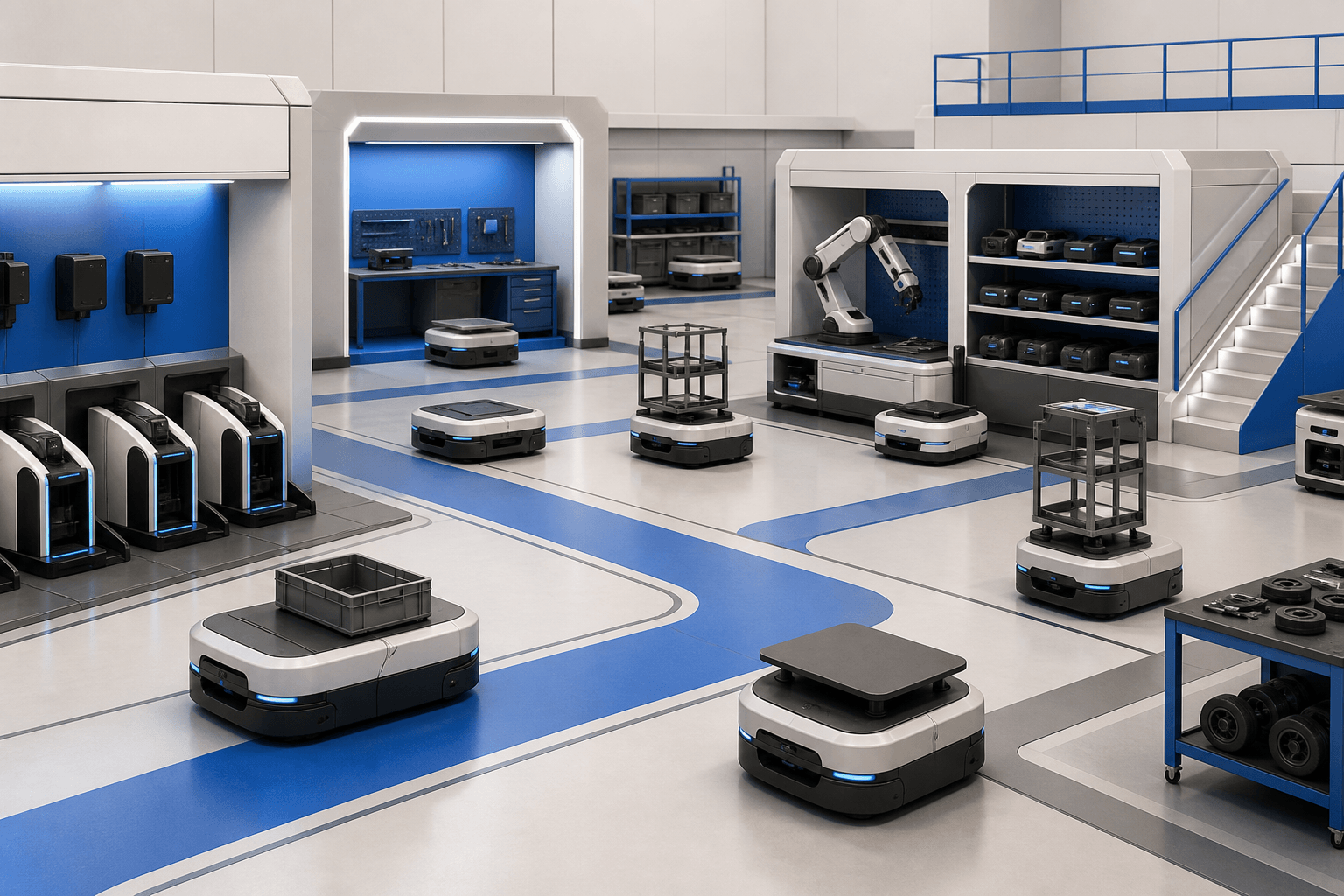
AI-generated illustration (not a photograph or measured data).
Why it matters
Robotics companies face a management transition when deployment stops being a demonstration problem and becomes a service problem. A hundred machines spread across operating warehouses require monitoring, spare parts, field support, software releases, customer success and commercial discipline. They also generate the edge cases that laboratory testing cannot reproduce.
Robust AI’s choice of CEO reflects that transition. Tchakarov’s mandate appears oriented toward customers, operations and scale, while Jules returns his attention to technical development. This division can be productive if it prevents sales expansion from consuming the engineering leadership required to improve the platform.
The milestone also offers a more concrete signal than production capacity alone. A robot counted as deployed is supposed to be installed in an operating workflow. In an A3 interview, Brooks said shipped units exceeded deployed units and that additional systems were expected to enter deployment within 30 days. That distinction matters: manufactured, shipped and operating are different commercial stages.
Claims versus evidence
Company claim: Robust AI says Carter deployments are doubling every six months. The company has not published a time series, starting base or site-by-site count that allows readers to calculate that rate independently.
Company claim: Tchakarov said a forthcoming platform would increase Carter’s value by more than tenfold by turning robots into “intelligence agents.” Robust AI said the platform would use transactional and computer-vision data to provide operational intelligence. No released product specification, price, customer result or independent performance benchmark accompanied that forecast.
Public evidence: Named deployments demonstrate that Carter is used in warehouse workflows rather than existing only as a prototype. Saddle Creek described an operating tote-delivery application, while ShipLab and O’Neill disclosed defined deployment plans. Aptiv separately confirmed its perception partnership for Gen 3 Carter.

AI-generated illustration (not a photograph or measured data).
What remains unknown
- The number of paying customers, active sites and robots operating at each site.
- How Robust AI defines a deployed unit and whether inactive or trial systems remain in the total.
- Fleet uptime, intervention frequency, support workload and contract renewal rates.
- Revenue, recurring revenue, gross margin and the economics of its robotics-as-a-service contracts.
- Whether the announced six-month doubling rate can continue from a larger base.
- The launch date, commercial terms and measured impact of the forthcoming data platform.
- How Jules’s new innovation role and Tchakarov’s CEO authority will divide product decisions in practice.
Editorial analysis
The leadership change is best read as an operating-stage decision, not evidence of a crisis or an inevitable exit. Robust AI has enough machines in the field for support, reliability and customer expansion to become central management problems. Hiring an executive with experience scaling warehouse-robotics companies is a rational response to that shift.
Crossing 100 deployments changes the quality of the company’s evidence, but not its completeness. It suggests customers are relying on Carter in real facilities. It does not reveal whether those deployments form a durable, profitable business or whether they are concentrated in a small number of accounts.
The next decisive indicators are operational rather than promotional: a site-level fleet breakdown, renewal or expansion by existing customers, sustained uptime, faster installation and improving service economics. If those measures strengthen while the new platform ships to working fleets, Robust AI will have evidence of a repeatable automation business. For now, it has passed an important early threshold and appointed leadership intended to carry the harder scaling work that follows.
Related company, robot, and technology
No related Embodied AI Insights article has been assigned at publication. Direct future connections should include a Robust AI company profile, a Carter robot profile and an explainer on robotics-as-a-service economics once those pages exist.
Sources & evidence
- Robust.AI Appoints Marin Tchakarov CEO as Orders for Carter Mobile Robot Soar — Robust AI via GlobeNewswire, company announcement, August 17, 2026. Accessed September 2, 2026.
- Rodney Brooks on the Realities of Deploying Robots — Association for Advancing Automation, independent industry reporting and named interview, August 26, 2026. Accessed September 2, 2026.
- Robust.AI Introduces “Crawl, Walk, Run” Automation Model with ShipLab Deployment — Robust AI, company and customer announcement, July 8, 2026. Accessed September 2, 2026.
- Robust.AI Partners with O’Neill Logistics to Deploy 24 Carter Robots — Robust AI, company and customer announcement, July 28, 2026. Accessed September 2, 2026.
- Robust.AI Selects Aptiv Perception for Its Gen 3 Carter Robot — Aptiv, partner announcement, June 23, 2026. Accessed September 2, 2026.
- Saddle Creek Deploys Robust.AI’s Carter Collaborative Robots — Robust AI and Saddle Creek Logistics Services, deployment announcement, November 13, 2025. Accessed September 2, 2026.
Sources — Robust AI leadership and Carter deployment milestone
Access date: September 2, 2026
-
Robust.AI Appoints Marin Tchakarov CEO as Orders for Carter Mobile Robot Soar
- Publisher: Robust AI via GlobeNewswire
- Type: Primary company announcement
- Published: August 17, 2026
- URL: https://www.globenewswire.com/news-release/2026/08/17/3346142/0/en/robust-ai-appoints-marin-tchakarov-ceo-as-orders-for-carter-mobile-robot-soar.html
- Supports: CEO appointment, Anthony Jules’s new role, reported 100-plus deployments, named customers, growth and future-platform claims.
-
Rodney Brooks on the Realities of Deploying Robots
- Publisher: Association for Advancing Automation
- Author: Brian Heater
- Type: Independent industry reporting and named executive interview
- Published: August 26, 2026
- URL: https://www.automate.org/robotics/industry-insights/rodney-brooks-on-the-realities-of-deploying-robots/aph
- Supports: Leadership transition, 100th deployed unit, distinction between shipped and deployed robots, support implications of field scale.
-
Robust.AI Introduces “Crawl, Walk, Run” Automation Model with ShipLab Deployment in Vista, CA
- Publisher: Robust AI and ShipLab
- Type: Primary company/customer announcement
- Published: July 8, 2026
- URL: https://www.robust.ai/shiplab-deployment
- Supports: Phased pilot, performance-gated expansion, RaaS payment structure and proposed workflow.
-
Robust.AI Partners with O’Neill Logistics to Deploy 24 Carter Robots Across Two Distribution Centers
- Publisher: Robust AI and O’Neill Logistics
- Type: Primary company/customer announcement
- Published: July 28, 2026
- URL: https://www.robust.ai/oneill-logistics-deployment
- Supports: 24-robot plan, two named sites, Q4 2026 go-live plan and intended workflows.
-
Robust.AI Selects Aptiv Perception, Powered by PULSE, for Its Gen 3 Carter Robot
- Publisher: Aptiv
- Type: Primary partner announcement
- Published: June 23, 2026
- URL: https://www.aptiv.com/en/newsroom/article/robust.ai-selects-aptiv-perception-powered-by-pulse-for-its-gen-3-carter-cobot
- Supports: Aptiv perception selection, radar-and-vision scope and functional-safety pathway.
-
Saddle Creek Deploys Robust.AI’s Carter Collaborative Robots to Enhance Warehouse Operations and Efficiency
- Publisher: Robust AI and Saddle Creek Logistics Services
- Type: Primary company/customer deployment announcement
- Published: November 13, 2025
- URL: https://www.robust.ai/saddle-creek-deploys-robustais-carter-collaborative-robots
- Supports: Named operational deployment, tote-delivery workflow and customer statements about integration.