
What happened
On August 24, 2026, XPeng Inc. announced a conditional financing transaction for Dogotix, the entity being prepared to hold its robotics business. The company described the transaction as raising more than US$900 million at a post-money valuation above US$6.3 billion. IDG Capital led the external investor group, with Gaorong Ventures participating and Tencent and Alibaba joining as strategic investors.
The regulatory filing reveals a more structured transaction than the headline suggests. Dogotix expects approximately US$900 million from the subscription before any additional investor allocation or warrant exercise. The financing is subject to closing conditions, and the robotics assets, personnel, intellectual property, contracts, and operating resources are to be transferred into the Dogotix group through a carve-out plan.
Confirmed facts
| Item | Confirmed detail |
|---|---|
| Transaction | Conditional share purchase agreement involving XPENG, Dogotix, investors, and executive subscribers |
| Base proceeds | Approximately US$900 million |
| External capital | US$600 million from investors including IDG Capital, Gaorong Ventures, Tencent, and Alibaba |
| Other subscriptions | US$200 million from an XPENG subsidiary and US$100 million from entities controlled by XPENG executives |
| Additional capital | Up to US$15 million from an additional investor and up to US$500 million through future warrant exercises, neither included in the base US$900 million |
| Ownership | XPENG expects Dogotix to remain a controlled and consolidated subsidiary after completion |
| Planned use | Robotics growth, capital expenditure, and general working capital |
The filing also states that the preferred shares carry redemption, liquidation-preference, pre-emption, co-sale, anti-dilution, and other investor rights. A redemption mechanism may be triggered if Dogotix does not complete a qualifying IPO within seven years after the relevant subscription closes.
Company context
XPENG began as an electric-vehicle company, but it now presents autonomous driving, robotaxis, AI chips, foundation models, and humanoid robots as parts of a shared “Physical AI” strategy. Its next-generation humanoid, IRON, is the product around which the robotics financing narrative is built.
The company says IRON has 76 degrees of freedom across its body, 21 in each hand, three Turing AI chips, and up to 2,250 TOPS of effective computing power. It also says the robot uses a full-stack architecture developed in-house, spanning chips, controllers, actuation, dexterous hands, AI models, and control software. These specifications describe the intended platform; they do not establish production yield, task reliability, or customer economics.
The carve-out matters because it gives the robotics operation its own employees, assets, intellectual property, incentives, and financing channel while XPENG retains control and continues consolidating its results.
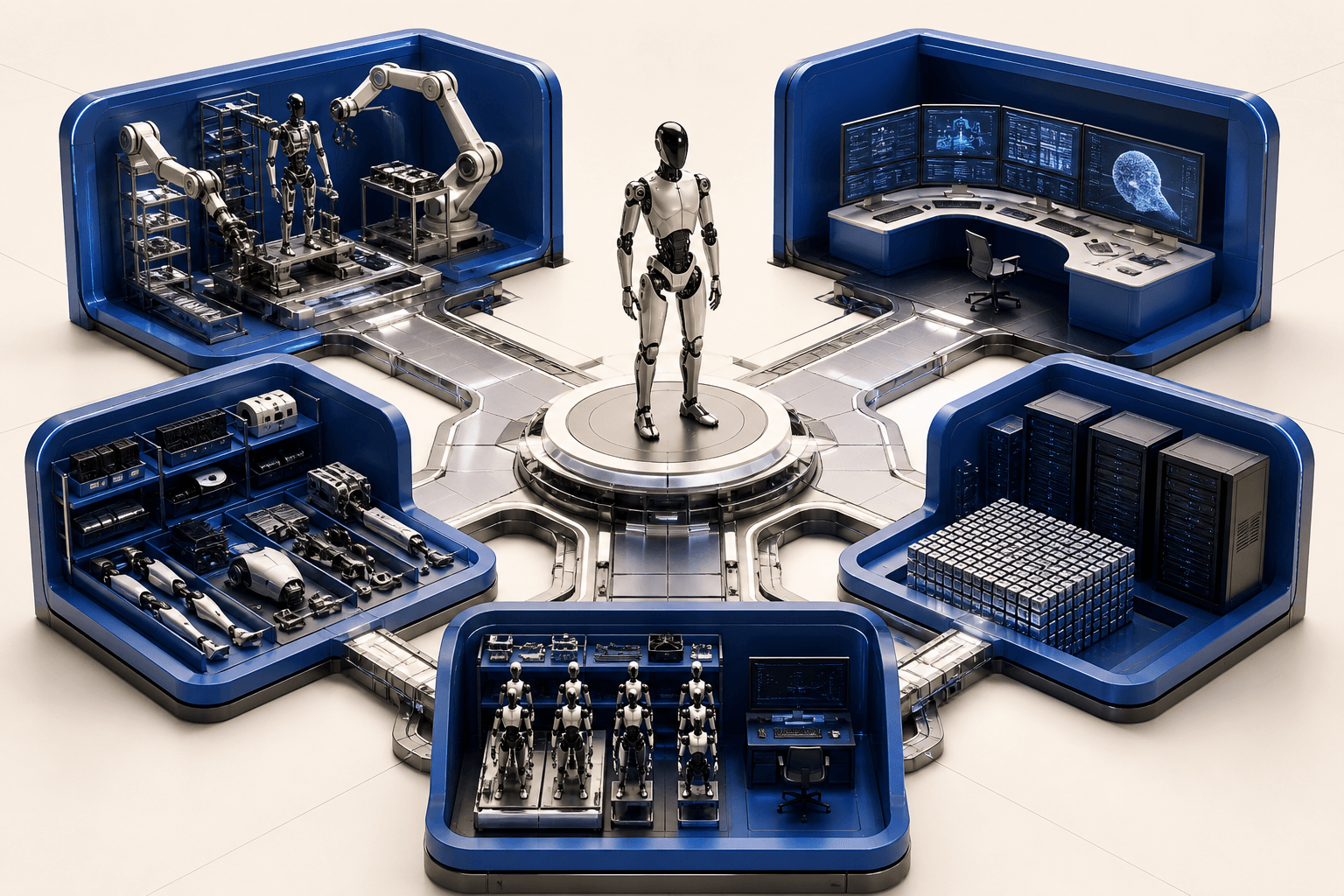
AI-generated illustration (not a photograph or measured data).
Why it matters
The transaction changes how XPENG can fund and measure its robotics ambition. Humanoid development consumes capital across mechanical design, actuators, compute, data collection, model training, factories, field support, and safety engineering. A separately financed subsidiary can attract investors who want direct exposure to robotics without requiring XPENG’s automotive shareholders to fund the entire program from the parent balance sheet.
It also produces an explicit market valuation for the robotics business. That valuation may help recruit employees and negotiate with suppliers, but it is not a measure of current robot revenue or operational maturity. The most consequential result is therefore organizational: XPENG is turning robotics from an internal research program into a distinct venture with its own capitalization, incentive structure, and possible route to a future listing.
Claims versus evidence
Company claim: XPENG says IRON is moving toward mass production by the end of 2026, with initial use at company stores and campuses, followed by launches and deliveries in China and overseas markets in 2027.
Public evidence: The financing agreements, carve-out plan, ownership structure, use of proceeds, and investor protections are described in a public filing. They provide evidence that XPENG has committed significant organizational and financial resources to robotics.
Evidence limit: The disclosed documents do not provide completed production volume, external customer orders, paid deployment counts, uptime, intervention rates, unit cost, selling price, gross margin, or task-level performance data. Funding creates capacity to pursue commercialization; it does not confirm that commercialization has occurred.
AI-generated illustration (not a photograph or measured data).
What remains unknown
Several questions will determine whether the financing becomes industrial progress:
- How much of the conditional subscription has closed and when each tranche becomes available.
- Which external customers, if any, have committed to buy or operate IRON.
- Whether initial store and campus use will be paid deployment, internal testing, or supervised demonstration.
- What tasks the production robot can complete repeatedly without remote intervention.
- The robot’s manufacturing cost, selling model, warranty obligations, service staffing, and expected gross margin.
- How intellectual property and engineering resources will be shared between Dogotix and XPENG’s vehicle business.
- Whether the potential US$500 million in warrant proceeds will ever be exercised.
Editorial analysis
The financing is important because it gives XPENG’s robotics effort time, capital, and organizational independence. It also shows that strategic investors are willing to value access to manufacturing infrastructure, chips, AI models, and a humanoid platform before broad commercial deployment is visible.
What it does not do is close the gap between a credible engineering program and a repeatable robot business. The decisive evidence will not be another demonstration or funding announcement. It will be a disclosed chain from production units to named tasks, operating hours, customer acceptance, service requirements, and revenue.
The next milestone worth watching is therefore the first externally documented IRON deployment with a defined task and measurable operating period. Until then, the US$900 million transaction should be read as proof of financial commitment—not proof that general-purpose humanoid labor has reached commercial scale.
Related company, robot, and technology
- Company: XPENG Robotics / Dogotix — the separately financed robotics operation controlled by XPeng Inc.
- Robot: XPENG IRON — the humanoid platform at the center of the company’s production and commercialization plans.
- Technology: Physical AI foundation models, on-device inference, dexterous manipulation, humanoid actuation, and robot manufacturing.
Sources & evidence
- Announcement relating to the Dogotix Share Purchase Agreement — XPeng Inc.; regulatory disclosure / Form 6-K; August 24, 2026; accessed September 2, 2026.
- XPENG Robotics business raises over US$900 million — XPENG; company announcement; August 24–25, 2026; accessed September 2, 2026.
- Xpeng carves out robotics business at US$6.3 billion post-money valuation — CnEVPost; independent reporting based on the exchange filing; August 24, 2026; accessed September 2, 2026.
- XPeng’s robotics unit raises over US$900 million at a US$6.3 billion valuation — TechNode; secondary reporting; August 25, 2026; accessed September 2, 2026.
Sources — XPENG Robotics financing
Access date for all sources: 2026-09-02
Primary sources
XPeng Form 6-K / Dogotix transaction announcement
- Publisher: XPeng Inc. / Hong Kong Stock Exchange disclosure furnished through Form 6-K
- URL: https://ir.xiaopeng.com/static-files/1d5a8981-d81f-475b-a13c-3ecdb466f999
- Publication date: 2026-08-24
- Source type: Regulatory disclosure; primary
- Supports: Subscription structure, approximately US$900M base proceeds, external and internal subscriptions, optional additional investment, warrants, closing conditions, investor rights, incentive plan, ownership scenarios, carve-out plan, use of proceeds, continuing consolidation, and IPO-linked redemption rights.
XPENG Robotics business financing announcement
- Publisher: XPENG
- URL: https://www.xpeng.com/pressroom/news/01a03797fccda01e0de68a02a256006a
- Publication date: 2026-08-24 announcement; newsroom page dated 2026-08-25
- Source type: Company announcement; primary
- Supports: Headline financing and valuation, named investors, stated uses, IRON product specifications, planned production timing, initial internal deployment plan, and 2027 launch and delivery targets.
- Evidence caution: Product capability, industry superlatives, production timing, and future deployment are company claims.
Secondary sources
Xpeng carves out robotics business at US$6.3 billion post-money valuation
- Publisher: CnEVPost
- URL: https://cnevpost.com/2026/08/24/xpeng-carves-out-robotics-business/
- Publication date: 2026-08-24
- Source type: Independent reporting based on the HKEX filing
- Supports: Plain-language breakdown of the US$600M external, US$200M subsidiary, and US$100M executive components; valuation assumptions; ownership scenarios; optional investment and warrant amounts; conditional status.
XPeng’s robotics unit raises over US$900 million at a US$6.3 billion valuation
- Publisher: TechNode
- URL: https://technode.com/2026/08/25/xpengs-robotics-unit-raises-over-900m-at-a-6-3bn-valuation/
- Publication date: 2026-08-25
- Source type: Secondary reporting
- Supports: Concise independent record of the announcement, named investor group, stated use of funds, and forward-looking IRON timetable.