
1. In one sentence
Learning from demonstration trains a robot to choose actions from examples of how a person performed a task instead of requiring every movement to be programmed by hand.
2. Why you need to understand it
Many current robot systems are advertised as learning from human data, teleoperation or imitation. Those phrases can sound as though a person shows the robot something once and the robot understands the skill. The actual process is more demanding.
A demonstration must be captured through an interface, converted into synchronized observations and actions, cleaned and used to train a policy—the rule or model that selects an action from the robot’s current information. The policy is then evaluated without the operator directly controlling each movement. Success depends on whether the training examples cover the situations the robot encounters during execution.
This matters because demonstration data is becoming a central input to robot learning. It can express delicate, contact-rich behavior that is difficult to specify with hand-written rules. It can also hide important limits: who collected the data, which body produced it, how many examples were recorded, how much the test scene changed and whether a human intervened when the learned policy failed.
3. The core idea
Learning from demonstration, often shortened to LfD, is a family of methods in which a robot learns behavior from examples supplied by a teacher. A major review in the Annual Review of Control, Robotics, and Autonomous Systems describes it as a way for robots to acquire skills by learning to imitate an expert, especially when ideal behavior is difficult to script or define as an optimization problem.
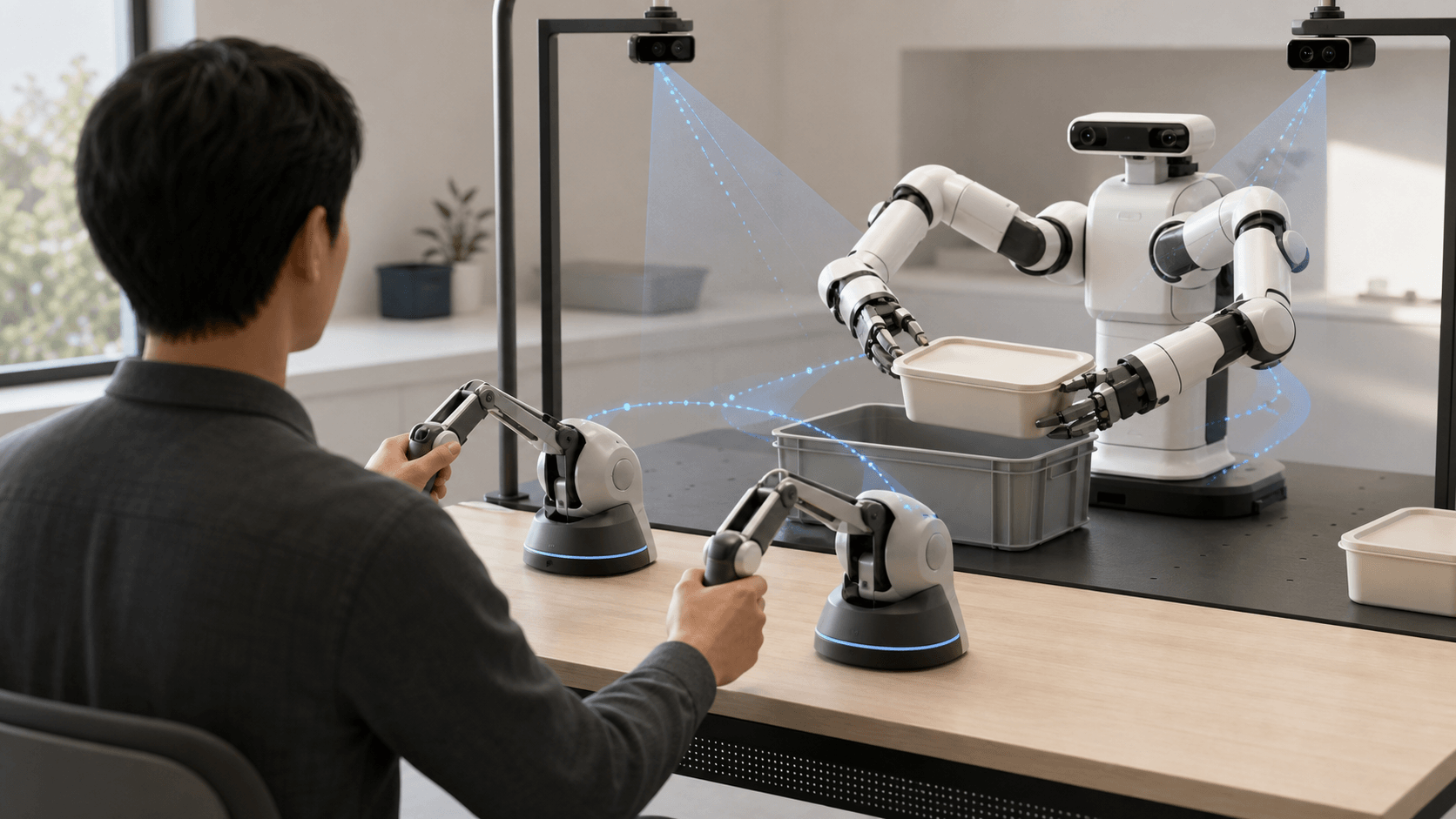
The data can be collected in several ways. A person may physically guide a robot arm, wear motion-capture equipment, operate a joystick or use a paired set of control arms. Teleoperation means that a person controls the robot from an interface while the system records what the robot senses and which commands it receives. Teleoperation creates demonstrations; it is not itself autonomous performance.
Each demonstration is usually a sequence. At one moment the observation might include camera images and joint positions; the corresponding action might be the next joint command or gripper movement. Training many such pairs teaches the policy to predict actions from new observations. A common approach called behavior cloning treats this as supervised learning: the human action is the target answer for the recorded situation.
The policy does not normally copy one demonstration frame by frame. It learns statistical patterns across examples. That distinction is important: useful imitation should respond to a shifted object or small disturbance, but generalization is limited by the diversity and quality of the data.
4. How it works
Imagine teaching a two-armed robot to place a food container into a storage bin and close the lid.
- Demonstrate the task. An operator controls the robot through a teleoperation interface and completes the task several times with varied object positions and natural differences in movement.
- Record observations and actions. The system synchronizes camera frames, joint positions, gripper states and operator commands. A usable example must preserve which action followed which observation.
- Prepare the dataset. Developers remove corrupted runs, align timing, define task boundaries and decide what information the policy may use. Poor demonstrations can teach poor behavior.
- Train the policy. A learning algorithm adjusts a model so that its predicted actions resemble the demonstrated actions for the recorded observations. Some methods predict one action at a time; others predict short sequences called action chunks.
- Run the robot autonomously and evaluate. The operator no longer selects every command. The policy observes the current scene, chooses actions and receives new observations as the task unfolds. Failures reveal situations missing from the data or errors the policy cannot recover from.
- Collect targeted additions. Developers can add demonstrations around failure cases, improve the interface or retrain the model. This expands the dataset but does not guarantee competence in every unrecorded condition.
This pipeline is an explanatory model. Individual systems may use additional labels, corrections, simulation, reinforcement learning or human intervention during training.
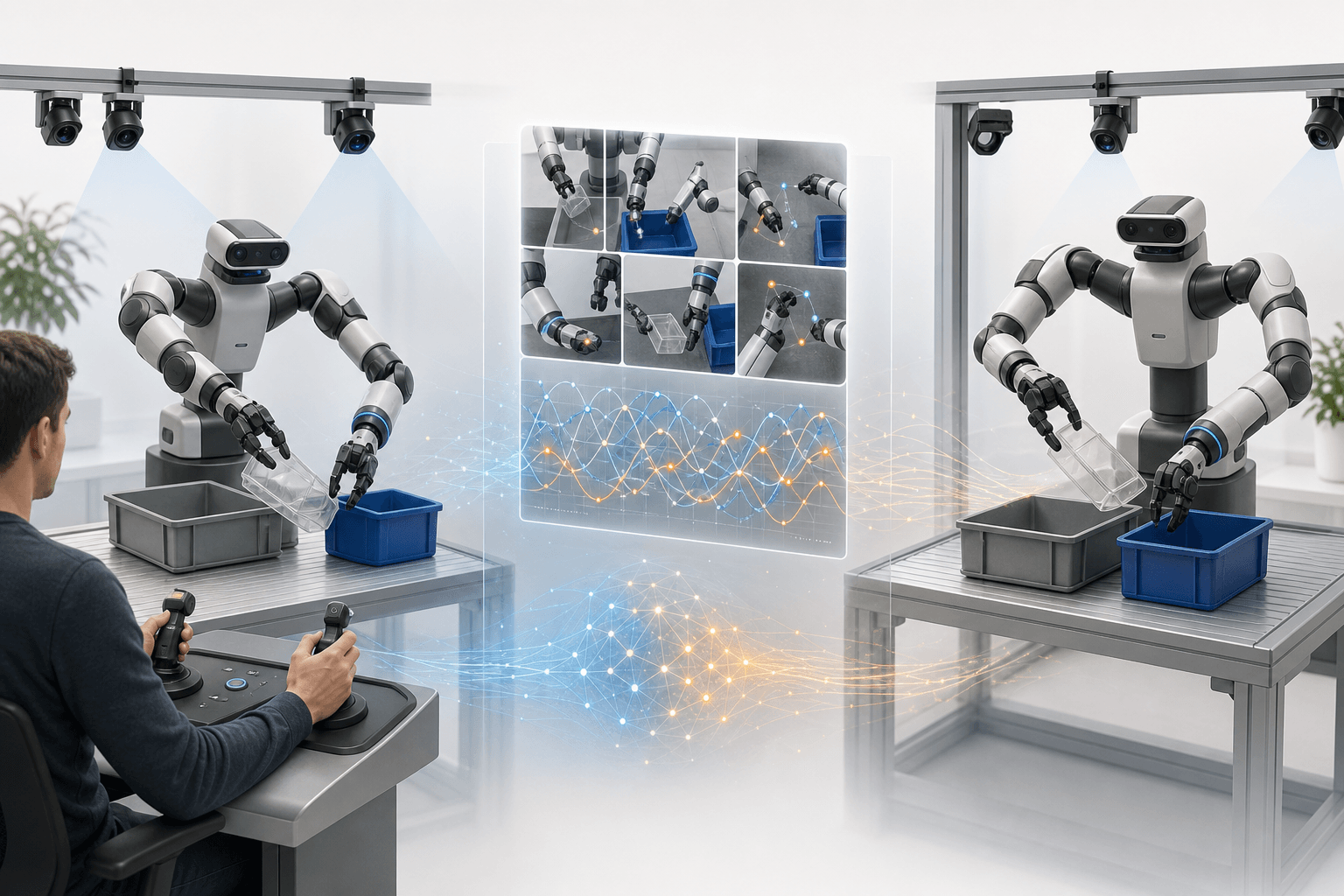
Training connects synchronized observations and actions to a policy that later controls the robot without continuous teleoperation. AI-generated illustration (not a photograph or measured data).
5. A real-world example
ALOHA — Research prototype. Researchers from Stanford, UC Berkeley and Meta introduced ALOHA as a low-cost, open-source system for bimanual teleoperation. A person moved smaller “leader” robot arms, while two “follower” arms mirrored the motion and recorded demonstrations. The team trained Action Chunking with Transformers, or ACT, to predict sequences of actions rather than only the next action.
The researchers reported real-world tasks including opening a translucent condiment cup and inserting a battery. Their paper reported 80–90% success on six tasks with about ten minutes of demonstration data; the project page also presents evaluations based on 50 demonstrations per task. These are author-reported research results under defined task setups, not evidence that the system can learn arbitrary manipulation from ten minutes of examples.
Mobile ALOHA — Research prototype. A later project added a mobile base and a whole-body teleoperation interface for tasks requiring movement and two-arm manipulation. The team collected 50 demonstrations per task and used supervised behavior cloning. The project reports that co-training with existing stationary ALOHA data increased success rates by as much as 90% on selected mobile-manipulation tasks, including cabinet use, elevator entry and cooking-related demonstrations.
“As much as 90%” is a relative improvement reported by the researchers, not a universal success rate. Mobile ALOHA remained a research platform, and its project page openly included failure examples. Both projects demonstrate the value of aligned human-action data while also showing that performance is tied to the chosen hardware, scenes, tasks and evaluation method.
6. Common misunderstandings
“One demonstration is enough”
A single example shows one route through one situation. It does not show how to respond when an object moves, a grasp begins poorly or an earlier action creates an unfamiliar view. Some narrow tasks can use very little data, but broad robustness requires relevant variation or other sources of prior knowledge.
“Teleoperation means the robot learned the task”
During teleoperation, a human selects the actions. Learning occurs only after a model is trained from the recorded data and then controls the robot without continuous action-by-action input. A teleoperated video is evidence of the hardware and interface, not autonomous policy performance.
“The robot understands the teacher’s intention”
Behavior cloning usually learns correlations between observations and actions. It may reproduce successful behavior without representing the teacher’s full goal or reasoning. If two strategies look similar in the data but differ in an unobserved condition, the policy may not know which one the person intended.
“Imitation automatically generalizes to new situations”
A policy can generalize within limits, but it is most reliable near the situations represented by training. Once small errors move it into an unfamiliar state, later predictions can worsen because the demonstrations contain few examples of recovery from the robot’s own mistakes.
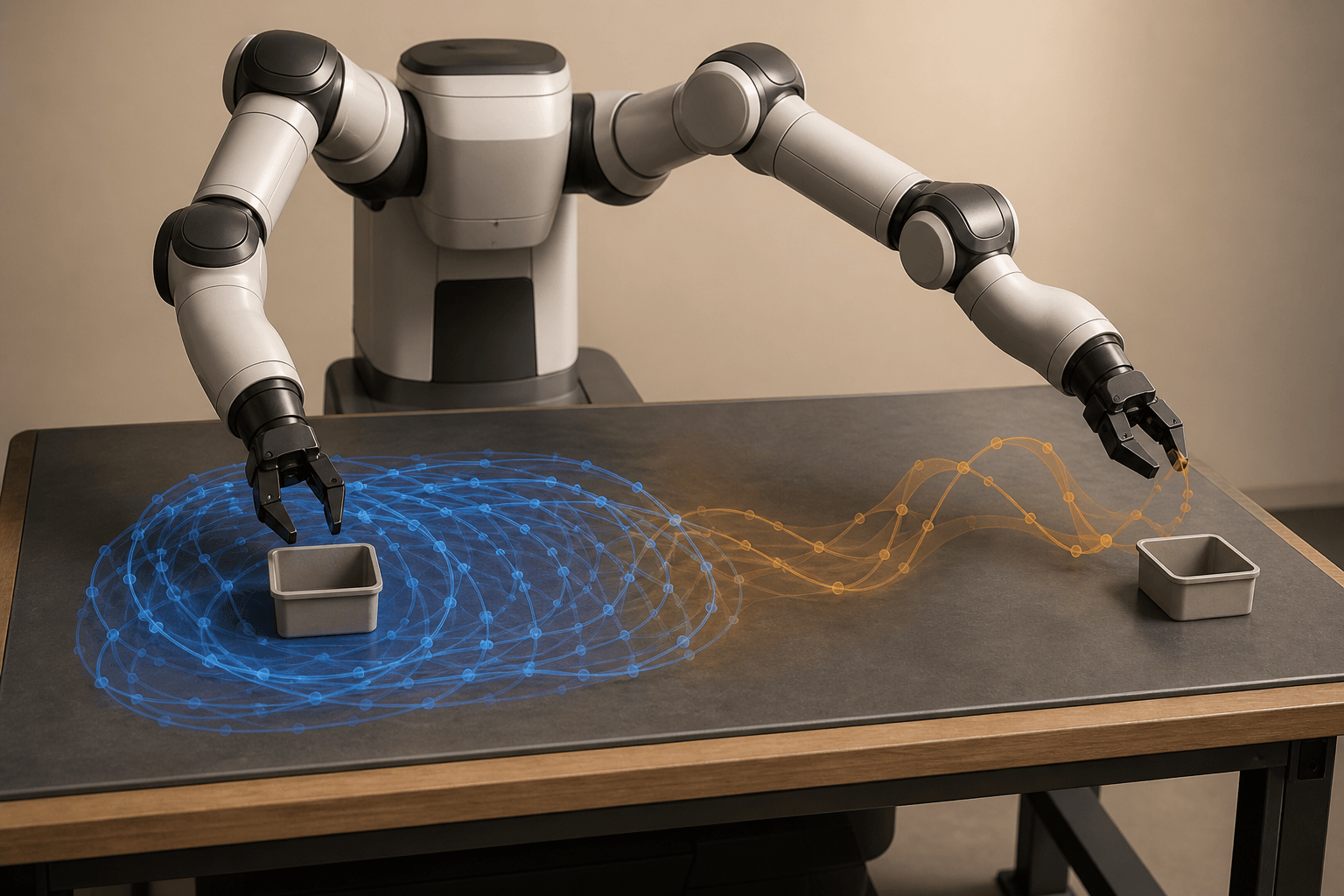
Demonstrations cover only part of the situations a robot may create during autonomous execution. AI-generated illustration (not a photograph or measured data).
7. Current limitations
Demonstration collection is expensive because it consumes human time and physical hardware. Interfaces can also bias the data. If the operator cannot feel contact or see an occluded object, the demonstration may omit information needed for reliable execution.
Human examples are inconsistent. People move at different speeds, choose different strategies and occasionally make mistakes. Dataset preparation can remove obvious failures, but deciding which variation is useful requires judgment. A policy may average incompatible behaviors or copy shortcuts that work only in the training setup.
The largest technical problem is often distribution shift: the robot encounters observations unlike those in the demonstrations. Small action errors accumulate. A slightly poor grasp changes the next camera image; the unfamiliar image produces another poor action; the policy drifts farther from the demonstrated trajectories. Action chunking, interactive correction and more diverse data can reduce this problem but do not eliminate it.
Transfer across bodies is also difficult. An action recorded for one arm geometry, camera position or gripper may not map directly to another. Safety remains separate: a policy that imitates successful examples still needs limits, monitoring and recovery behavior for states the teacher never demonstrated.
8. Key takeaways
- Learning from demonstration trains policies from examples of expert behavior rather than complete hand-written motion rules.
- Teleoperation is a way to collect demonstrations; it is not autonomous execution.
- Demonstration data must align what the robot observed with the action the teacher selected.
- Policies can generalize within the coverage of their data, but errors can push them into unfamiliar states.
- Research results must be read with the task, hardware, demonstration count and evaluation conditions attached.
9. Where to go next
This is article 5 of the six-part Beginner guide path. Read the earlier guides on robot definitions, embodied AI, sensing and feedback control first. Continue with What Robot Autonomy Really Means, which explains how learned behavior fits inside systems that still involve supervision, assistance and operational limits.
10. Sources & evidence
- Recent Advances in Robot Learning from Demonstration — peer-reviewed field review.
- Learning Fine-Grained Bimanual Manipulation with Low-Cost Hardware — ALOHA and ACT primary paper.
- ALOHA project — research project documentation, demonstrations and reported evaluations.
- Mobile ALOHA — research project documentation.
- Mobile ALOHA: Learning Bimanual Mobile Manipulation with Low-Cost Whole-Body Teleoperation — primary research paper.
Sources — How Robots Learn From Human Demonstrations
Access date: September 2, 2026
1. Recent Advances in Robot Learning from Demonstration
- Authors: Harish Ravichandar, Athanasios S. Polydoros, Sonia Chernova and Aude Billard
- Institution: Annual Review of Control, Robotics, and Autonomous Systems
- URL: https://www.annualreviews.org/content/journals/10.1146/annurev-control-100819-063206
- Publication date: May 2020; first published online December 6, 2019
- Source type: Peer-reviewed field review
- Supports: Definition, motivation, method diversity and unresolved theoretical and practical challenges in robot learning from demonstration.
2. Learning Fine-Grained Bimanual Manipulation with Low-Cost Hardware
- Authors: Tony Z. Zhao, Vikash Kumar, Sergey Levine and Chelsea Finn
- URL: https://arxiv.org/abs/2304.13705
- Publication date: April 23, 2023
- Source type: Primary research paper
- Supports: ALOHA hardware, teleoperation, ACT, compounding-error motivation, tasks, data scale and reported success rates.
3. ALOHA project
- Organizations: Stanford University, UC Berkeley and Meta researchers
- URL: https://tonyzhaozh.github.io/aloha/
- Publication date: 2023 project page
- Source type: Primary research-project documentation
- Supports: Leader–follower teleoperation design, 50-demonstration evaluations, action-chunk prediction, camera observations, robustness and failure examples.
4. Mobile ALOHA
- Authors: Zipeng Fu, Tony Z. Zhao and Chelsea Finn
- URL: https://mobile-aloha.github.io/
- Publication date: 2024 project page
- Source type: Primary research-project documentation
- Supports: Whole-body teleoperation, mobile bimanual tasks, 50 demonstrations per task, supervised behavior cloning, co-training and reported relative improvement.
5. Mobile ALOHA: Learning Bimanual Mobile Manipulation with Low-Cost Whole-Body Teleoperation
- Authors: Zipeng Fu, Tony Z. Zhao and Chelsea Finn
- URL: https://mobile-aloha.github.io/resources/mobile-aloha.pdf
- Publication date: CoRL 2024
- Source type: Primary research paper
- Supports: Mobile ALOHA system design, learning setup, evaluated tasks and research results.
- Attribution boundary: All task performance values are author-reported results under the paper’s evaluation conditions.