
1. In one sentence
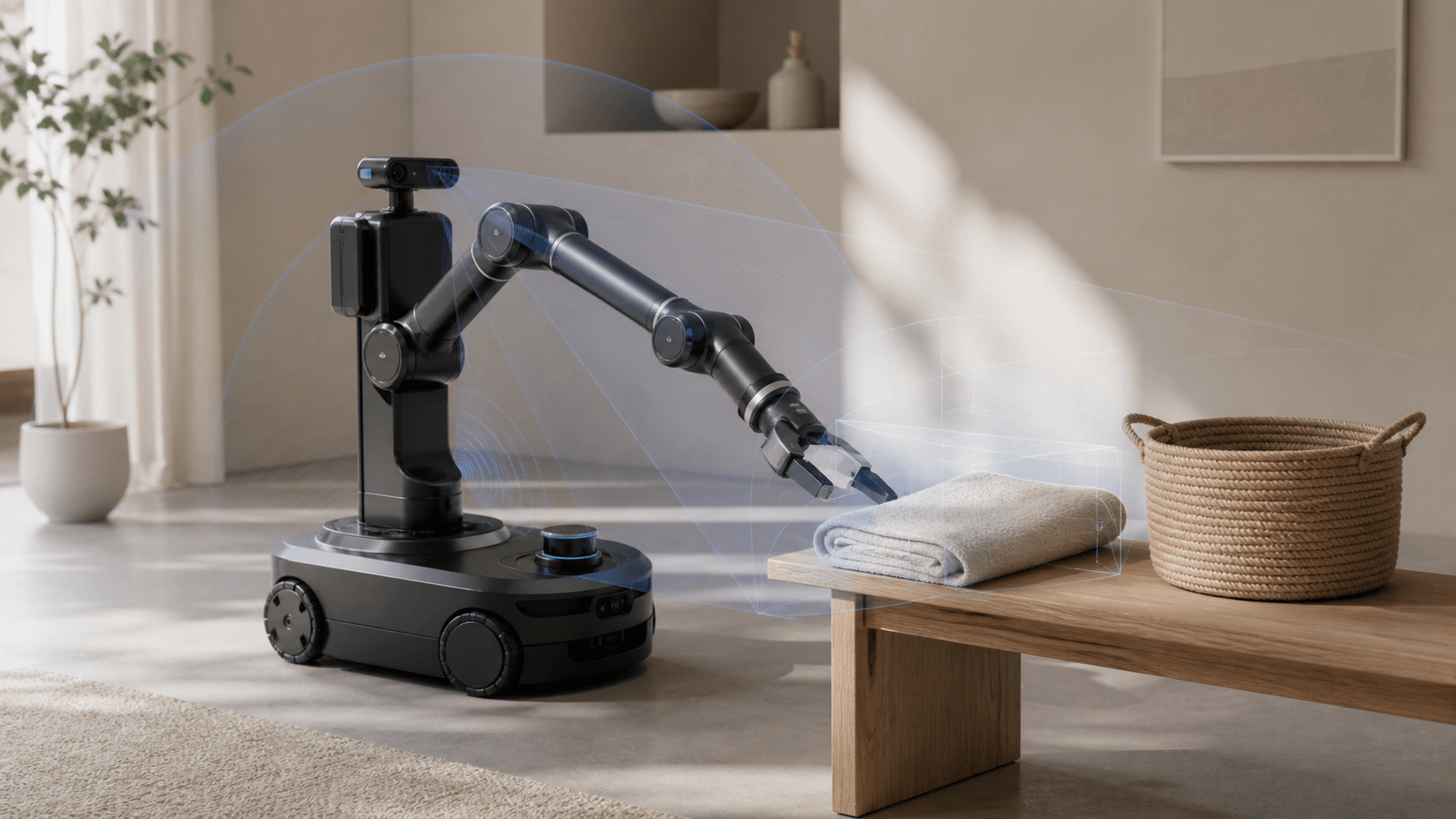
Embodied AI is artificial intelligence that uses a physical or simulated body to sense an environment, choose actions and deal with the consequences of changing that environment.
2. Why you need to understand it
An image model can label a cup without touching it. A language model can describe how to put the cup in a cupboard without lifting anything. A robot asked to do the job faces a different problem: it must find the cup from imperfect sensor data, reach without hitting nearby objects, grip with enough force, carry the load and confirm that the cup is stable at the destination.
That difference explains why impressive software performance does not automatically become reliable robot performance. News about “physical AI,” robot foundation models or general-purpose humanoids often compress several separate achievements into one claim. A system may recognize an object but fail to grasp it. It may produce a sensible plan but lack the reach, force control or balance to execute it. It may succeed in a prepared demonstration but fail when lighting, object position or friction changes.
Understanding embodiment gives readers a practical test for such claims: What body performed the task, what did it sense, what actions could it take, what environment was allowed, and how reliably did the complete loop work?
3. The core idea
The word embodied means that intelligence is connected to a body with particular physical abilities and limits. The body may be a real robot or a simulated agent used for research. It has sensors that produce measurements, actuators that create movement, and a specific shape that determines what it can reach, carry or survive.
MIT’s Embodied Intelligence group describes its goal as understanding intelligent behavior in the physical world by integrating perception, sensing, language, learning and planning in physical agents. The important point is integration. Embodied AI is not one model or one hardware category. It is a system in which interpreting the world, deciding what to do and controlling a body must work together.
The body is not merely a container for software. A camera’s position changes what can be observed. A gripper’s geometry changes which objects can be held. Wheel placement changes where a mobile robot can travel. Joint limits determine which poses are possible. These physical properties shape the information available to the AI and the actions it can choose.
The environment also answers back. Pushing a door changes its angle. Grasping fabric deforms it. Moving closer to an object may reveal a hidden surface. Researchers sometimes call this continuous relationship a perception–action loop: sensing informs action, action changes the situation, and the changed situation must be sensed again.
4. How it works
Consider a mobile robot asked to place a dropped towel into a laundry basket.
- Receive a goal. The system converts the instruction into a task it can attempt, including a target object and desired final condition.
- Sense the body and environment. Cameras or depth sensors measure the room, while internal sensors report wheel motion, joint position and other aspects of the robot’s own state.
- Estimate the situation. Perception software turns incomplete measurements into working estimates: where the towel is, where the basket is, which space is traversable and how the towel might be grasped.
- Select and execute actions. Planning chooses a route and manipulation sequence. Controllers send commands to motors, but physical motion is affected by delay, friction, contact and mechanical limits.
- Observe the result and adapt. The robot measures again. If the towel slips, the path is blocked or the basket moved, it must correct, ask for help or stop safely.
This five-step description is an explanatory tool, not a claim that every robot uses identical software modules. Some systems combine several steps inside one learned model; others divide them among perception, planning and control programs. The physical loop remains: an action has to occur through a particular body, and its result has to be measured.
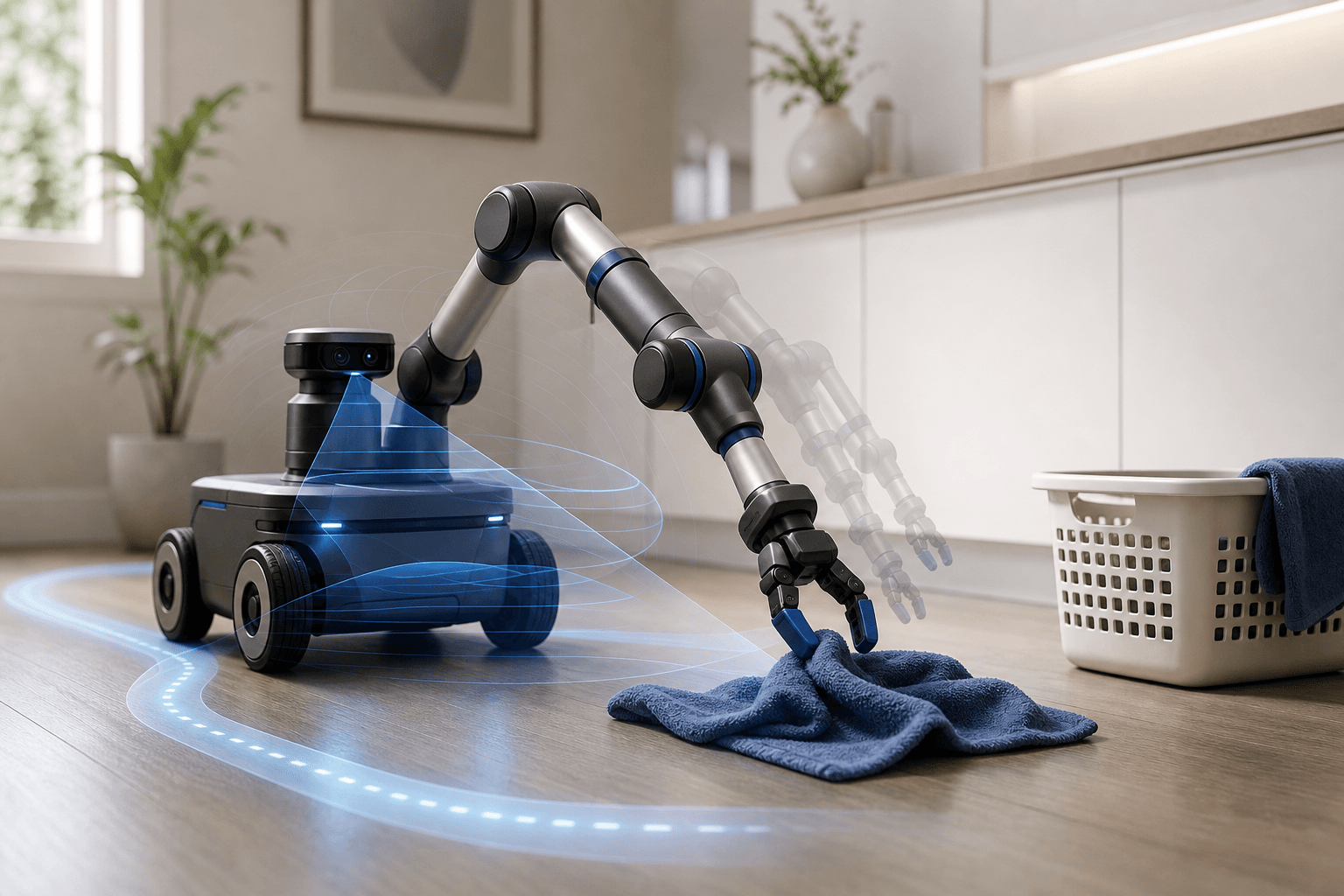
The perception–action loop continues after motion begins because contact and changing viewpoints create new information. AI-generated illustration (not a photograph or measured data).
5. A real-world example
BEHAVIOR-1K — Research benchmark in simulation. Stanford researchers created BEHAVIOR-1K around 1,000 everyday activities selected from survey responses about tasks people want robot help with. Its current project site describes 50 interactive scenes and more than 10,000 objects, while the peer-reviewed project paper documents the benchmark design and an initial simulation-to-reality study.
The benchmark makes embodiment visible because success is not just choosing the right answer. An agent must complete long sequences involving navigation and manipulation in house-scale environments. Objects may be rigid, deformable or liquid, and tasks can require changes such as cleaning, cooking or organizing. The agent’s observations, action space and physical capabilities determine which solutions are possible.
BEHAVIOR-1K does not prove that household robots can perform all 1,000 activities in real homes. It is a research benchmark implemented in simulation, designed to measure progress under reproducible conditions. Its authors report that long-horizon tasks and complex manipulation remain difficult even for leading robot-learning approaches.
RT-2 — Research demonstration. Google DeepMind reported that RT-2 combined web-scale visual-language training with robot action data, then produced action commands for a robot arm. The team evaluated the research system across more than 6,000 robot trials and reported improved performance on selected unseen scenarios. These are research-team results, not evidence of unrestricted general-purpose operation. The demonstrations used particular robots, tasks and evaluation conditions, showing that language and visual knowledge still had to be translated into the action space of a specific body.
6. Common misunderstandings
“Embodied AI means humanoid robots”
A humanoid is one possible embodiment, not the definition. A wheeled manipulator, robot arm, quadruped or simulated agent can all support embodied intelligence. Body shape matters because it changes the available observations and actions, but intelligence does not require a human silhouette.
“Adding a language model makes a robot embodied AI”
A language model can help interpret instructions or construct plans, but a complete physical system also needs sensing, state estimation, action generation and control. If the model cannot use current physical observations or influence the body’s actions, it is not performing the entire embodied task.
“A realistic simulation is the same as the real world”
Simulation can provide repeatable tasks, scalable training and known ground truth. It still approximates contact, materials, sensor noise and the diversity of real environments. Transfer from simulation to hardware is therefore a separate achievement that needs its own evidence.
“One polished demonstration proves general intelligence”
A demonstration proves that a system completed a shown attempt under the displayed conditions. It does not reveal the success rate, human preparation, remote assistance, failure cases or performance outside that setup. Embodied competence must be stated in relation to a task, body and operating environment.
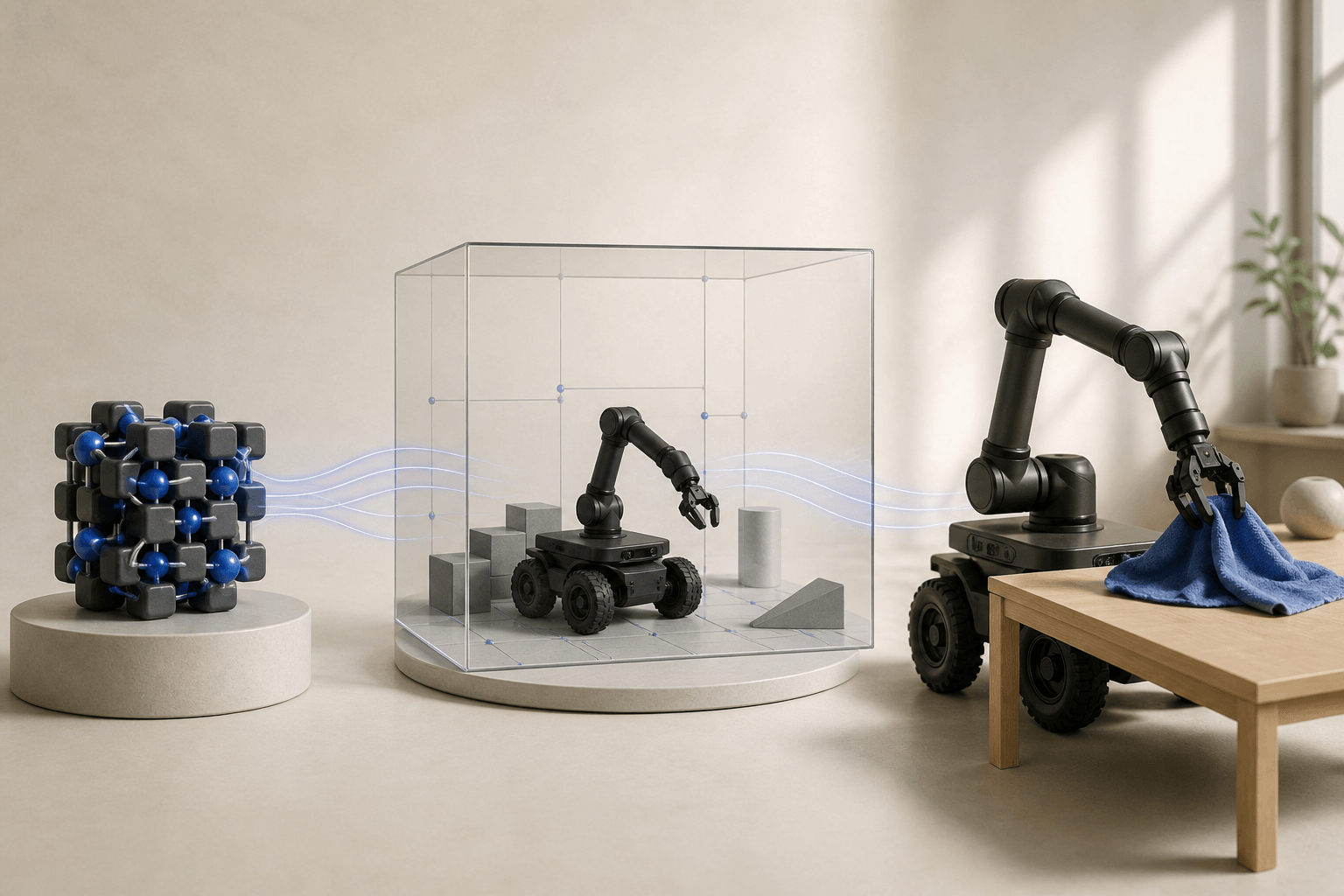
Software reasoning, simulation and physical execution can support one another, but they are not interchangeable evidence. AI-generated illustration (not a photograph or measured data).
7. Current limitations
Embodied AI systems remain constrained by incomplete data and by the cost of gathering physical experience. Web data contains abundant descriptions and images, but much less information about the exact forces, contacts and motor commands needed to complete tasks. Robot demonstrations are slower and more expensive to collect, and data recorded on one body may not transfer cleanly to another.
Real environments are also difficult to bound. Lighting changes, objects move, people interrupt, materials deform and sensors fail. An agent can encounter situations absent from training, yet physical trial and error may damage equipment or endanger people. This makes exploration and recovery harder than in many purely digital systems.
Long tasks compound mistakes. A small perception error can produce a poor grasp; a poor grasp can move an object; the changed scene can invalidate the remaining plan. Hardware adds limits in reach, payload, battery life, heat, precision and speed. Even a strong high-level model cannot command an impossible pose or recover information a sensor never captured.
Finally, evaluation remains fragmented. A benchmark score, a laboratory success rate and a commercial deployment measure different things. Readers should look for the defined task, number of attempts, operating conditions, intervention rules and evidence source before treating an “embodied intelligence” claim as general capability.
8. Key takeaways
- Embodied AI links sensing and decision-making to a body that acts in a physical or simulated environment.
- The body shapes intelligence by determining what the system can observe, reach, move and withstand.
- Useful behavior requires a repeated loop of perception, action and correction, not a one-time software answer.
- Simulation and demonstrations are valuable evidence, but neither automatically proves reliable real-world deployment.
- Every capability claim should be tied to a specific task, embodiment, environment and level of human assistance.
9. Where to go next
This is article 2 of the six-part Beginner guide path. Start with What Makes a Machine a Robot? if you need the category boundary. Continue with How Robots Sense the World—and Why Sensing Is Not Understanding, then How Feedback Control Turns Robot Commands Into Reliable Motion, How Robots Learn From Human Demonstrations and What Robot Autonomy Really Means as those guides are published.
10. Sources & evidence
- Embodied Intelligence — MIT Computer Science and Artificial Intelligence Laboratory.
- BEHAVIOR-1K project — Stanford Vision and Learning Lab.
- BEHAVIOR-1K: A Human-Centered, Embodied AI Benchmark with 1,000 Everyday Activities and Realistic Simulation — primary research paper.
- AI experts establish the “North Star” for the domestic robotics field — Stanford School of Engineering.
- From Machine Learning to Robotics: Challenges and Opportunities for Embodied Intelligence — robotics research perspective.
- RT-2: New model translates vision and language into action — Google DeepMind research announcement; performance statements are research-team claims.
Sources — What Is Embodied AI—and Why Does a Body Change the Problem?
Access date: September 2, 2026
1. Embodied Intelligence
- Institution: MIT Computer Science and Artificial Intelligence Laboratory
- URL: https://ei.csail.mit.edu/index.html
- Publication date: Not stated
- Source type: Authoritative research-group page
- Supports: Intelligent behavior in the physical world; integration of perception, sensing, language, learning and planning in physical agents.
2. BEHAVIOR
- Institution: Stanford Vision and Learning Lab
- URL: https://behavior.stanford.edu/
- Publication date: Continuously updated project site
- Source type: Official research-project documentation
- Supports: BEHAVIOR-1K’s 1,000 human-grounded household activities, interactive scenes, objects, long-horizon manipulation focus and simulation scope.
3. BEHAVIOR-1K: A Human-Centered, Embodied AI Benchmark with 1,000 Everyday Activities and Realistic Simulation
- Authors: Chengshu Li et al.
- URL: https://arxiv.org/abs/2403.09227
- Publication date: March 14, 2024
- Source type: Primary research paper
- Supports: Benchmark design, survey grounding, simulation environment, long-horizon task difficulty and initial simulation-to-reality study.
4. AI experts establish the “North Star” for the domestic robotics field
- Institution: Stanford University School of Engineering
- URL: https://engineering.stanford.edu/news/ai-experts-establish-north-star-domestic-robotics-field
- Publication date: December 20, 2021
- Source type: University research explanation
- Supports: Plain-language account of embodied AI as situational and physical awareness and capability; BEHAVIOR context; simulation-to-reality boundary.
5. From Machine Learning to Robotics: Challenges and Opportunities for Embodied Intelligence
- Authors: Nicholas Roy et al.
- URL: https://arxiv.org/abs/2110.15245
- Publication date: October 28, 2021
- Source type: Primary robotics research perspective
- Supports: Purposeful physical exchange, safety-critical interactions, distribution shift, task adaptation and limitations of directly transferring mainstream ML assumptions to robotics.
6. RT-2: New model translates vision and language into action
- Institution: Google DeepMind
- URL: https://deepmind.google/blog/rt-2-new-model-translates-vision-and-language-into-action/
- Publication date: July 28, 2023
- Source type: Research-organization announcement linked to primary paper
- Supports: RT-2 design, use of web and robot data, robot action output, reported trial count and reported generalization results.
- Attribution boundary: Capability and performance statements are treated as Google DeepMind research-team claims.