
In one sentence
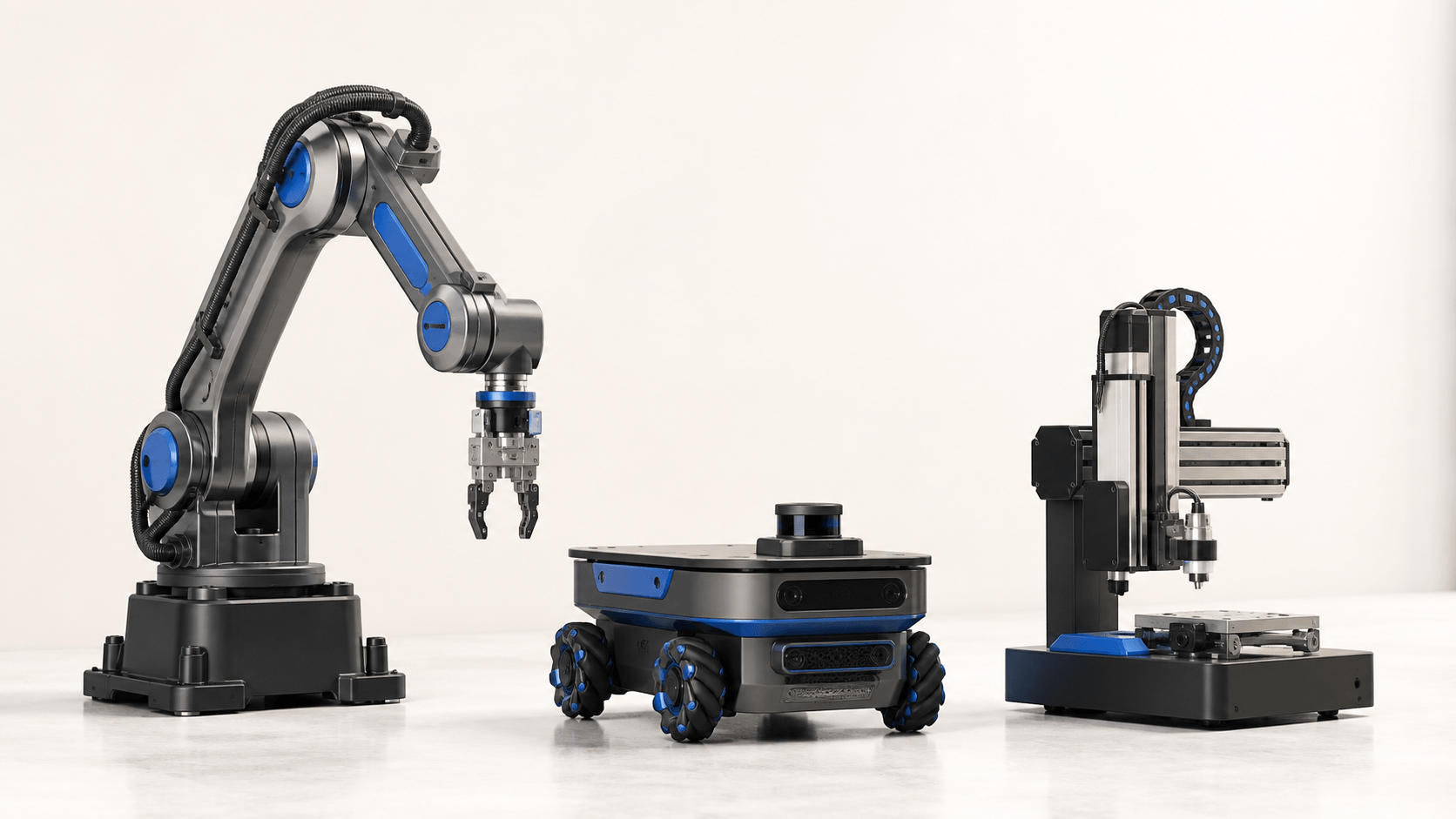
A robot is a powered, programmable machine that performs physical movement or manipulation with at least some ability to use its current state and sensor information without a person continuously choosing every action.
Why you need to understand it
The word “robot” is applied to everything from factory arms and warehouse vehicles to chatbots, remote surgical tools and humanoid prototypes. Those systems may all be technologically sophisticated, but they do not all fit the same technical category. If the label is used too loosely, it becomes difficult to judge what a product can actually do.
This matters especially in embodied AI, where software is connected to a body that can move, touch objects and change the environment. Before asking whether a machine is intelligent, you need to know what part of the system is programmed, what part is physically actuated, what it senses and which decisions it can make without constant human control.
A clear definition also prevents marketing terms from replacing evidence. Calling a vehicle “autonomous,” for example, does not reveal which tasks it handles independently, which environments it can navigate or when a human must intervene.
The core idea
ISO 8373:2021, as summarized by the International Federation of Robotics, defines a robot as a programmed, actuated mechanism with a degree of autonomy that performs locomotion, manipulation or positioning. In plain language, four ingredients matter.
First, the machine is programmed: its behavior can be specified or changed through instructions. Second, it is actuated: motors, hydraulic cylinders or other devices turn energy into physical motion. Third, it performs a physical function such as moving itself, handling an object or positioning a tool. Fourth, it has a degree of autonomy—some ability to perform its intended task using its current state and sensing without a human directly selecting every moment-to-moment action.
Autonomy does not have to mean complete independence. A person may assign the task, set a destination, load a workpiece, supervise the operation or take over during an exception. The useful question is not “Is a human involved?” It is “Which parts of this defined task does the machine perform on its own?”
Appearance is not part of the definition. A fixed industrial arm, a wheeled cleaning machine and a powered wearable device can all be robots. A human-shaped shell, meanwhile, does not make an internally remote-controlled machine autonomous.
How it works
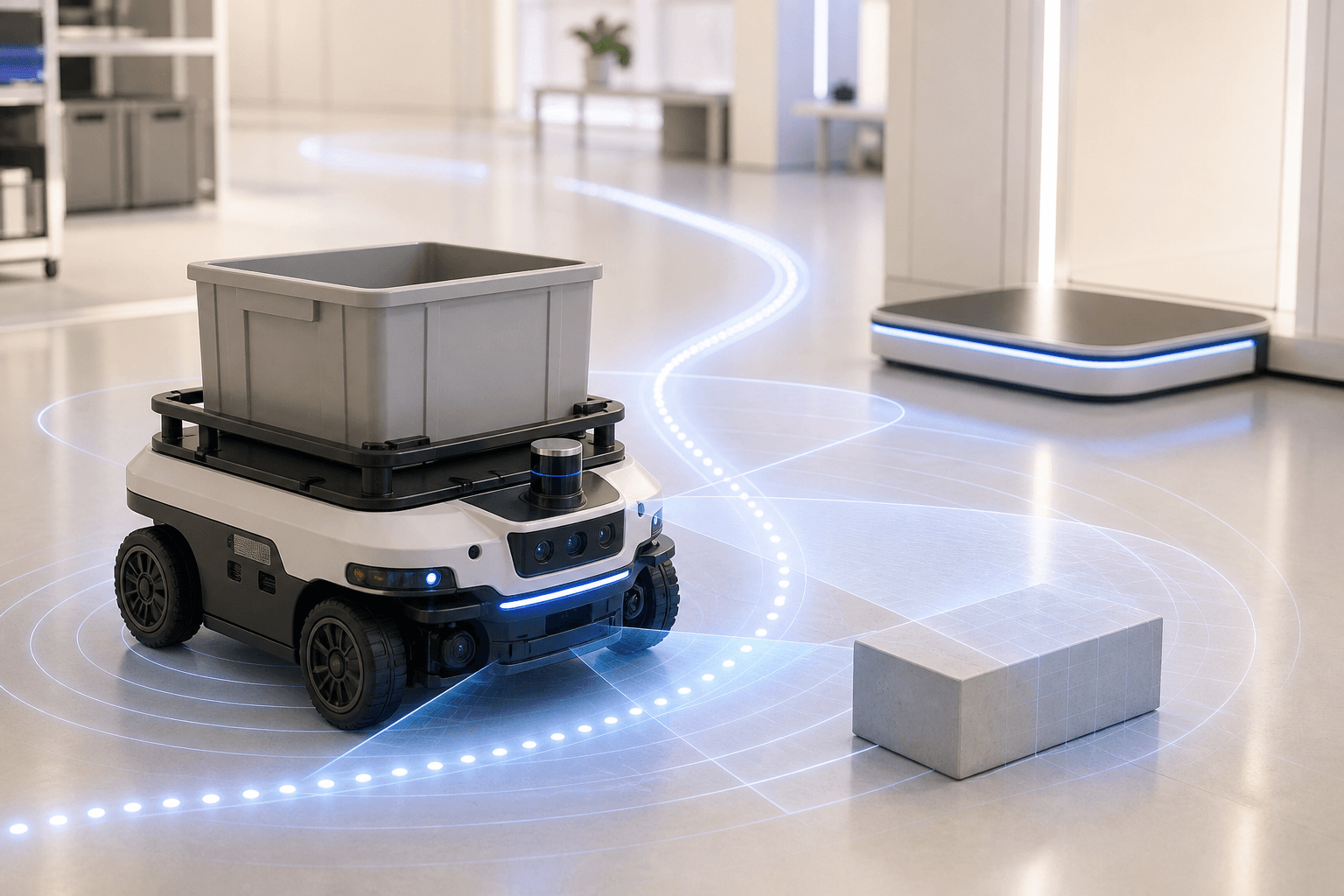
Consider a mobile machine asked to carry a cart from a loading area to a workstation.
-
Receive a task. A person or warehouse system supplies a goal, such as moving the cart to a specified destination. The goal comes from outside the robot; receiving it does not remove autonomy from the later execution.
-
Sense the current situation. Cameras, range sensors, wheel encoders or other instruments measure the surroundings and the machine’s own motion. An encoder is a sensor that measures how far a motor or joint has moved.
-
Estimate what is happening. The controller—the computer that runs the robot’s behavior—combines sensor measurements into a working estimate of its location, obstacles and progress. This estimate can be wrong because sensors are noisy or objects can be hidden.
-
Choose and execute an action. Software selects a route or immediate movement, then sends commands to the actuators. The wheels turn and the machine changes the physical world by moving the cart.
-
Check and correct. The robot senses again, compares the result with its goal and changes course if a person or obstacle blocks the path. This repeating link between sensing and action is what separates independent task execution from a machine that only follows continuous joystick commands.
AI-generated illustration (not a photograph or measured data).
A real-world example
Commercial category: industrial robot arms. OSHA describes an industrial robot system as more than an arm. It includes the manipulator, controller, power, sensors, communications and an end effector—the tool attached to the arm, such as a gripper or welding gun. The application program defines the task, while the controller sends commands that move the joints. These systems are widely used for handling, assembly, welding, painting and inspection. They qualify as robots even when fixed behind guarding and repeating tightly constrained operations.
Commercial deployment: Amazon Proteus. Amazon describes Proteus as an autonomous mobile robot that transports heavy carts while navigating around people. In August 2026, the company said the original version operated in dock areas at 25 US fulfillment centers. That deployment count and the safety, navigation and performance descriptions are Company claims, not independent measurements. Still, the stated operating model illustrates the definition: a human or software system assigns work, while the robot uses perception and navigation to choose movements rather than receiving continuous steering commands.
Amazon separately described a next-generation Proteus that accepts natural-language tasks. As of the company’s announcement, that version was a Pilot in Amazon laboratories with European deployment planned for 2027. It should not be confused with the already deployed original system.
Common misunderstandings
“A robot must look like a person.” Humanoid appearance is one possible body plan, not a requirement. Most commercially deployed robots are arms, mobile platforms or task-specific machines because their shapes are optimized for particular work.
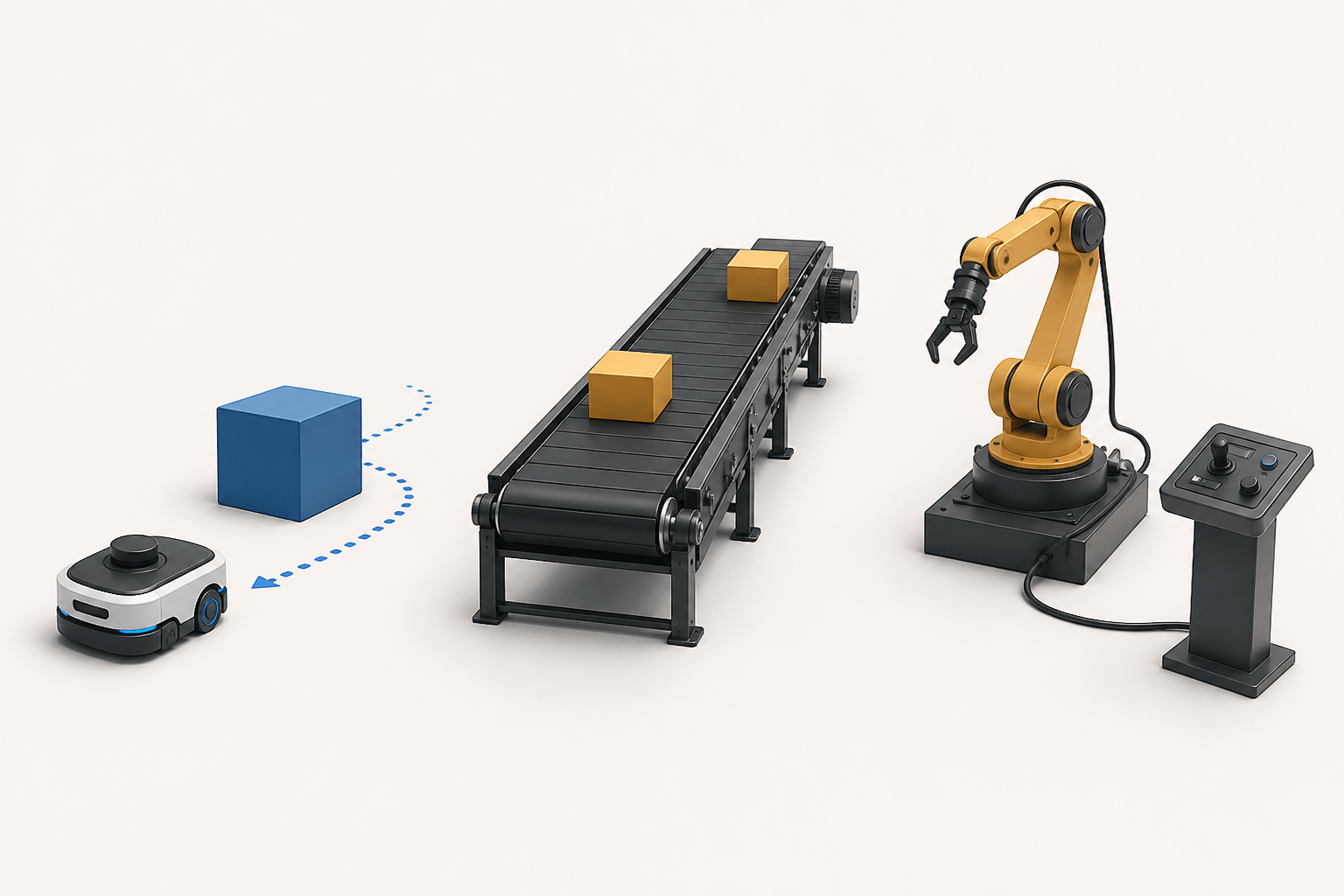
“Any automated machine is a robot.” A conventional conveyor can move objects automatically, but it may simply run a fixed mechanism without the combination of programmable physical behavior and state-based autonomy used in the ISO definition. An automated system may contain robots without every machine inside it being a robot.
“Anything controlled from far away is a robot.” Standards terminology draws a boundary here. IFR explains that a teleoperated manipulator that lacks the required autonomy is a robotic device rather than a robot under ISO 8373. Remote control can still be valuable and technically difficult; it simply places immediate action selection with the human operator.
“Autonomous means the machine never needs people.” Even highly autonomous robots receive goals, operate within designed environments and rely on people for installation, maintenance, monitoring and exception handling. Autonomy always refers to a particular task under particular conditions.
AI-generated illustration (not a photograph or measured data).
Current limitations
There is no single everyday boundary that resolves every edge case. Standards provide useful definitions, but statistical organizations and industries sometimes refine them for practical reasons. IFR notes that “autonomous mobile robot” is a marketing term rather than a category defined in ISO 8373, and it applies its own rules when collecting market data.
A binary label also hides important variation. Two machines may both qualify as robots while differing enormously in perception, adaptability, safety, physical capability and dependence on remote support. A factory arm can execute precise programmed motion in a controlled cell yet fail if the workpiece is unexpectedly rotated. A mobile robot can navigate around ordinary obstacles but stop when sensors are blocked or the environment leaves its tested operating range.
Finally, being a robot says nothing by itself about intelligence, usefulness or readiness. Concept machines, research prototypes, demonstrations, pilots and commercial products can all be robots. Evidence about reliability, task success, intervention and deployment must be evaluated separately.
Key takeaways
- A robot combines programming, actuation, physical action and some task-specific autonomy.
- Shape does not determine whether a machine is a robot.
- Autonomy can be partial and still involve human goals, supervision and maintenance.
- Automation, teleoperation and robotics overlap, but they are not interchangeable terms.
- The robot label does not prove intelligence, safety or commercial readiness.
Where to go next
This is the first article in the six-part Beginner guide path. Continue with What Is Embodied AI—and Why Does a Body Change the Problem?, followed by guides to robot sensing, feedback control, learning from human demonstrations and robot autonomy as those articles are published.
Sources & evidence
- World Robotics 2025: Service Robots — definitions and methods — International Federation of Robotics, standard-derived definitions based on ISO 8373:2021, 2025. Accessed September 2, 2026.
- Service robots: definition and standardization — International Federation of Robotics, standard-derived terminology. Accessed September 2, 2026.
- Industrial Robot Systems and Industrial Robot System Safety — US Occupational Safety and Health Administration, technical manual. Accessed September 2, 2026.
- Amazon unveils next-generation Proteus robot — Amazon, company announcement, August 2026. Accessed September 2, 2026.
- Look back on 10 years of Amazon robotics — Amazon, company background and product announcement, 2022. Accessed September 2, 2026.
Sources — What makes a machine a robot?
Access date: September 2, 2026
-
World Robotics 2025: Service Robots — Sources and Methods
- Institution: International Federation of Robotics
- Type: Standard-derived industry methodology based on ISO 8373:2021
- Published: 2025
- URL: https://ifr.org/img/worldrobotics/Sources___Methods_WR_2025_Service_Robots.pdf
- Supports: Core robot definition, robotic-device distinction, industrial/service/mobile categories, AGV boundary and AMR terminology note.
-
Service Robots — Definition and Standardization
- Institution: International Federation of Robotics
- Type: Standard-derived reference page
- Published: Continuously maintained
- URL: https://ifr.org/service-robots
- Supports: Degree-of-autonomy definition, partial/full autonomy, human interaction, service-robot and robotic-device distinctions.
-
Industrial Robot Systems and Industrial Robot System Safety
- Institution: US Occupational Safety and Health Administration
- Type: Government technical manual
- Published: Current OSHA Technical Manual chapter
- URL: https://www.osha.gov/otm/section-4-safety-hazards/chapter-4
- Supports: Industrial robot system components, controller and manipulator roles, structures, applications and autonomous mobile-robot description.
-
Amazon Unveils Next-Generation Proteus Robot
- Institution: Amazon
- Type: Primary company announcement
- Published: August 2026
- URL: https://www.aboutamazon.com/news/operations/amazon-proteus-robot-europe-investment-employee-support
- Supports: Company-reported original deployment at 25 US centers, task description, next-generation pilot status and planned European deployment.
-
Look Back on 10 Years of Amazon Robotics
- Institution: Amazon
- Type: Primary company background and product announcement
- Published: June 2022
- URL: https://www.aboutamazon.com/news/operations/10-years-of-amazon-robotics-how-robots-help-sort-packages-move-product-and-improve-safety
- Supports: Original Proteus operating concept, cart-moving task and company claims about perception and navigation.