
1. What happened
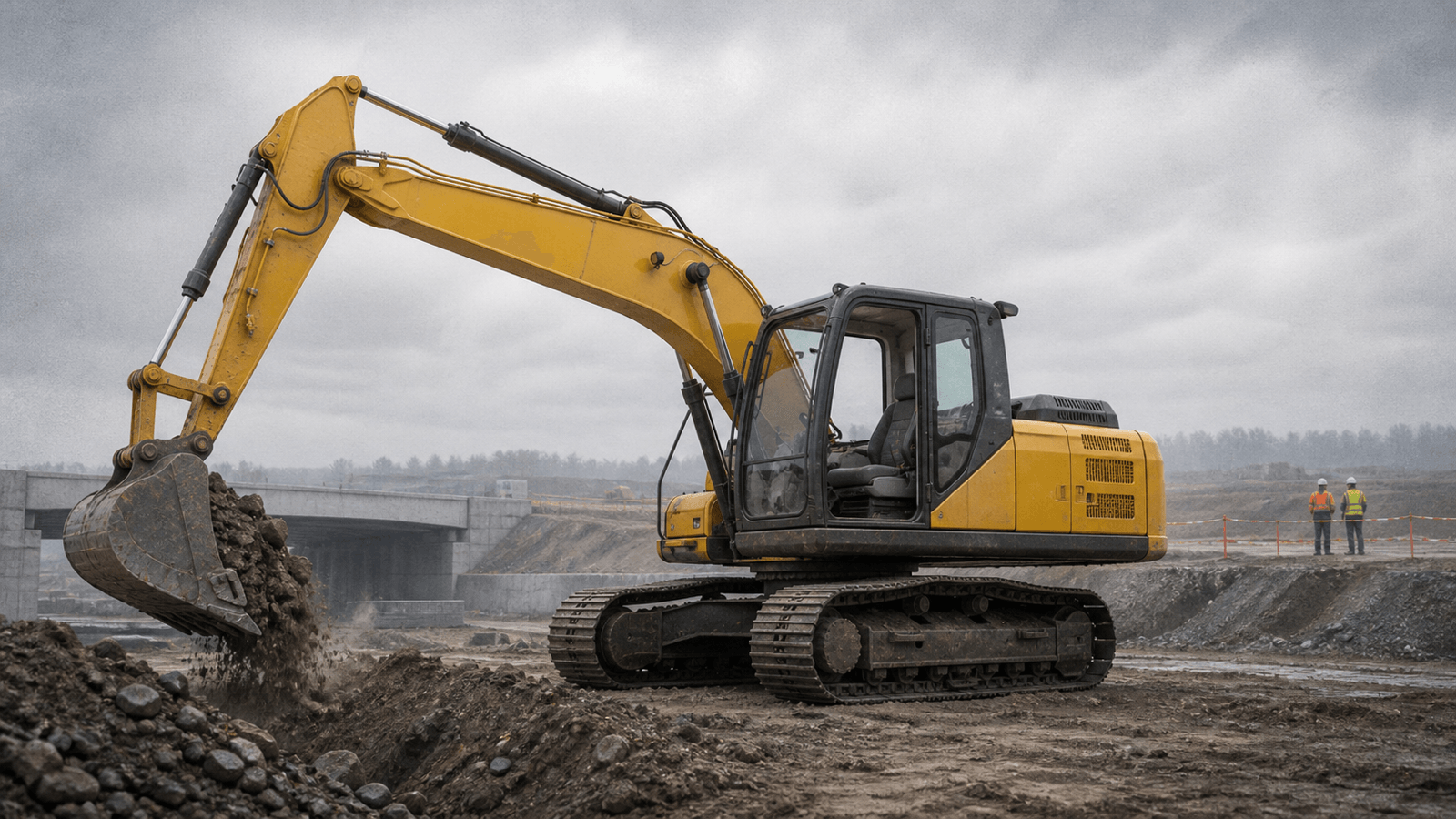
On August 17, 2026, Bedrock Robotics announced that excavators fitted with its autonomy system were operating without people in their cabs on three live US construction sites. The company named a Nevada water-treatment facility with Sundt Construction, a multi-million-cubic-yard earthwork site in Texas with Champion Site Prep, and a 1.2-million-cubic-yard civil sitework project with Zachry Construction Corporation. Bedrock Robotics announcement
The change is specific but meaningful: Bedrock moved from publicly described supervised excavation in 2025 to what it calls operator-out commercial deployment. Independent coverage confirms that the machines are working without onboard operators, while also describing the rollout as a limited test. “Operatorless” therefore means the cab is empty; it does not establish that the sites run without supervisors, remote assistance, safety staff or conventional human-operated equipment.
2. Confirmed facts
| Fact | Evidence boundary |
|---|---|
| Bedrock announced three operator-out deployments on August 17, 2026, involving Sundt, Champion Site Prep and Zachry. | The announcement does not disclose the number of equipped excavators or the start date at each site. |
| The named projects include a Nevada water-treatment facility, a Texas earthwork site described as multi-million-cubic-yard, and a 1.2-million-cubic-yard civil sitework project. | Project scale does not reveal how much work the autonomous excavators have completed. |
| Bedrock says its Operator package adds sensors and onboard compute to existing excavators in a same-day retrofit without permanent machine changes. | This is a Company claim; no installation record or contractor-side acceptance report was published. |
| A site manager sets the initial plan, after which Bedrock says the system perceives, plans and executes the task. | The public materials do not define intervention triggers, remote-support procedures or autonomy boundaries. |
| Plant & Equipment identifies Cat 352 and Cat 336 hydraulic excavators among the full-size machines involved. | This is trade-publication reporting, not a complete fleet inventory. |
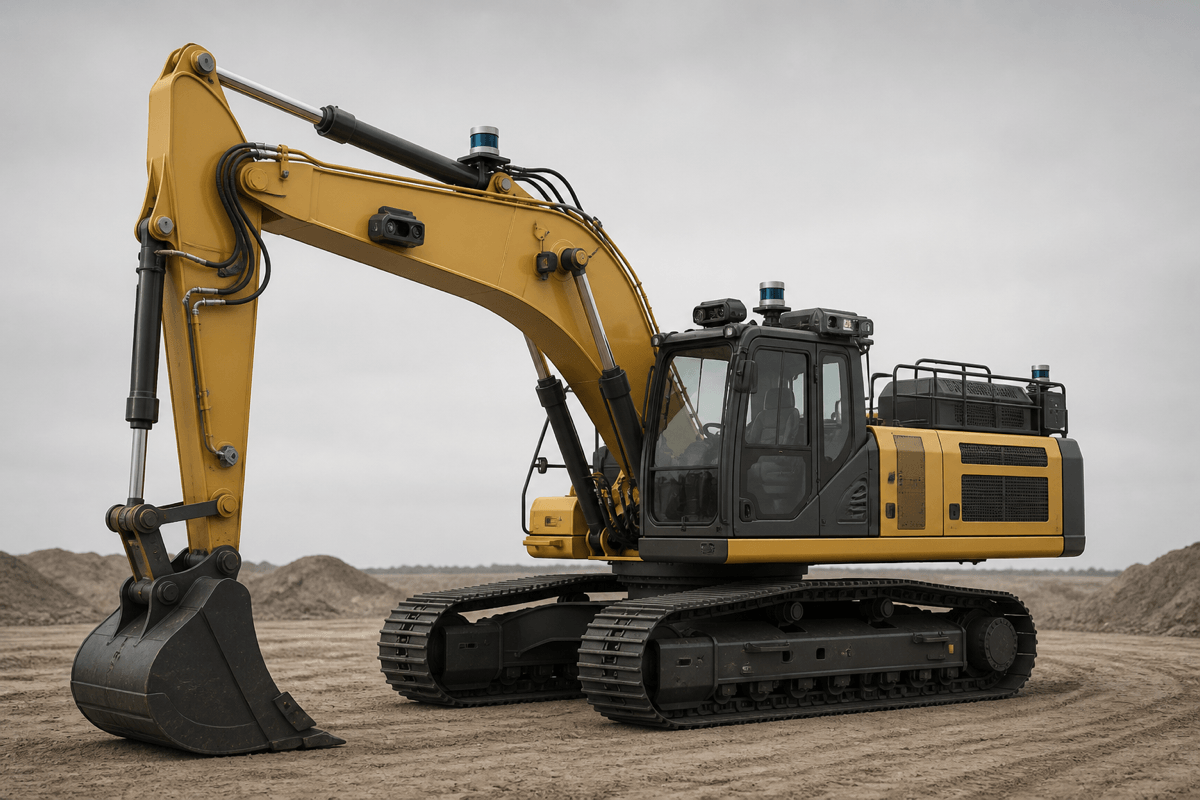
AI-generated illustration (not a photograph or measured data).
Bedrock also says a machine stops automatically when a person or unauthorized object comes too close, and that normal site operation requires no special barrier. Those are safety claims, not published safety results. The reviewed sources contain no test protocol, stopping-distance data, incident history or third-party certification that would allow readers to evaluate the claim.
3. Why it matters
Excavation turns perception and planning into economically measurable physical work. A system must repeatedly identify terrain, control a multi-jointed machine, manage bucket contact and respond as every pass changes the work surface. Doing that on customer jobsites with an empty cab is stronger evidence than a staged demonstration because delays, coordination errors and machine downtime affect an active project.
The retrofit approach could also matter commercially. Contractors already own mixed fleets, so adding autonomy without permanently modifying or replacing a machine may lower the adoption barrier. Manual operation remains available, according to independent reporting. But the value depends on more than removing one person from one cab. Contractors will still need to know how many people supervise the system, how frequently it stops, and whether the total cost per cubic yard improves.
4. Background
Bedrock’s previous public milestone retained closer human involvement. In November 2025, the company said supervised systems had moved more than 65,000 cubic yards while loading human-driven articulated dump trucks at a 130-acre manufacturing site for Sundt. It also said the technology had been installed on excavators from 20 to 80 tons. These company-reported figures show substantial field testing, but not operator-out performance. 2025 supervised-autonomy announcement
In February 2026, Bedrock raised $270 million in Series B funding and said it was targeting its first fully operator-less customer deployments during 2026. The August announcement is therefore the claimed delivery of a previously stated milestone. Bedrock says its models draw on tens of thousands of field hours, but it has not published the composition of that dataset or a benchmark connecting training hours to jobsite performance.
The company’s larger ambition is coordinated autonomy across excavators, dump trucks, dozers and loaders. That remains a roadmap. The evidence announced in August applies to excavators on three sites, not mixed fleets that schedule and execute an entire earthwork operation by themselves.
5. What remains unknown
- How many autonomous excavators are operating at each site, and for how many operator-out hours per day?
- How often does a machine require an onsite intervention, remote assist, manual takeover or reset?
- What are uptime, task-completion rate, fuel consumption, rework and cost per cubic yard versus a skilled human operator?
- How does the system perform across changing soil, weather, site geometry and traffic conditions?
- What safety events, near misses, emergency stops and false detections have occurred under operator-out operation?
- Who is accountable for planning, exclusion zones, machine inspection and recovery when the autonomy stops?
- What does the customer pay for installation, software, support and maintenance?
AI-generated illustration (not a photograph or measured data).
6. Editorial analysis
Bedrock has crossed an important evidence boundary: named contractors are allowing empty-cab excavators to perform work on live commercial projects. That is a stronger signal of customer confidence than supervised prototyping. It also places the system in the changing environment that makes construction autonomy difficult.
The announcement does not yet prove a productivity or safety advantage. Site size is not autonomous output, an empty cab is not zero human support, and a company description of automatic stopping is not an incident record. The most useful next evidence would be a contractor-authored, site-level report giving autonomous hours, material moved, interventions, downtime, fuel use, rework, safety events and a comparable human baseline. Until those figures appear, the correct description is operator-out commercial deployment with undisclosed operating economics—not demonstrated fleet-scale autonomy.
That evidence should cover ordinary shifts rather than a selected best run. Repeated results across different crews, soil conditions and machine sizes would show whether the system is transferable or still depends on tightly prepared operating conditions.
7. Related reading
- Technology: How spatial perception changes robot decisions explains why sensing a changing work area is only the start of reliable action.
- Explainer: Why robots struggle to move from simulation to reality provides context for the gap between controlled testing and variable jobsites.
8. Sources & evidence
- Bedrock Robotics launches fully autonomous excavator deployments — Bedrock Robotics, primary company announcement distributed by GlobeNewswire, August 17, 2026, accessed September 1, 2026.
- Bedrock Robotics deploys operatorless excavators at three commercial sites — RuntimeWire, independent analysis, August 17, 2026, accessed September 1, 2026.
- Bedrock puts fully autonomous Cat excavators to work — Plant & Equipment, trade reporting, August 18, 2026, accessed September 1, 2026.
- Bedrock Robotics announces supervised autonomy testing on active construction sites — Bedrock Robotics, primary company announcement distributed by PR Newswire, November 18, 2025, accessed September 1, 2026.
- Bedrock Robotics raises $270 million in Series B funding — Bedrock Robotics, primary company announcement distributed by PR Newswire, February 4, 2026, accessed September 1, 2026.
Bedrock operatorless excavators — source register
- Access date for every source: 2026-09-01
- Primary event date: 2026-08-17
| ID | Source | Publisher / origin | Date | Type | Use and evidence boundary |
|---|---|---|---|---|---|
| S1 | Bedrock Robotics launches fully autonomous excavator deployments | Bedrock Robotics via GlobeNewswire | 2026-08-17 | Primary company announcement | Event, named contractors and sites, retrofit and safety descriptions. Performance and safety language remains company claims. |
| S2 | Bedrock Robotics deploys operatorless excavators at three commercial sites | RuntimeWire | 2026-08-17 | Independent analysis | Confirms empty cabs, explains limited scope, summarizes prior milestone and identifies operational metrics still needed. Its Business Insider quotations are not treated as direct interviews by this article. |
| S3 | Bedrock puts fully autonomous Cat excavators to work | Plant & Equipment | 2026-08-18 | Trade reporting | Supports named projects and reports Cat 352 and 336 machine models. It largely relies on the company announcement and is not independent performance validation. |
| S4 | Supervised autonomy testing on active construction sites | Bedrock Robotics via PR Newswire | 2025-11-18 | Primary company announcement | Historical supervised deployment, 65,000 cubic yards, 130-acre site, human-driven dump trucks and 20-to-80-ton excavators. All figures are company-reported. |
| S5 | Bedrock raises $270 million in Series B funding | Bedrock Robotics via PR Newswire | 2026-02-04 | Primary company announcement | Funding and the stated 2026 operator-less deployment target. Funding figures and valuation are company-announced. |
| S6 | Bedrock Robotics | Bedrock Robotics | current at access | Primary company site | Current high-level product positioning and roadmap. Not used as performance evidence. |
Excluded or limited evidence
- Promotional video and still imagery were not used to infer autonomy, runtime, safety or deployment scale.
- Project volume describes total project scope, not autonomous material moved.
- “Fully autonomous” is Bedrock’s label. The article uses “operator-out” or “empty cab” when describing the independently supportable capability.
- No customer-authored operating report, regulatory record, certification, incident log or benchmark dataset was found in the reviewed materials.