
1. What happened
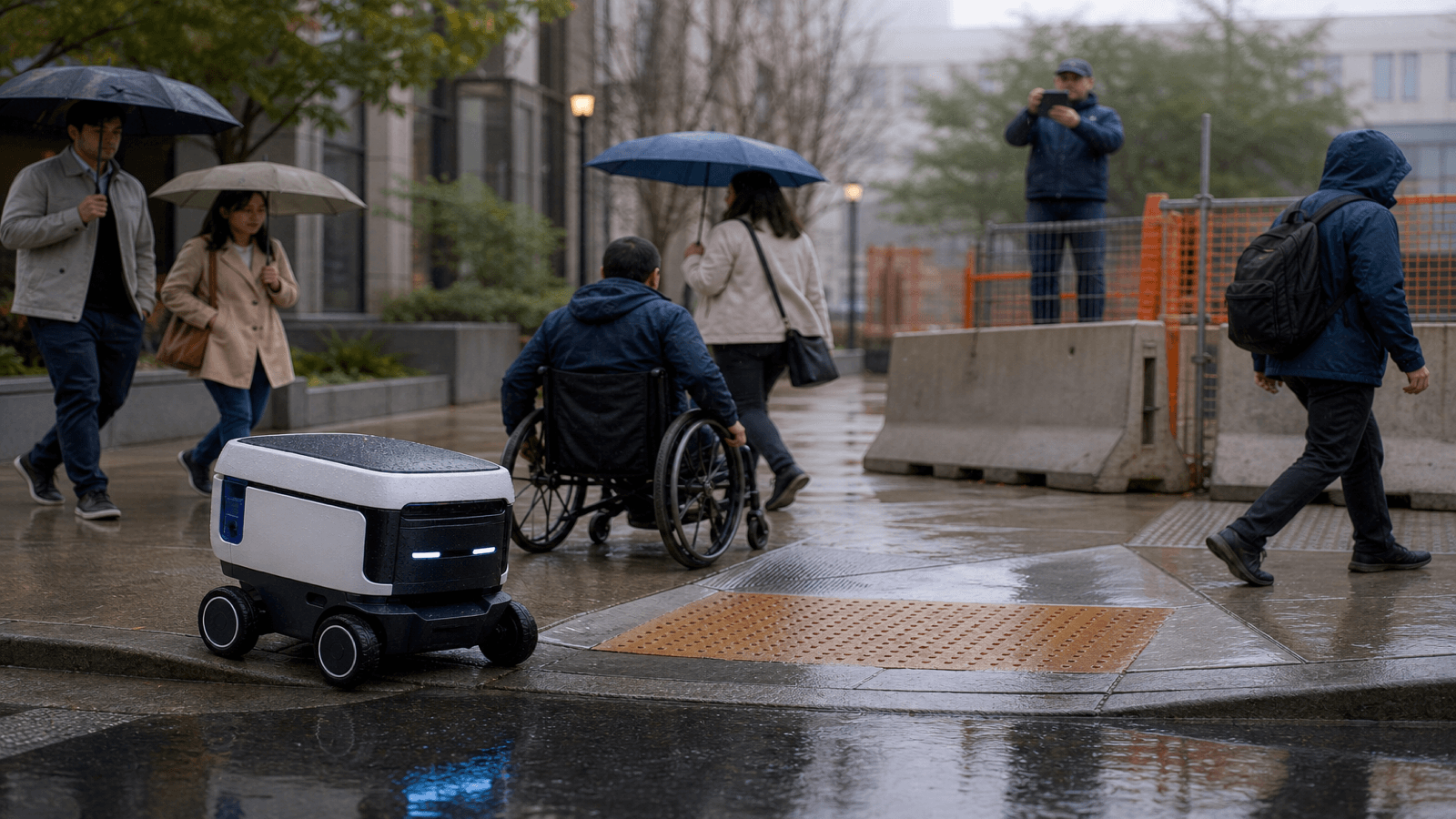
On August 28, 2026, the City of Hoboken announced a 12-month delivery-robot pilot with Coco Robotics and Avride. The program is expected to begin on September 3 with 20 low-speed electric robots: 10 from each company. Operations will initially be limited to a small zone in the First Ward. Any increase in the fleet will require city approval. City of Hoboken
The announcement authorizes a controlled test; it does not describe a service already in operation. As of this article’s publication date, the planned launch is still two days away. No deliveries, customer usage, safety record or street-level performance from the Hoboken pilot can yet be evaluated.
2. Confirmed facts
| Fact | Evidence boundary |
|---|---|
| Hoboken approved a 12-month pilot involving Coco Robotics and Avride. | Approval does not establish that operations have begun or that the program will continue after the trial. |
| The initial fleet is capped at 20 robots, split evenly between the two providers. | The city has not published a target for deliveries per robot or a timetable for expansion. |
| Operations are expected to begin September 3 in a small First Ward zone. | The exact street boundaries and later expansion sequence were not included in the announcement. |
| Robots will initially run seven days a week on a limited schedule. | Daily operating hours were not published. |
| The devices are designed for a maximum speed of 6 mph and an average operating speed of about 2 mph. | These are design and operating descriptions, not measurements from Hoboken streets. |
| The city plans to collect delivery, mileage, emissions, pedestrian-access and community-feedback data. | No public baseline, reporting cadence or success threshold has been specified. |
AI-generated illustration (not a photograph or measured data).
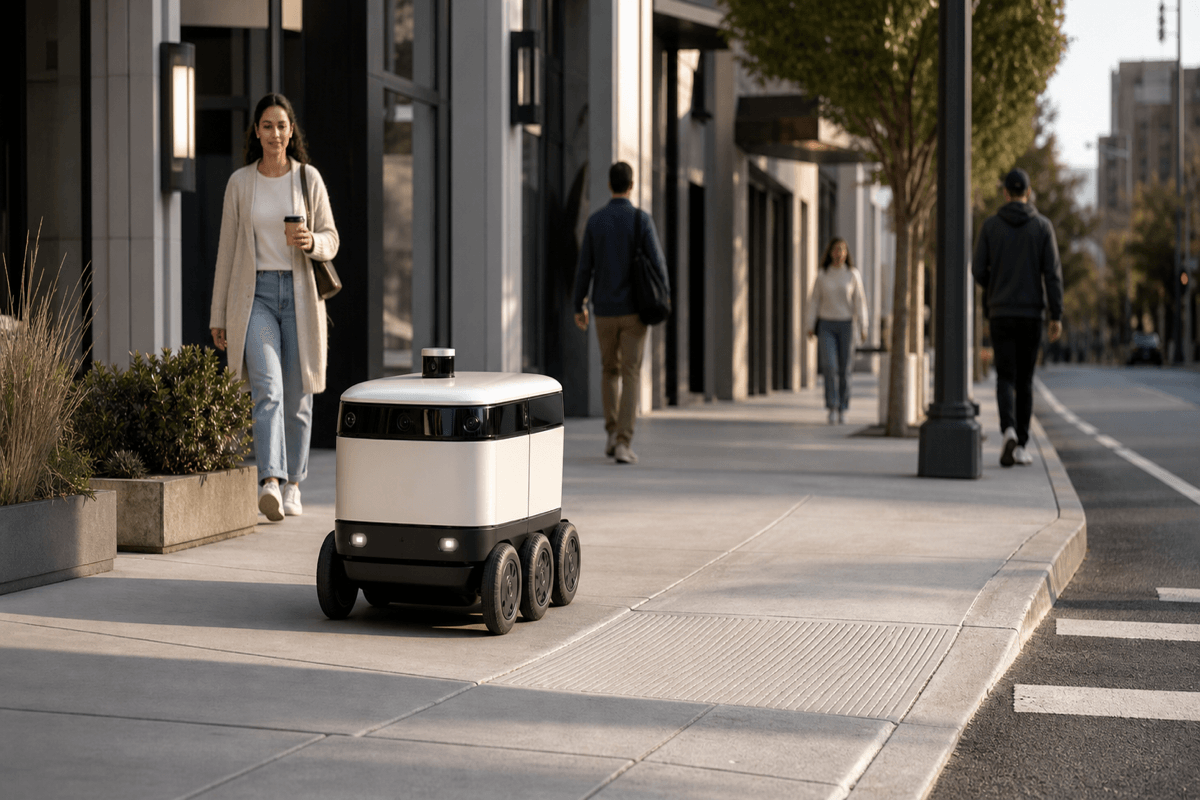
The city says both providers will use local personnel for deployment, charging, maintenance and field response. Coco’s robots will operate under continuous remote supervision, according to the announcement. The city also says navigation cameras will be used for safety, personal information will not be recorded, and faces and license plates will be blurred. These are stated operating rules; their implementation has not yet been independently assessed.
3. Why it matters
Twenty robots are not a large fleet. The more important feature is that Hoboken is treating public sidewalks as a governed test environment rather than an unrestricted product launch. The program begins with a geographic limit, a numerical cap, no-go zones, local response staff and a requirement for further approval before expansion.
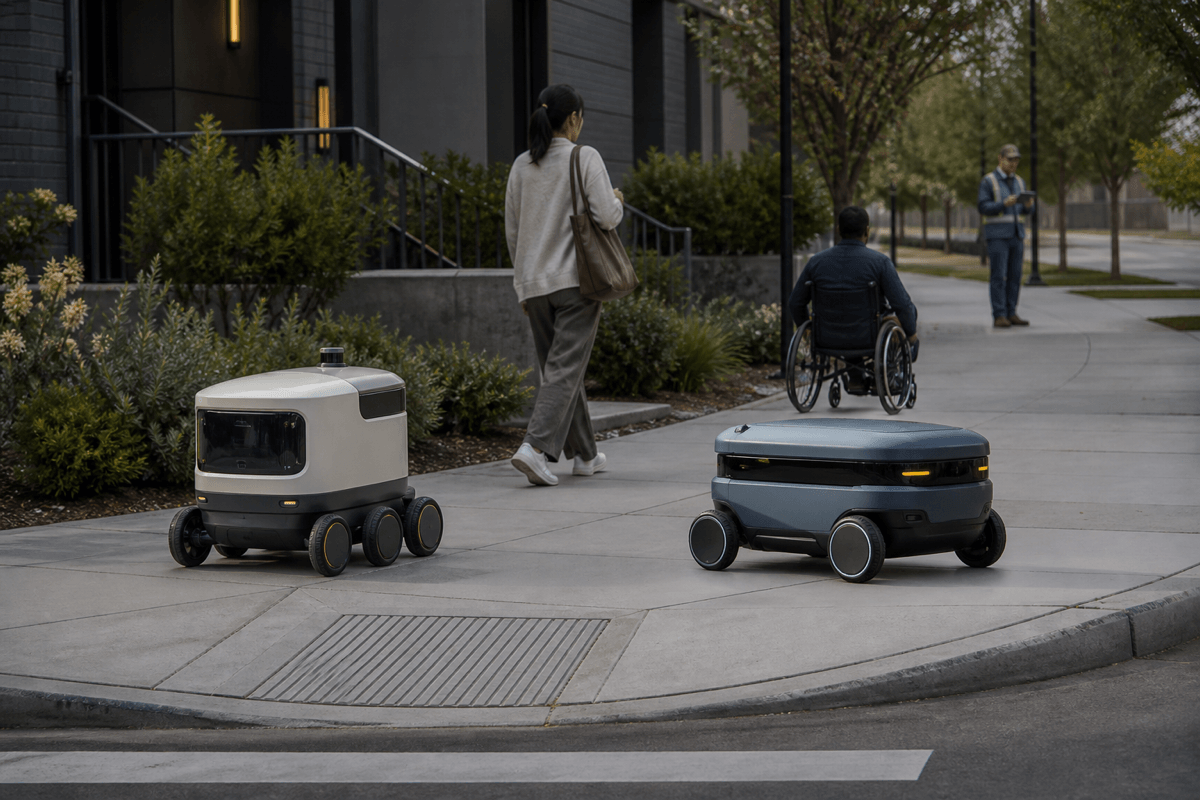
That structure creates an opportunity to evaluate a practical question facing many cities: can delivery robots reduce short vehicle trips without transferring congestion from streets to sidewalks? A successful outcome would require more than completed orders. The devices must coexist with pedestrians, wheelchair users, children, pets, bicycles, street furniture and temporary obstructions in a dense urban environment.
4. Background
Hoboken’s City Council first built a legal framework for personal delivery devices. Local outlet The Hoboken Girl reported that the council unanimously passed the ordinance on August 12 and made it effective immediately. At that stage, the legislation did not itself authorize a provider to operate; a limited pilot still required separate council approval. The Hoboken Girl
That distinction matters. The regulation established conditions, while the August 28 announcement identified the providers, starting fleet, intended launch and evaluation period. Residents may be offered robot delivery through participating businesses on DoorDash, Uber Eats, Grubhub or Wonder when the service is available for a specific order. Customers and businesses will be able to decline robotic delivery.
The city expects roughly $6,000 in revenue over the 12-month program. It also says the full year will allow evaluation across seasons and operating conditions. Local reporting frames the pilot as reversible: expansion needs approval, and continued use will depend on performance and public acceptance. Daily Hudson
5. What remains unknown
- What are the precise operating hours and street boundaries at launch?
- How many orders will participating businesses and customers assign to robots?
- How often will a robot require remote intervention or in-person recovery?
- How will blocked sidewalks, construction, bad weather and crowded events affect service?
- What process will residents use to report obstruction, unsafe behavior or accessibility problems?
- Will the city publish incidents, near misses, complaints and disabled-vehicle events in a consistent format?
- How will claimed vehicle-trip and emissions reductions be calculated against a public baseline?
- What performance, safety and accessibility thresholds will determine expansion, modification or cancellation?
AI-generated illustration (not a photograph or measured data).
6. Editorial analysis
Hoboken’s strongest decision is not choosing two robot suppliers; it is making expansion conditional. Beginning with two providers could reveal whether operational outcomes depend on a specific platform or on the city’s street environment. But a two-company pilot also requires comparable reporting. If the companies define interventions, failures and completed deliveries differently, the city will not have a reliable basis for judging them.
The announced data categories are useful but incomplete without definitions. “Miles traveled” does not show whether a robot blocked a curb ramp. “Deliveries” does not show how many required remote help. “Emissions avoided” depends on what trip would otherwise have occurred. Community feedback can reveal problems, but voluntary complaints are not a substitute for systematic observation of pedestrian access.
The pilot should therefore be read as the start of evidence collection, not evidence of success. The first meaningful public update would state actual launch dates, active units, operating hours, attempted and completed deliveries, interventions, field recoveries, incidents, complaints and accessibility observations. It should also explain whether each metric comes from the city, the operators or an independent reviewer.
If Hoboken publishes those measures throughout the year, the program could become a useful municipal case study. If it reports only deliveries and promotional estimates, the city may complete a 12-month trial without answering whether the robots improved urban logistics.
7. Related reading
- Technology: How robots build spatial perception explains how mobile systems interpret routes, obstacles and changing environments.
- Explainer: From data to deployment: the robotics pipeline explains why a controlled trial is different from validated commercial operation.
8. Sources & evidence
- City of Hoboken announces Delivery Robot Pilot Program in partnerships with Coco Robotics and Avride — City of Hoboken, primary municipal announcement, August 28, 2026, accessed September 1, 2026.
- Hoboken Approves Delivery Robot Pilot Program — Daily Hudson, secondary local reporting, August 28, 2026, accessed September 1, 2026.
- Food Delivery Robots May Be Coming to Hoboken — The Hoboken Girl, secondary local reporting on the preceding ordinance and public concerns, August 19, 2026, accessed September 1, 2026.
Hoboken delivery robot pilot — source register
- Access date: 2026-09-01
- Primary event date: 2026-08-28
- Planned operating start: 2026-09-03
| ID | Source | Type | Evidence boundary |
|---|---|---|---|
| S1 | City of Hoboken announces Delivery Robot Pilot Program in partnerships with Coco Robotics and Avride — City of Hoboken, 2026-08-28 | Primary municipal announcement | Confirms approval, duration, providers, initial fleet, intended launch, operating rules, data categories and decision process. Planned benefits and safety behavior remain unvalidated. |
| S2 | Hoboken Approves Delivery Robot Pilot Program — Daily Hudson, 2026-08-28 | Secondary local reporting | Restates program structure and emphasizes the pilot’s reversible status. It relies substantially on municipal information and is not independent performance evidence. |
| S3 | Food Delivery Robots May Be Coming to Hoboken — The Hoboken Girl, 2026-08-19 | Secondary local reporting | Documents the preceding ordinance, council sequence and public accessibility concerns before the provider pilot was approved. It predates the final program announcement. |
Evidence limits
- The September 3 launch was still in the future on the publication date.
- No Hoboken delivery, usage, intervention, safety, accessibility or emissions result existed in the reviewed record.
- Speed, navigation, privacy and yielding behavior are program or provider descriptions, not observed local results.
- Planned benefits such as fewer vehicle trips, less congestion and fewer emissions are goals, not established outcomes.
- The city did not publish detailed success thresholds, reporting frequency or comparable provider metrics in the announcement.