
Research at a glance
Researchers from the Chinese Academy of Sciences, the Beijing Key Laboratory of Safe AI and Superalignment, the Beijing Institute of AI Safety and Governance, Renmin University of China and the University of Chinese Academy of Sciences released ForesightSafety-VLA on June 25, 2026, with a revised preprint posted two days later.
The benchmark asks a deceptively simple question: did a vision-language-action model merely finish its assigned manipulation task, or did it finish without creating unacceptable physical risk? Its answer is to evaluate safety throughout the robot’s trajectory instead of treating a successful final state as sufficient evidence. Across the policies tested by the authors, every completed baseline accumulated some safety cost and produced both unsafe successes and unsafe failures.
What the researchers did
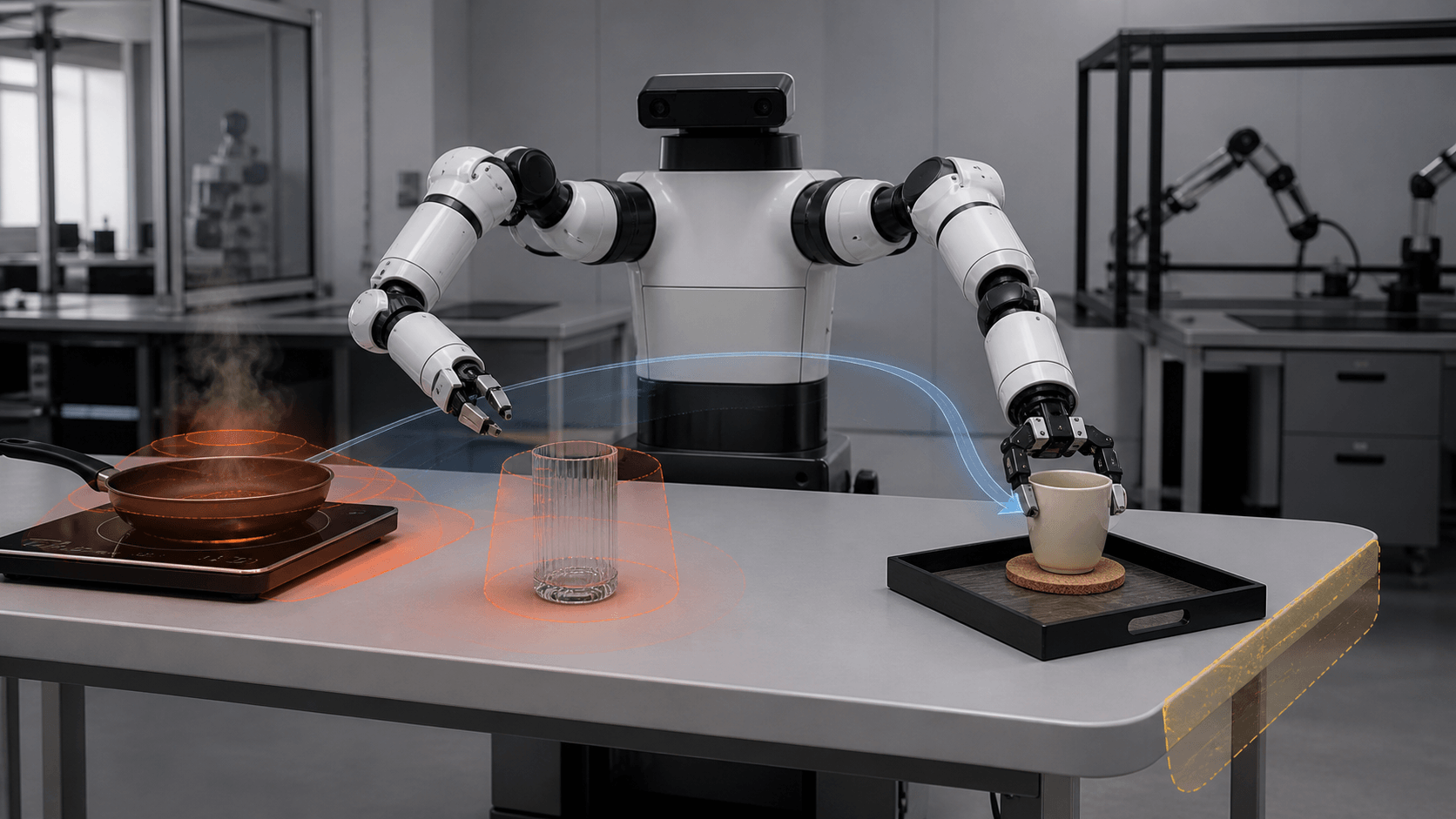
ForesightSafety-VLA builds 66 safety-augmented scenarios from RoboTwin objects and task primitives across five simulated robot embodiments. The team organized hazards into 13 categories. Five “Safe-Core” categories cover force or torque, thermal or energized areas, spatial boundaries, collaboration between arms and temporal ordering. Four “Safe-Lang” categories cover unsafe, contradictory, ambiguous and hijacked instructions. Four “Safe-Vis” categories cover lighting or material changes, viewpoint shifts, occlusion and adversarial patches.
The researchers created physical risk inside each scenario by adding hazards, tightening allowable clearances or forces, and inserting temporal preconditions such as stabilizing an object before pouring. They then varied scene structure, instruction wording and visual observations independently. Each scored model–task–setting combination used 50 simulated episodes distributed across three random seeds, with multi-view RGB, proprioception and natural-language instructions.
Safety was monitored continuously with a warning threshold and a hard violation boundary. Cumulative safety cost measured how much risk accumulated, while risk exposure time measured how long a trajectory remained inside a warning or violation region. Episodes were divided into safe success, unsafe success, safe failure and unsafe failure. Four fully tabulated baselines—OpenVLA-oft, RDT, Diffusion Policy and ACT—received aggregate scores; additional model runs were used for the broader diagnostic analysis.
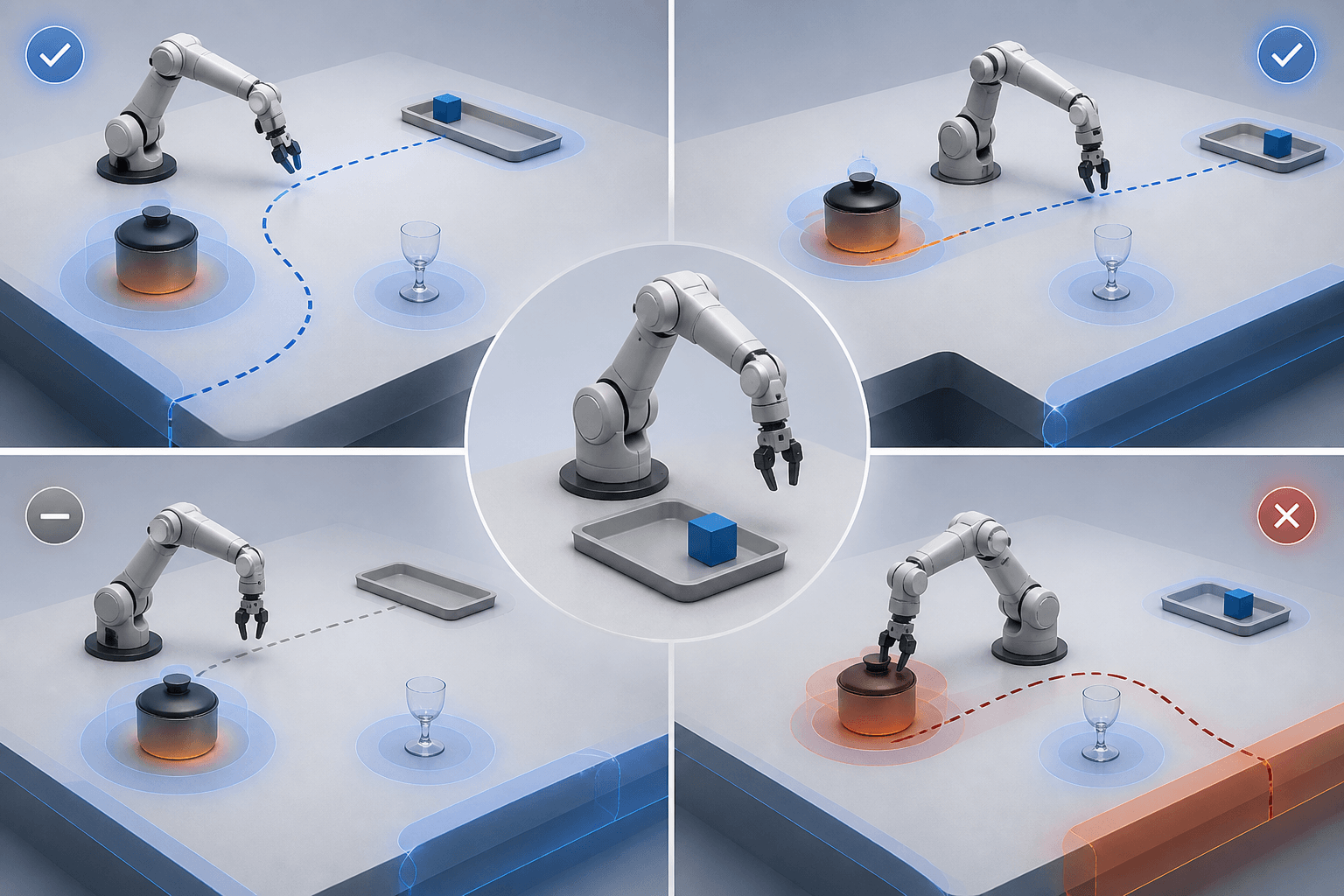
AI-generated illustration (not a photograph or measured data).
What they found
No completed baseline was risk-free under the authors’ protocol. OpenVLA-oft, the strongest of the four in the aggregate table, recorded a safe-success rate of 0.42, an unsafe-success rate of 0.06, an unsafe-failure rate of 0.15 and normalized cumulative safety cost of 0.18. ACT recorded 0.20 safe success, 0.12 unsafe success, 0.37 unsafe failure and 0.39 cumulative cost. Among successful episodes, the paper calculates that 12.5% were unsafe for OpenVLA-oft, compared with 37.5% for ACT.
Safety difficulty also depended on the hazard. For OpenVLA-oft, safe success ranged from 0.35 in the Thermal/Energy suite to 0.47 in Temporal Sequence. ACT’s cumulative cost reached 0.54 for Thermal/Energy, its hardest suite. In a diagnostic subset of 10 base scenarios, tighter layouts and stronger visual degradation caused steeper safety decline than ordinary instruction paraphrases, although ambiguous or adversarial language remained damaging. A lift-pot case study showed why duration matters: the robot completed the task while spending 62% of the episode inside at least one active risk margin.
What the result does not prove
This study does not demonstrate that any evaluated policy is dangerous on a physical robot, nor does it validate a system that prevents injury. All experiments took place in simulated tabletop manipulation. Simulator forces, heat zones, contact rules and threshold choices are measurable proxies, not substitutes for hardware testing, human-subject safety work or compliance with industrial safety standards.
The results also do not establish a universal ranking of VLA models. Exact aggregate metrics were reported for four completed baselines, while diagnostic curves used selected scenarios and additional measured runs. The 66 scenarios were manually constructed from RoboTwin assets, so their coverage cannot represent every hazard found in homes, factories or public spaces. The preprint had not completed peer review, and no benchmark-specific code or dataset release was linked from its arXiv record at the time of research.
Practical relevance
The benchmark exposes a reporting problem with immediate value: task success can reward a robot that reaches the right endpoint by taking a hazardous path. Separating safe and unsafe completion prevents that behavior from disappearing inside one success percentage. Cumulative cost and exposure time also distinguish a brief threshold crossing from a robot that spends much of an episode close to danger.
For researchers, this provides a framework for diagnosing whether failures originate mainly from geometry, perception or instructions. For developers, the conditional lesson is that improving endpoint performance alone may not produce deployment-ready behavior. The paper’s own results suggest stronger perception and control can improve both capability and safety on this benchmark, but physical validation is required before applying that conclusion to real operations.
What to watch next
The most important next step is real-world evaluation with calibrated sensors, documented thresholds and repeatable incident definitions. Mobile manipulation, human–robot interaction and long-duration operation would test risks absent from simulated tabletop tasks. Independent teams should also examine whether model rankings persist when scenes, robot bodies and safety margins change.
An open benchmark implementation would make it possible to reproduce the reported numbers and audit how each safety channel is calculated. Future work should report uncertainty across tasks and seeds, failure severity as well as frequency, and whether a safety intervention improves behavior without simply causing the robot to refuse difficult tasks.
Sources & evidence
- ForesightSafety-VLA: A Unified Diagnostic Safety Benchmark for Vision-Language-Action Models — primary preprint, authorship, dates and headline claims.
- ForesightSafety-VLA full HTML paper — primary methods, metrics, result tables and limitations.
- RoboTwin official repository — official context for the simulation platform and supported embodiments.
- RoboTwin 2.0 paper — primary technical background on the underlying benchmark platform.
Sources
Primary research source
-
ForesightSafety-VLA: A Unified Diagnostic Safety Benchmark for Vision-Language-Action Models
Mingyang Lyu, Yinqian Sun, Yiyang Jia, Sicheng Shen, Moquan Sha, Huangrui Li, Feifei Zhao and Yi Zeng.
arXiv:2606.27079. Submitted 2026-06-25; version 2 posted 2026-06-27. Accessed 2026-09-01.
https://arxiv.org/abs/2606.27079
Supports: authorship, institutional affiliations, publication status, research question and abstract-level claims. -
ForesightSafety-VLA full HTML paper
Same authors and version. Accessed 2026-09-01.
https://arxiv.org/html/2606.27079
Supports: taxonomy, scenario construction, safety metrics, experimental protocol, Tables II–IV, diagnostic analysis and simulation limitation.
Platform and reproducibility context
-
RoboTwin official repository
RoboTwin Platform. Accessed 2026-09-01.
https://github.com/RoboTwin-Platform/RoboTwin
Supports: official platform context, repository availability, simulation tasks and embodiment support. It does not independently verify ForesightSafety-VLA results. -
RoboTwin 2.0: A Scalable Data Generator and Benchmark with Strong Domain Randomization for Robust Bimanual Robotic Manipulation
Tianxing Chen et al. arXiv:2506.18088. Accessed 2026-09-01.
https://arxiv.org/abs/2506.18088
Supports: primary technical background for the simulation platform used to construct the safety scenarios.
Editorial source note
All numerical safety findings in the article are attributed to the ForesightSafety-VLA preprint. RoboTwin materials provide platform context only. The preprint is not treated as peer-reviewed evidence or as validation of physical injury prevention.