
1. Core conclusion
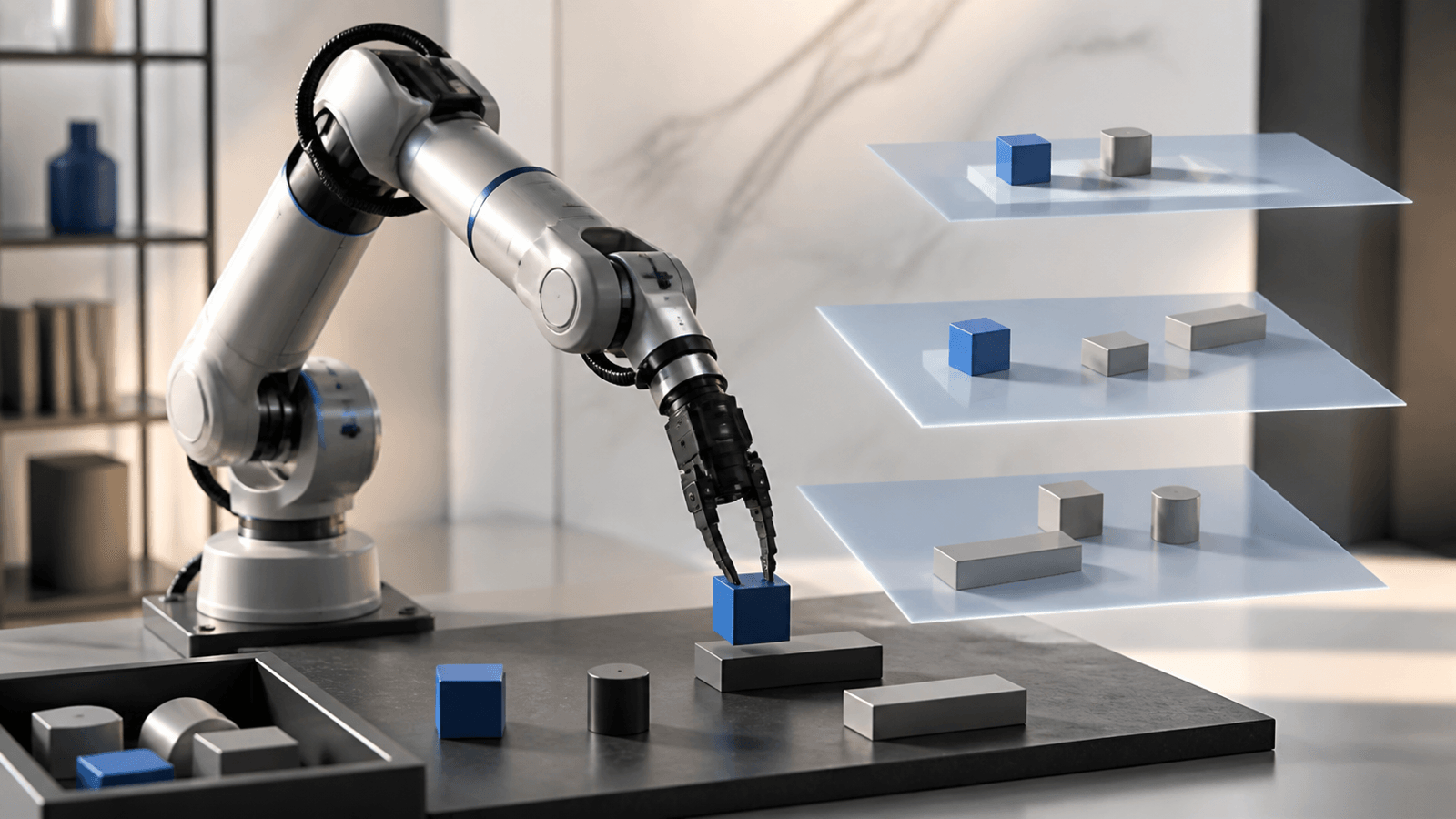
Robot world models are evolving from video generators into components that can supply synthetic demonstrations, preview the consequences of instructions and help policies choose actions. Their value is conditional: a predicted future must preserve embodiment, contact and causal dynamics, then connect to commands the real robot can execute. Current research shows useful gains on bounded tasks, but a visually convincing prediction can still be physically wrong. World-model quality is therefore not yet equivalent to reliable planning.
2. The problem
A conventional vision-language-action model maps an observation and an instruction directly to robot actions. It may learn that a gripper near a drawer should approach the handle and pull. What it does not necessarily represent explicitly is how the drawer, gripper and surrounding objects will change under each possible action. The policy reacts from patterns in its training data without being required to generate a coherent future first.
That matters when actions have delayed consequences. A grasp that appears correct in one frame may slip later. Pulling the wrong object can produce a plausible motion while failing the instruction. A long task may require comparing several choices before moving, yet physical trial and error is expensive and can damage hardware or surroundings.
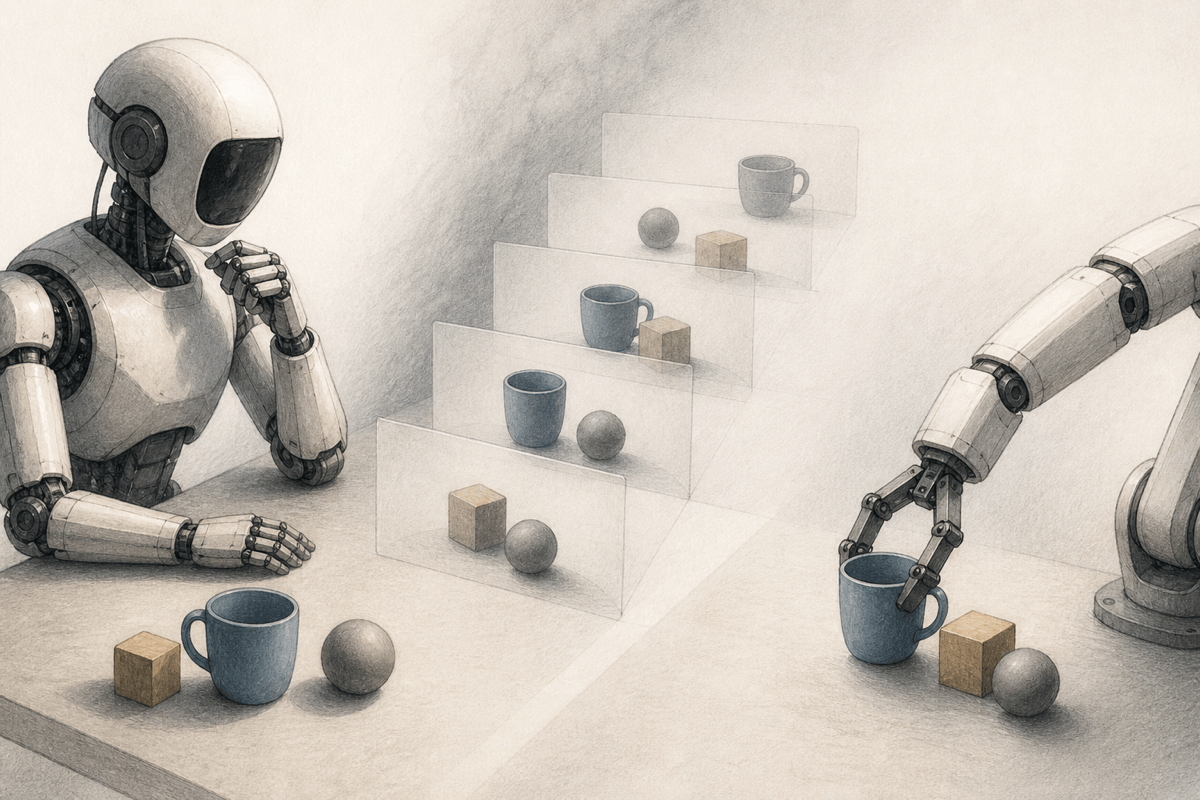
A world model attempts to learn how an environment evolves. In robotics, this can mean predicting future images, latent states, object motion or contact outcomes conditioned on the current scene and a proposed action. The attraction is clear: the robot could rehearse possibilities internally instead of executing every candidate in the real world. The hard part is that prediction errors compound, and video realism can conceal broken mechanics.
3. How it works
The simplest pipeline separates imagination from control. A video model receives an initial camera image and a language instruction, then generates a sequence showing a possible completion. A second component—often an inverse-dynamics model or action expert—infers the robot commands that could have produced those frames. The resulting image-action pairs can train a policy or provide a candidate plan.
A more integrated design lets prediction and action learning influence each other. Instead of treating a generated video as finished data, the system trains the world model alongside an action head so that imagined states preserve details useful for control. DVG-WM, for example, separates a low-resolution dynamics preview from high-resolution visual refinement, then attaches a diffusion-policy action expert. Gradients from imitation learning flow into both the action expert and world model.
The emerging “world action model” category goes further. A 2026 survey defines it as learning a joint distribution over future states and actions, rather than a reactive mapping from observations to commands. Its taxonomy distinguishes cascaded systems, where prediction and action remain separate stages, from joint systems that generate or represent both within one architecture. In either case, the model needs a condition—an instruction, proposed action or goal—and produces a future that is useful for deciding what to do next.
AI-generated illustration (not a photograph or measured data).
4. Representative approaches
Synthetic trajectories from generated video. DreamGen adapts image-to-video models to a target robot, generates videos of tasks and environments, then recovers pseudo-actions with either a latent action model or an inverse-dynamics model. The authors report that a humanoid learned 22 new behaviors in seen and unseen environments while starting from teleoperation data for one pick-and-place task in one environment. This path uses the world model mainly as a data engine. Its policy does not need to run the video generator during every physical action.
Embodiment-anchored data composition. RoboDream addresses a failure mode of free video generation: a model may change the robot’s body or invent infeasible motion. It anchors generation to rendered robot movement and conditions appearance on scene and object priors. Existing trajectories can be placed into new visual contexts, or an operator can move without physical props while the model adds objects afterward. This approach gives up some generative freedom to preserve the robot trajectory.
Prediction connected to an action expert. DVG-WM splits dynamics and appearance because the two demand different computation. A low-resolution stage predicts interaction dynamics; a smaller refinement stage restores contact-sensitive visual detail; an action expert converts the imagined future into commands. The project reports evaluation on LIBERO and two real Galaxea A1 tasks. This is closer to planning with a world model, but its reported total video-prediction time of 88.7 seconds remains far from a fast control loop.
One language interface across domains. Qwen-RobotWorld predicts future visual trajectories from an observation and natural-language action descriptions across manipulation, driving, navigation and human-to-robot transfer. Its report describes an 8.6-million video-text corpus spanning more than 20 embodiments and 500 action categories. The proposed uses include data augmentation, virtual evaluation and planning signals. This tests whether language can unify heterogeneous actions, while leaving the downstream conversion from visual futures to safe real commands as a separate engineering problem.
5. Real-world applications
The most immediate application is training-data expansion. Real robot demonstrations require hardware, operators, reset time and controlled spaces. A world model can vary backgrounds, objects, viewpoints or tasks around a smaller set of trajectories. DreamGen and RoboDream both report downstream policy improvements, but each limits generation differently to reduce infeasible motion.
A second application is candidate evaluation. A policy or planner could propose several actions, predict their outcomes, reject futures that do not satisfy the instruction and execute the remaining choice. This resembles model-predictive control, except the transition model is learned from large visual datasets rather than written entirely from equations. Iterative use requires prediction fast enough to matter before the scene changes.
A third application is virtual testing. Qwen-RobotWorld presents world models as scalable environments for policy evaluation. That is attractive when real tests are costly, but a policy can exploit errors in a learned simulator just as it can exploit errors in a conventional simulator. Virtual performance only becomes evidence about deployment when the model reproduces the physical factors that determine success and failure.
6. How it is evaluated
World-model papers often report image and video metrics such as PSNR, SSIM, LPIPS and FVD. These measure pixel similarity, perceptual similarity or distribution-level video quality. Object-level accuracy and mask overlap can test whether the intended object and robot region remain consistent. Such metrics help diagnose generation, but they do not directly measure whether the predicted action succeeds.
Downstream policy evaluation is more informative. DVG-WM reports two real manipulation tasks with 10 rollouts: moving a banana and placing bread in a bowl. Its project page reports 75% and 70% success for DVG-WM with its action expert, compared with 30% and 20% for the stated vision-only diffusion-policy baseline. Those numbers are tied to two tasks, one robot setup and the authors’ experimental protocol; they are not a general reliability estimate.
DreamGen introduces DreamGen Bench and reports correlation between video-generation performance and downstream policy success. Qwen-RobotWorld reports rankings on EWMBench, DreamGen Bench, WorldModelBench and PBench, plus zero-shot analyses on RoboTwin-IF. Cross-benchmark results broaden coverage, but benchmark scores still inherit each dataset’s scenes, action descriptions and judging model.
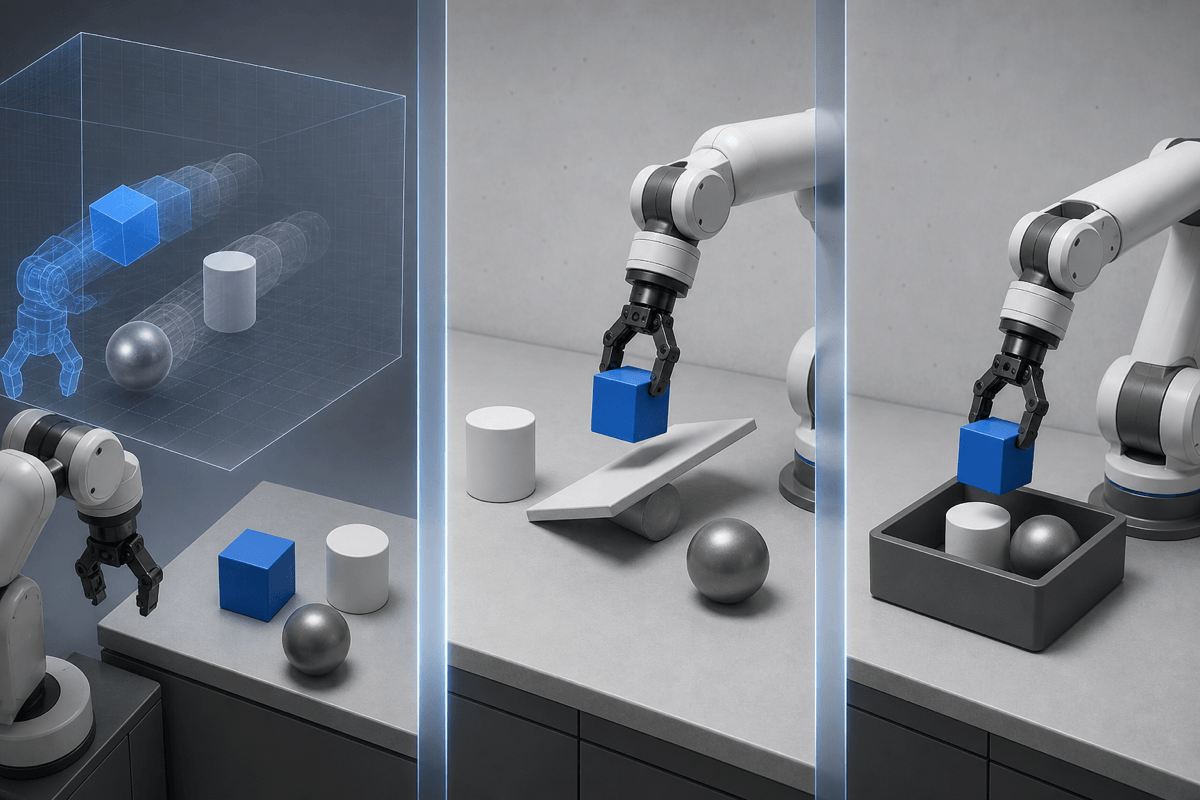
A stronger evaluation would jointly report future-state accuracy, contact-event accuracy, executable-action error, task success, interventions, recovery, latency and results under changed objects, viewpoints and dynamics. It would also compare against policies trained with equal amounts of real data and compute.
AI-generated illustration (not a photograph or measured data).
7. Current limitations
Plausibility is not causality. A generated hand can appear to pull a drawer while missing the handle, changing object geometry or violating friction. A video model trained to produce likely-looking frames is not automatically trained to preserve the exact physical state needed for control.
Actions must be recovered or represented. Video shows what happened, not the torques, joint commands or forces that caused it. Inverse dynamics can infer pseudo-actions, but ambiguity remains: several actions may create similar images, and invisible forces cannot be recovered reliably from RGB alone.
Error compounds over time. A small mistake in object position becomes the input to the next prediction. Longer imagined sequences may drift even when early frames look correct. Replanning from fresh observations can reduce drift, but it increases inference cost.
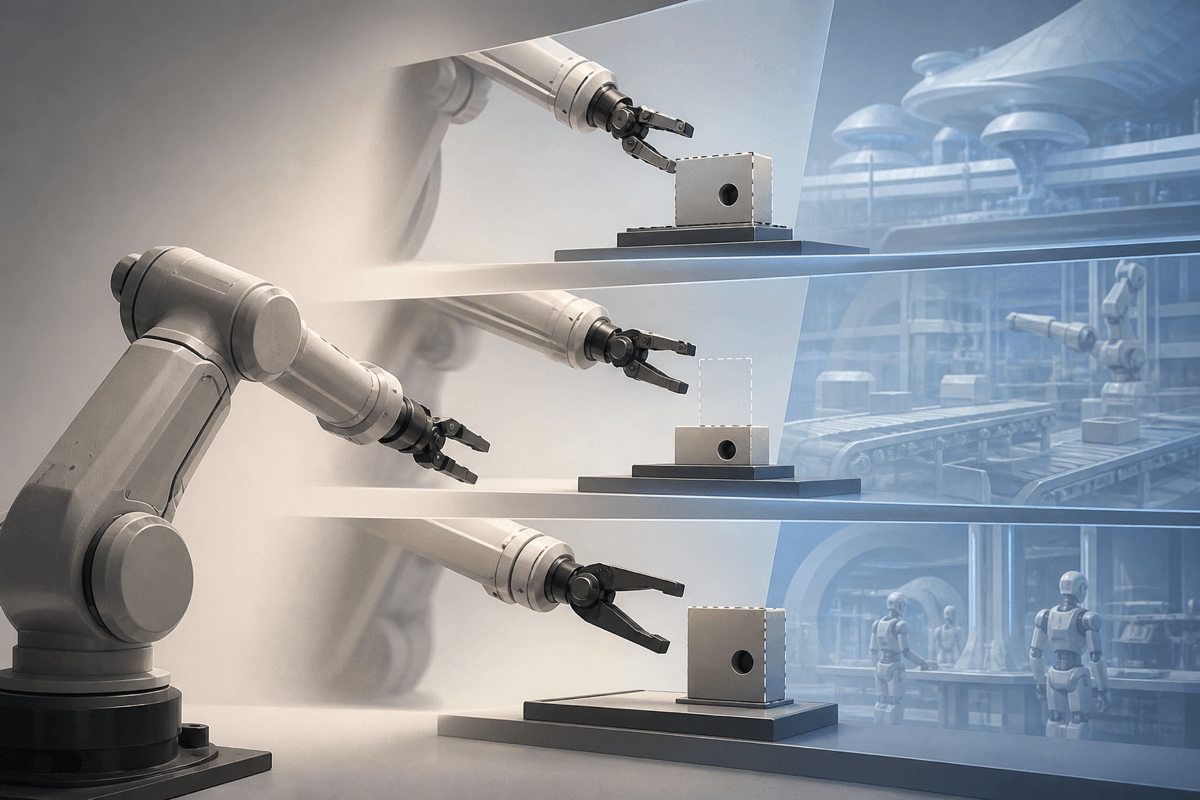
Embodiments constrain transfer. A predicted trajectory suited to one arm, gripper or humanoid may be unreachable for another. RoboDream’s explicit anchoring responds to this problem, while broader models attempt to learn across multiple bodies. Neither approach removes kinematic limits or hardware-specific calibration.
Speed remains a systems constraint. High-quality video diffusion can require many denoising steps. DVG-WM’s reported acceleration is meaningful relative to its baselines, yet an 88.7-second prediction cannot supply high-frequency corrections. Practical systems may need slow world-model reasoning above a much faster local controller.
AI-generated illustration (not a photograph or measured data).
8. Why it deserves attention
World models could change the economics of robot learning by turning limited trajectories into broader training distributions and allowing some evaluation before hardware execution. They may also give robot policies an explicit mechanism for comparing consequences instead of reacting directly from perception to action.
The decisive evidence will not be prettier generated video. It will be repeated gains on real robots under matched data and compute, accurate prediction of contact and failure, lower intervention rates, and planning fast enough for changing scenes. Researchers must also show when prediction should be trusted and how the system detects that an imagined future has left the physically plausible region.
The field is moving from “generate a possible future” toward “generate a future that improves an executable decision.” That transition is technically important. It is not complete.
9. Sources & evidence
- World Action Models: The Next Frontier in Embodied AI — Wang et al., survey and taxonomy, May 12, 2026, accessed September 1, 2026.
- Qwen-RobotWorld Technical Report — Zhang et al., primary technical report, revised June 17, 2026, accessed September 1, 2026.
- DreamGen: Unlocking Generalization in Robot Learning through Video World Models — Jang et al., primary research paper, revised June 17, 2025, accessed September 1, 2026.
- RoboDream: Compositional World Models for Scalable Robot Data Synthesis — Ye et al., primary research paper, June 1, 2026, accessed September 1, 2026.
- DVG-WM: Disentangled Video Generation Enables Efficient Embodied World Model for Robotic Manipulation — Shan et al., ECCV 2026 project and paper, accessed September 1, 2026.
Robot world models and action planning — source register
- Research date: 2026-09-01
- Article slug:
robot-world-models-action-planning
| ID | Source | Type | Supported evidence and boundary |
|---|---|---|---|
| S1 | World Action Models: The Next Frontier in Embodied AI — Siyin Wang et al., 2026-05-12 | Primary survey | Defines WAMs, distinguishes cascaded and joint architectures, and organizes data/evaluation. A survey synthesizes cited work but does not independently validate it. |
| S2 | Qwen-RobotWorld Technical Report — Jie Zhang et al., v3 2026-06-17 | Primary technical report | Supports model architecture, EWK corpus scale, covered embodiments/action categories, intended applications and author-reported benchmark rankings. Results are team-reported. |
| S3 | DreamGen — Joel Jang et al., v2 2025-06-17 | Primary research paper | Supports four-stage neural-trajectory pipeline, latent-action/inverse-dynamics recovery, reported 22 behaviors and DreamGen Bench. Does not establish unrestricted generalization. |
| S4 | RoboDream — Junjie Ye et al., 2026-06-01 | Primary research paper | Supports embodiment-anchored synthesis, retrieval-and-rebirth and prop-free teleoperation. Downstream gains remain tied to the authors’ tasks and setups. |
| S5 | DVG-WM — Ziyu Shan et al., ECCV 2026 | Primary project and paper | Supports two-stage dynamics/refinement architecture, action expert, LIBERO metrics, inference times and two-task real-world results. Project page is author-controlled evidence. |
Evidence boundaries
- Video quality metrics do not directly establish action correctness, task success or physical safety.
- Generated trajectories may contain embodiment, contact or dynamics errors invisible to common perceptual metrics.
- Paper-reported real-world success rates apply only to the stated robot, tasks, rollout counts and baselines.
- Dataset scale does not establish the quality, diversity or causal correctness of every training example.
- No reviewed source demonstrates a general world model that reliably plans across arbitrary robots and environments.