
1. The central question
When a robot maker says a humanoid is designed to work safely near people, what has actually been established? The statement can refer to useful engineering features: detecting a person, limiting motion, stopping through an independent controller or communicating intended movement. It can also be misunderstood as a blanket assurance that the robot is safe in any workplace and task.
Those meanings are not equivalent. Safety belongs to a complete application. The same robot may carry an empty tote slowly through a marked aisle, lift a heavy metal part beside an operator, or use a powered tool at a workstation. Its speed, payload, end effector, surroundings and failure consequences are different in each case.
“Cooperatively safe” is best understood as a design objective: enabling productive work in proximity to people through layers of sensing, control and risk reduction. It is not a substitute for application-level risk assessment, validation and operating controls. For humanoids, that distinction is especially important because a tall, mobile, dynamically balanced machine can create hazards unlike those of a fixed collaborative arm.
2. Conceptual foundation
Traditional industrial automation often separates people from hazards with fences, gates and interlocks. The robot may move quickly inside its cell because a person entering the protected area triggers a stop. Collaborative robot applications change this relationship. A person and robot may share a workspace, approach the same object or alternate access to a station.
Collaboration does not mean unrestricted contact. Standards-oriented safety practice uses defined methods to prevent or limit hazardous interaction. Two widely discussed methods are speed and separation monitoring, which maintains enough distance to stop before contact, and power and force limiting, which controls the mechanical effect if contact occurs. Other collaborative modes include safety-rated monitored stops and hand guiding.
The word system matters. A base robot may include safety-rated components, but the deployed system also contains a gripper, payload, software, fixtures, floor conditions and people performing specific tasks. A soft robot arm holding a sharp tool can be dangerous. A robot with excellent human detection can still drop a load. A safe stop can create a different hazard if a dynamically balanced machine falls.
Risk assessment therefore begins with foreseeable hazards and exposure. It asks who can enter the area, what energy the robot can transfer, where crushing or trapping can occur, how a failure is detected and what happens when the robot or network loses capability. Controls are selected to reduce those risks to an acceptable level, and the resulting application is validated.
3. How the system works
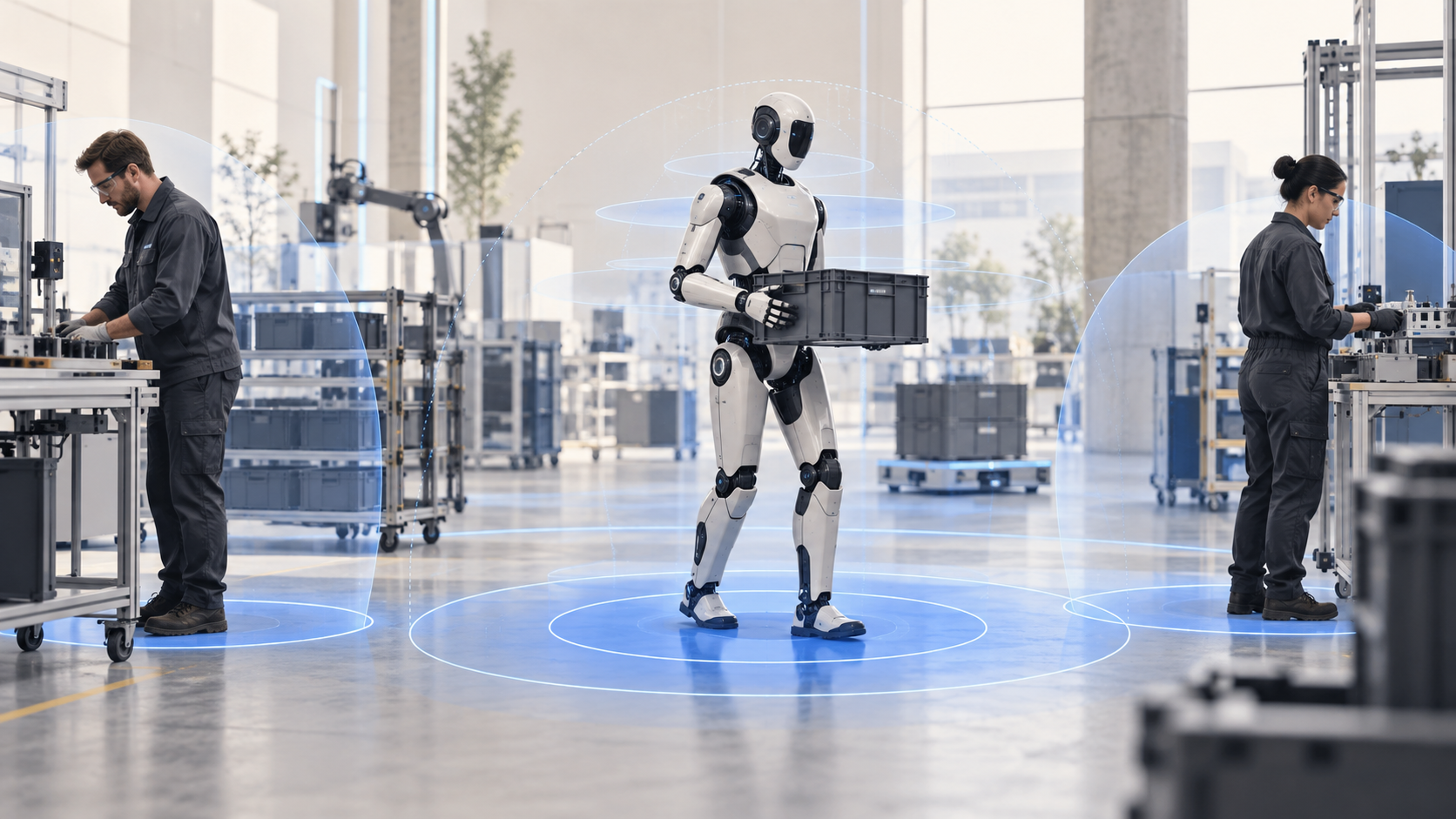
A humanoid designed for close proximity typically uses several safety layers. The first is perception. Cameras, depth sensors, lidar or other devices estimate where people and obstacles are. The system may define protective zones that change with robot speed, direction and stopping distance. Detection alone is insufficient; uncertainty, blind spots and sensor faults must also be considered.
The second layer is safety control. A controller receives safety-related signals and commands a defined response independently of the main AI planner. Depending on the situation, that response may reduce speed, prevent entry into a region, stop motion or move the machine toward a more stable state. Independence matters because a high-level model can be wrong while the safety layer still enforces a physical boundary.
The third layer is mechanically constrained behaviour. Joint torque limits, compliant elements, rounded surfaces and lower speed can reduce the severity of contact. These features do not make every contact harmless. Effective force depends on moving mass, geometry, velocity, body location and whether a person can move away.
A fourth layer is communication. Lights, sounds and visible motion can help workers understand whether the robot has detected them, intends to turn or is about to resume. These cues support cooperation but cannot carry the primary safety burden. A person may not see a light or hear an alarm in a noisy plant.
Finally, operational controls govern the surrounding work. Marked routes, training, maintenance procedures, load limits, tool restrictions and incident reporting address hazards that software cannot remove. The practical safety case is the combined performance of all five layers.
4. Major approaches
Separation-based operation
The robot monitors the distance to a person and adjusts motion so it can stop before the separation becomes unsafe. This approach is attractive for large mobile humanoids because it avoids relying on physical contact. Its performance depends on detection coverage, latency, robot and human approach speed, braking behaviour and uncertainty in position estimates.
In a quiet test area, separation can look simple. In production, a worker may emerge from behind a rack, another vehicle may block a sensor, or the robot may carry a load that changes its stopping distance. Validation must cover the actual environment and credible worst cases rather than an average demonstration.
Power-and-force-limited interaction
This approach limits the energy transferred during contact. It can involve low mass, compliant joints, torque sensing and speed constraints. It is common in collaborative arms but harder to generalise to a full-size humanoid carrying a substantial payload. The robot’s tool and the geometry of contact matter as much as the body.
A low-force arm may be acceptable when carrying foam and unacceptable when holding a sharp component. Contact against a free-moving arm differs from trapping a person between the robot and a fixed structure. Power and force limiting must therefore be evaluated for the application, not inferred from the robot’s appearance.
Safety-rated stop and controlled retreat
When a hazard is detected, the robot can enter a monitored stop. A biped may also need to preserve balance or move into a stable posture. This introduces a humanoid-specific problem: stopping every joint immediately may not be the safest physical response if the machine could fall.
Manufacturers may design a sequence that reduces motion, places a foot or sits the robot down. The response needs a clear safety rationale, bounded time and validation across configurations. A controlled retreat should not create new contact with a person behind the machine.
Task and workspace restriction
The most reliable way to reduce risk is often to narrow the task. A humanoid can begin with light payloads, low speeds, controlled routes and limited worker access. As evidence accumulates, the operating envelope can expand. This may seem less ambitious than general autonomy, but it allows risk controls and productivity measurements to be tied to a defined job.
5. Evidence and examples
ISO/TS 15066 helped formalise collaborative industrial robot concepts, including speed and separation monitoring and power and force limiting. NIST research has highlighted the measurement challenge behind these functions: a separation system must account for the motion of the person and robot, response time, stopping time and uncertainty. The standard concept is clear, while reliable verification in varied environments remains engineering work.
NIST has also argued for task-based analysis of human–robot collaboration. The method considers tooling, expected contact, duration and the distribution of force rather than assigning safety to a robot model in isolation. That framework is directly relevant to humanoids because one platform may perform several tasks with different tools.
The Association for Advancing Automation describes humanoids as dynamically stable industrial mobile robots, a category not fully covered by older assumptions about fixed arms or conventional mobile robots. Work on ANSI/A3 TR R15.108 and ISO 25785-1 aims to address robots that depend on active control to remain stable. These documents are evidence that the standards landscape is adapting, not proof that every marketed humanoid already satisfies a complete common regime.
Agility Robotics’ Digit 5 launch offers a current product example. The company describes human detection, visual and auditory cues, and an independent safety controller that can trigger avoidance, stopping or a seated posture. Agility also says it contributes to the emerging standards projects. Those details show an architecture designed around close proximity. Public deployment evidence will still be needed to establish how the system performs across sites, payloads and edge cases.
6. Trade-offs
Productivity versus separation. Larger protective distances give a robot more time to stop, but frequent slowing can reduce throughput. A fast system is not useful if normal worker traffic repeatedly interrupts it. Facility layout and route planning may be as important as controller speed.
Capability versus mechanical risk. Higher payload, longer reach and stronger actuators allow more valuable tasks. They can also increase impact energy and trapping hazards. Safety controls must adapt to the current tool and load rather than assume one permanent robot envelope.
Learned behaviour versus predictable bounds. AI policies can handle variation that fixed programmes cannot. Their errors may be difficult to anticipate. A practical design lets learned components propose or execute actions inside constraints enforced by a simpler, independently monitored layer.
Natural motion versus legibility. A humanoid may move efficiently in ways that surprise nearby workers. Slower, more deliberate motion and explicit cues can improve understanding, but may reduce speed. Legibility should be tested with the people who share the workspace.
Fail-safe versus stable failure. Cutting power is intuitive for a fixed machine. For a walking robot, loss of active control may cause a fall. Designers must decide which controlled motions remain allowed during a safety response and show that those motions reduce rather than transfer risk.
7. Current limitations
Humanoid safety evidence is difficult to compare. Manufacturers publish different operating hours, task success measures and safety descriptions. Detailed stopping curves, intervention logs, near-miss data and application-level risk assessments are rarely public. A polished video cannot reveal the frequency of protective stops or human assistance.
Standards are also catching up with the category. Existing industrial robot and mobile-robot frameworks provide important principles, but a dynamically stable machine with arms, tools and changing payloads combines several hazard classes. New technical reports and standards require time to complete, adopt and translate into repeatable conformity processes.
Perception remains fallible. Reflective clothing, occlusion, lighting, dust and crowded scenes can change detection performance. AI-based human tracking may improve flexibility but introduces data dependence and uncertain behaviour outside the training distribution. Safety functions need diagnostic coverage and conservative fallback states.
Finally, workplace acceptance cannot be reduced to collision prevention. Workers need to understand the robot’s role, reporting procedures and limits. Poorly designed interaction can create distraction, ergonomic workarounds or pressure to bypass safeguards even when the machine meets its technical specification.
8. Open questions
What evidence should a humanoid supplier publish? Useful reporting could include stopping performance by speed and payload, intervention categories, protective-stop frequency, exposure hours and the scope of independent assessment. Common definitions would make products easier to compare.
How should learned policies be validated when they can generate many motions? Testing every trajectory is impossible. Safety cases may need constrained action spaces, runtime monitors, scenario libraries and statistical evidence, combined with conventional limits that remain valid when the policy behaves unexpectedly.
What is the safest response for a biped that detects a person at close range? Stopping, stepping away and sitting each carry different risks. The correct action may depend on balance state, nearby obstacles and payload, which makes the safety response itself a controlled decision.
Who owns application responsibility when a robot changes tasks through software? A new tool or policy can alter risk without changing the base hardware. Operators need a change-management process that determines when reassessment and validation are required.
9. Editorial synthesis
“Cooperatively safe” is useful when it points to a concrete system design: reliable human detection, independent safety control, bounded motion, understandable cues and an application that has been assessed for shared work. It becomes misleading when treated as a permanent property of a robot regardless of task.
The right question is not “Is this humanoid safe?” It is “Under which validated conditions can this robot perform this task near these people, and what happens when a component fails?” A credible answer specifies speed, separation, payload, tools, environment, response time and operating procedure. It also identifies evidence gaps.
Humanoids may eventually reduce the need for rigid cages in some industrial workflows. That progress will come from narrower, measurable deployments before it becomes a broad capability. Safety claims should expand only as quickly as the evidence supporting the operating envelope.
10. Key takeaways
- “Cooperatively safe” describes a design goal, not universal certification of every humanoid application.
- Safety is a property of the robot, tool, payload, software, workspace, task and operating procedure together.
- Separation monitoring, power and force limits, safety-rated stopping, communication cues and task restrictions address different hazards.
- Dynamically stable humanoids need safety responses that preserve stability instead of assuming an immediate power cut is harmless.
- The strongest evidence is application-specific: stopping measurements, intervention records, independent assessment and sustained operation under defined conditions.
11. Further reading
- What Robot Autonomy Really Means: A Practical Guide to Levels of Independence
- Beyond the Success Rate: How Generalist Robot Policies Should Be Evaluated
- Agility Digit: Product Profile and Deployment Record
12. Sources & evidence
This explainer uses NIST research on human–robot collaboration, A3 material on emerging humanoid safety standards and Agility Robotics’ Digit 5 announcement as a current product example. Standards-oriented sources establish principles; manufacturer material establishes claimed product design. Neither is treated as application certification. The source list below provides the citations and evidence notes.
Sources
- National Institute of Standards and Technology. “Characterizing Task-Based Human-Robot Collaboration Safety in Manufacturing.” February 27, 2015. https://www.nist.gov/publications/characterizing-task-based-human-robot-collaboration-safety-manufacturing
- National Institute of Standards and Technology. “Sensors for Safe, Collaborative Robots in Smart Manufacturing.” 2017. https://tsapps.nist.gov/publication/get_pdf.cfm?pub_id=924262
- Association for Advancing Automation. “Safety by Design: How Humanoid Robots Must Evolve to Depart the Walled Garden.” 2026. https://www.automate.org/robotics/blogs/safety-by-design-how-humanoid-robots-must-evolve-to-depart-the-walled-garden
- Association for Advancing Automation. “Robot Safety Standard Documents.” https://www.automate.org/robotics/safety/robot-safety-standard-documents
- Agility Robotics. “Agility Unveils Digit 5 Humanoid Robot Built for Cooperatively Safe Work at Scale.” September 15, 2026. https://www.agilityrobotics.com/content/agility-unveils-digit-5-humanoid-robot-built-for-cooperatively-safe-work-at-scale
Evidence note
NIST and A3 sources explain safety methods and the developing standards context. The Digit 5 material is a manufacturer statement and is used as an example of a claimed architecture, not proof of application certification.