
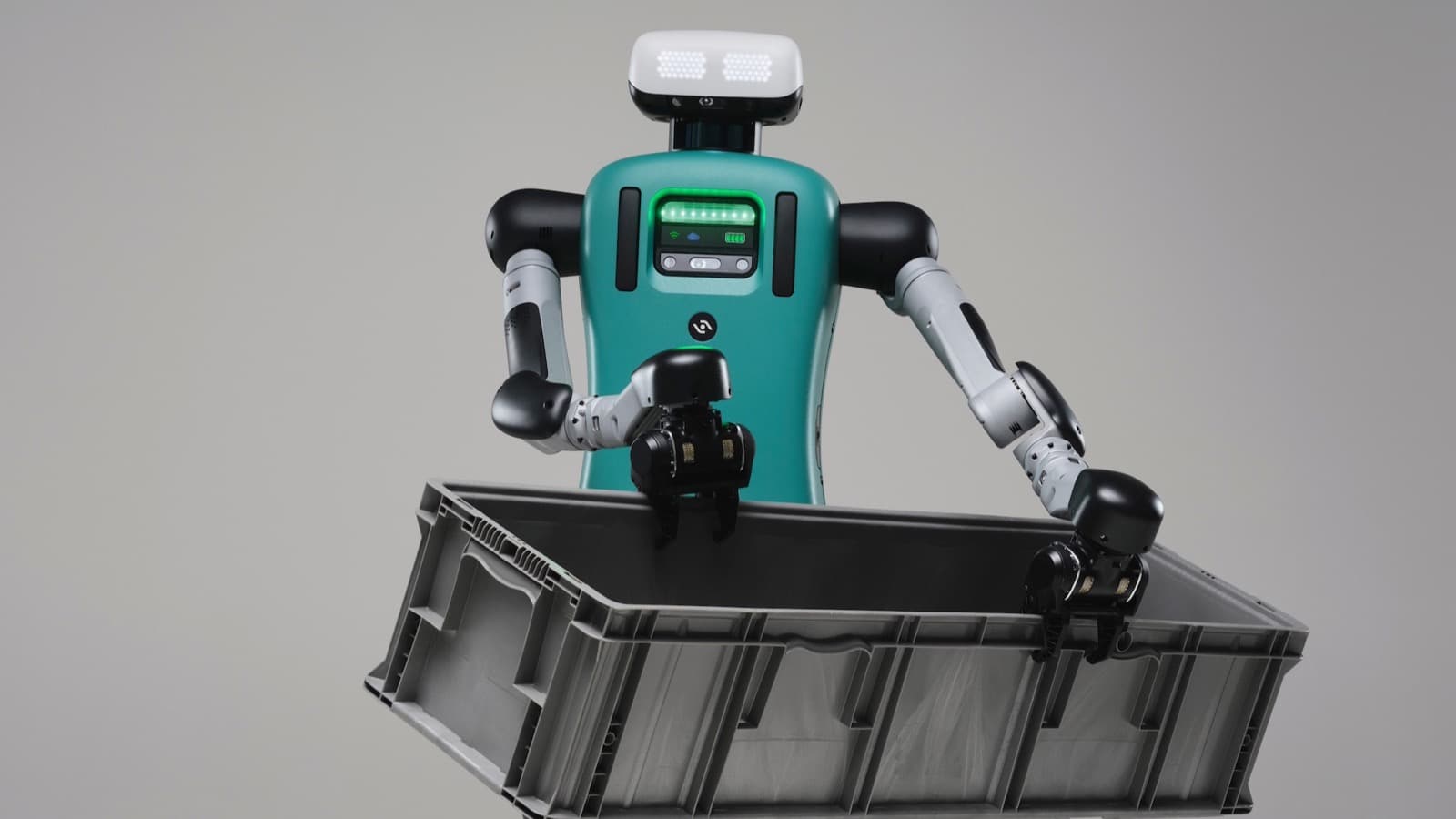
1. Identity and current status
Digit is a bipedal mobile-manipulation robot built by Agility Robotics—now branded Agility—for repetitive material-handling work in warehouses, distribution centers and factories. Its reverse-jointed legs, upright torso, shoulder-mounted arms and task-specific grippers were designed around useful movement in human-built facilities rather than close visual imitation of a person. The current deployed generation is Digit v4. Agility solutions Agility investor presentation
As of September 1, 2026, Digit’s status is Commercial. GXO signed a multi-year Robots-as-a-Service agreement in June 2024 after a 2023 proof of concept, placing Digit in a live SPANX fulfillment operation near Atlanta. Agility later reported more than 100,000 tote movements at that site. Commercial agreements and deployments have also been announced with Toyota Motor Manufacturing Canada, Schaeffler and Mercado Libre. GXO agreement 100,000-tote milestone
Commercial does not mean mass-market or general purpose. Today’s v4 performs narrow, engineered workflows and can remain separated from ordinary workers by a guarded workcell. Agility’s upcoming Digit v5 is a distinct generation intended to add cooperative safety, higher payload, interchangeable end effectors and longer daily operation. This profile keeps deployed v4 evidence separate from v5 plans.
2. Core specifications
| Field | Current deployed Digit v4 | Evidence boundary |
|---|---|---|
| Height | About 5 ft 9 in (1.75 m) | Figure stated by Agility CEO; current public product page omits it |
| Weight | About 160 lb (73 kg) | Figure stated by Agility CEO; not shown on current product page |
| Degrees of freedom | Not publicly disclosed | Early Digit arm DoF and third-party totals are not substituted for v4 documentation |
| Payload | 35 lb (15.9 kg) carrying capacity | Company rating; v5’s planned 50 lb is not assigned to v4 |
| Speed | Not publicly disclosed | No current rated or independently measured travel speed located |
| Runtime | 4 hours per battery cycle | Company rating; task mix and test protocol are not published |
| Sensors | Company describes 360° awareness of people, objects and surroundings | Models, resolution, range, redundancy and coverage are not publicly detailed |
| Compute | “NextGen power-efficient edge AI compute” | Hardware model and performance are undisclosed; v5’s planned NVIDIA IGX Thor is separate |
| Battery | Autonomous charging; company models up to about 16 operating hours in 24 hours for v4 | Investor material describes a 2:1 work-to-charge ratio; site conditions may differ |
| Product version | Digit v4 deployed; Digit v5 planned for 2026 release | v5 performance remains management expectation until released and deployed |
Digit v4 also uses fixed, task-specific end effectors and reaches up to 5.5 feet according to Agility’s investor material. Safety hardware announced for the generation includes a Category 1 stop, safety PLC, on-robot emergency stop, wireless teach pendant with an integrated emergency stop and Functional Safety over EtherCAT. These are manufacturer specifications, not a complete independent performance certificate. Digit innovations
3. Product position
Digit is positioned as enterprise automation sold with deployment software and service, not as a general developer humanoid. Its initial job is to connect “islands of automation”: for example, unloading totes from autonomous mobile robots and placing them onto a conveyor. This work is repetitive and ergonomically unattractive, but structured enough to define the robot’s location, objects, handoff points and exception procedures.
The body reflects that focus. Legs allow Digit to traverse human-scale aisles and reposition without tracks. The narrow upright form reduces its footprint. High arms increase reach and support whole-body coordination, while the grippers favor secure tote handling over human-like fingers. Agility’s argument is practical: a humanoid shape is valuable when it avoids rebuilding the facility, not because it resembles a person.
The full product is a system. Digit supplies mobility and manipulation; proprietary physical-AI layers coordinate balance and skills; Agility Arc connects robots with warehouse systems, assigns tasks and exposes operational metrics; deployment and support teams configure and maintain the workflow.
4. Publicly claimed capabilities
Company claim: Agility describes Digit as fully autonomous within configured workflows. The product page says it can connect existing automation, address hard-to-fill work, use interchangeable end effectors and acquire capabilities through simulation and learning frameworks. Its first marketed skills cover repetitive, dangerous and load-intensive tasks in manufacturing, logistics and distribution. Agility solutions
Arc is claimed to integrate with AMRs, conveyors, warehouse management, execution and manufacturing systems. It provides fleet status, productivity metrics, assignments and workflow control, with encrypted communications, single sign-on and role-based access. Agility also markets onsite service, remote monitoring, software updates and workflow expansion.
The current boundary is important. The deployed v4 can grasp and hold task-specific objects; Agility’s own investor materials place broader object manipulation, assembly, dynamic end effectors and unguarded operation with people in the v5 roadmap. Company language about continuously learning new tasks should not be read as unsupervised, instant learning at a customer site.
5. Verified capabilities
The strongest evidence is the GXO workflow. GXO—not only the robot maker—confirmed a multi-year RaaS agreement and described fully operational Digits moving totes from AMRs to conveyors in a live warehouse. Agility later reported that Digit passed 100,000 tote movements at the Flowery Branch facility and had completed a year of full-time deployment. These figures verify sustained repetition far beyond a staged demo, although no independent audit publishes throughput per hour, intervention count or downtime. GXO agreement Digit’s Next Steps
Agility’s May 2026 investor presentation reports 65,000 aggregate operating hours and deployment commitments in nine customer facilities. It identifies v4 working at Schaeffler’s Cheraw, South Carolina plant, placing 25-pound baskets of bearing components from a stamp press into a washing machine. These are company-reported operating metrics filed with the SEC, not regulator-validated performance data.
Safety evidence is narrower but concrete. Digit v4 passed an OSHA-recognized Nationally Recognized Testing Laboratory field evaluation at a customer production line. Agility correctly notes that the evaluation was site-specific. TIME reported in 2024 that Digit worked behind a barrier; the investor deck still characterizes v4 as confined to a workcell. The certification therefore supports deployment in an assessed configuration, not unrestricted operation beside the public. NRTL field evaluation TIME
6. Software and developer access
Arc is the customer-facing control layer. It maps facilities, defines workflows, orchestrates fleets, integrates enterprise systems, monitors productivity and supports troubleshooting. Agility’s physical-AI stack uses whole-body control, deployment data, simulation, motion capture and teleoperation to train skills; the company has also described NVIDIA Isaac Lab and Jetson Thor in its broader development workflow. Agility and AI
No public Digit v4 SDK, low-level control API, simulator package, model weights, ROS interface or self-service developer purchase was found. Customers receive a managed deployment rather than a general research platform. Unknown: the exact customer API surface, data-retention rules, offline behavior, update controls, exception-handling staffing and access to raw fleet data.
7. Pricing and availability
Digit has no public list price or standard monthly RaaS rate. Enterprise customers contact Agility for a configured deployment, software and support package. GXO confirms a multi-year RaaS agreement but does not disclose its commercial terms.
TIME initially reported a US$30-per-hour payment and later corrected the article: Agility’s CEO had used a hypothetical human wage in a return-on-investment calculation, not stated what GXO paid. That number must not be presented as Digit’s price. TIME correction
Investor materials say Agility expects both RaaS and ownership models for v5 and reports more than US$300 million in conditional, multi-year v5 orders associated with 1,000 robots. Those figures are not current-period revenue, delivered units or public per-robot pricing.
8. Deployment evidence
Digit’s deployment record includes a live GXO commercial workflow, a Schaeffler manufacturing task, a Toyota Canada commercial agreement following a pilot, and a Mercado Libre agreement for fulfillment work beginning in Texas. Agility also names Amazon among customers and earlier trials. In July 2026 it described Schaeffler, GXO, Toyota and Mercado Libre as active deployments. Toyota agreement Mercado Libre agreement
The maturity varies by site. GXO offers the clearest long-duration task count. Schaeffler has a named production operation but no public aggregate cycle count. Toyota and Mercado Libre have commercial agreements, yet public disclosures do not give comparable hours, fleet sizes or throughput. AP independently identified Toyota, Schaeffler and Mercado Libre as early customers while emphasizing that v5—not v4—is the next scale target. Associated Press
9. Editorial assessment
Digit is the strongest current case that a humanoid can perform paid, repetitive industrial work rather than merely demonstrate a skill. The GXO contract, customer-confirmed workflow, 100,000-tote milestone, site-specific safety approval and additional commercial agreements establish a deployment record its peers rarely match.
That success is narrower than “general-purpose humanoid” suggests. Digit v4 works in structured cells, uses task-specific grippers and offers no public unit economics, intervention rate, uptime or customer-by-customer performance. Its most important advantages may be disciplined workflow engineering, Arc integration and service—not open-ended intelligence.
The transition to v5 is the next test. Agility promises higher payload, longer operation, dynamic end effectors and cooperative safety outside barriers, but those are not yet v4 achievements. Evidence that would strengthen the case includes audited site metrics, disclosed autonomy and exception rates, safety validation for unguarded v5 operation, and repeat deployments across multiple tasks at the same customer. Digit is commercially real today; whether it becomes broadly flexible and economically repeatable remains open.
10. Update history
- 2026-09-01: Profile created. Status set to Commercial based on the multi-year GXO RaaS operation and additional named enterprise agreements; v4 and planned v5 evidence separated.
- 2026-07-16: Agility announced its Fremont AI facility and named four active enterprise deployments.
- 2026-06-24: Agility announced its planned public listing and disclosed v5 order and operating metrics in investor materials.
- 2026-02-19: Toyota Motor Manufacturing Canada signed a commercial RaaS agreement after a pilot.
- 2025-11-20: Agility announced that Digit had moved more than 100,000 totes at GXO.
- 2025: Digit v4 received a site-specific NRTL field approval at a customer production line.
- 2024-06-27: GXO announced the multi-year commercial RaaS agreement.
11. Sources & evidence
- Humanoid Solutions — Agility Robotics, primary live product and Arc page, accessed 2026-09-01.
- Agility investor presentation — Agility Robotics/Churchill Capital XI, primary investor material filed with the SEC, 2026, accessed 2026-09-01.
- GXO multi-year agreement — GXO Logistics, primary customer announcement, 2024-06-27, accessed 2026-09-01.
- Digit moves over 100,000 totes — Agility Robotics, primary deployment update, 2025-11-20, accessed 2026-09-01.
- Beyond the Hype — Agility Robotics, primary safety update, 2025-11-24, accessed 2026-09-01.
- Toyota Canada commercial agreement — Agility Robotics and TMMC, primary joint announcement, 2026-02-19, accessed 2026-09-01.
- Mercado Libre commercial agreement — Agility Robotics and Mercado Libre, primary joint announcement, 2025-12-10, accessed 2026-09-01.
- Agility Robotics heads to Wall Street — Associated Press, independent reporting, 2026-06-24, accessed 2026-09-01.
- Blue Collar Robot — TIME, independent reporting with correction, 2024-10-29, accessed 2026-09-01.
- Meet your robotic coworker — McKinsey interview with Agility CEO Peggy Johnson, 2026, accessed 2026-09-01.
Agility Robotics Digit — sources
- Article slug:
agility-digit - Access date for all web sources: 2026-09-01
S1. Humanoid Solutions
- Publisher: Agility Robotics
- URL: https://www.agilityrobotics.com/solutions
- Publication date: Undated live page
- Source type: Primary product, Arc and service page
- Supports: current Digit positioning; 35-pound carrying capacity; four-hour battery life; autonomous operation claim; end effectors; Arc integrations, fleet tools and security; support model.
- Boundary: the page omits height, weight, DoF, speed, detailed sensor and compute specifications; performance language is promotional.
S2. Agility investor presentation
- Publisher: Agility Robotics and Churchill Capital Corp XI; filed with the US SEC
- URL: https://www.sec.gov/Archives/edgar/data/2074973/000121390026071287/ea029548401ex99-2.htm
- Publication date: 2026
- Source type: Primary investor material and securities filing exhibit
- Supports: v4/v5 distinction; 65,000 company-reported operating hours; nine facility commitments; v4 payload, runtime, autonomous charging, 360-degree awareness and safety; Schaeffler task; Arc; v5 roadmap, conditional orders and production plans.
- Boundary: figures and forecasts originate with management; SEC filing does not mean the regulator verified them. Conditional v5 orders are not revenue or delivered units.
S3. GXO multi-year RaaS agreement
- Publisher: GXO Logistics
- URL: https://investors.gxo.com/news-releases/news-release-details/gxo-signs-industry-first-multi-year-agreement-agility-robotics/
- Publication date: 2024-06-27
- Source type: Primary customer announcement
- Supports: multi-year commercial relationship; prior 2023 proof of concept; live SPANX facility; AMR-to-conveyor tote workflow; Arc use; RaaS model.
- Boundary: no fleet count, price, uptime, throughput or intervention rate is disclosed.
S4. Digit moves over 100,000 totes
- Publisher: Agility Robotics
- URL: https://www.agilityrobotics.com/content/digit-moves-over-100k-totes
- Publication date: 2025-11-20
- Source type: Primary deployment milestone
- Supports: company-reported 100,000-plus tote movements at GXO Flowery Branch and multiple tote-handling workflows.
- Boundary: total is not accompanied by an independent audit, time-normalized throughput, downtime, exception or labor-comparison data.
S5. Beyond the Hype
- Publisher: Agility Robotics
- URL: https://www.agilityrobotics.com/content/beyond-the-hype
- Publication date: 2025-11-24
- Source type: Primary safety announcement
- Supports: OSHA-recognized NRTL field evaluation; relevant standards; expansion from putwall to tote-recycling workflows; site-specific nature of the evaluation.
- Boundary: a site-specific field approval is not a universal product certification or proof of unguarded cooperative operation.
S6. Toyota Canada commercial agreement
- Publisher: Agility Robotics and Toyota Motor Manufacturing Canada
- URL: https://www.agilityrobotics.com/content/agility-robotics-announces-commercial-agreement-with-toyota-motor-manufacturing-canada
- Publication date: 2026-02-19
- Source type: Primary joint customer announcement
- Supports: completed pilot followed by RaaS agreement; intended manufacturing, supply-chain and logistics support; continued task exploration.
- Boundary: unit count, operating start, task metrics and commercial terms are not disclosed.
S7. Mercado Libre commercial agreement
- Publisher: Agility Robotics and Mercado Libre
- URL: https://www.agilityrobotics.com/content/mercado-libre-and-agility-robotics-announce-commercial-agreement
- Publication date: 2025-12-10
- Source type: Primary joint customer announcement
- Supports: commercial agreement; initial San Antonio fulfillment deployment; Arc integration and intended future expansion.
- Boundary: public text does not disclose fleet size, hours, throughput or expansion completion.
S8. Agility Robotics heads to Wall Street
- Publisher: Associated Press
- URL: https://apnews.com/article/agility-humanoid-robots-ipo-churchill-ai-39f2356b9c1e167d0985b821f70079c5
- Publication date: 2026-06-24
- Source type: Independent reporting and executive interviews
- Supports: customer list; purpose-built form; commercial claim context; v5 as next scale target; market and transaction context.
- Boundary: article reports company and transaction-party statements and does not independently audit deployment metrics.
S9. Blue Collar Robot
- Publisher: TIME
- URL: https://time.com/collections/best-inventions-2024/7094773/agility-robotics-digit/
- Publication date: 2024-10-29; corrected 2024-10-31
- Source type: Independent reporting
- Supports: Digit at GXO; guarded-operation boundary in 2024; company ROI claim; correction that US$30/hour was a hypothetical human wage, not GXO’s payment.
- Boundary: short profile, not a technical or long-duration operational audit.
S10. Meet your robotic coworker
- Publisher: McKinsey & Company
- URL: https://www.mckinsey.com.br/our-insights/meet-your-robotic-coworker
- Publication date: 2026
- Source type: Interview with Agility CEO Peggy Johnson
- Supports: current v4 height, weight and carrying capacity; human-centric design rationale; next-generation distinction.
- Boundary: dimensions are executive statements, not independent measurements; publication predates completed v5 validation.