
1. What happened
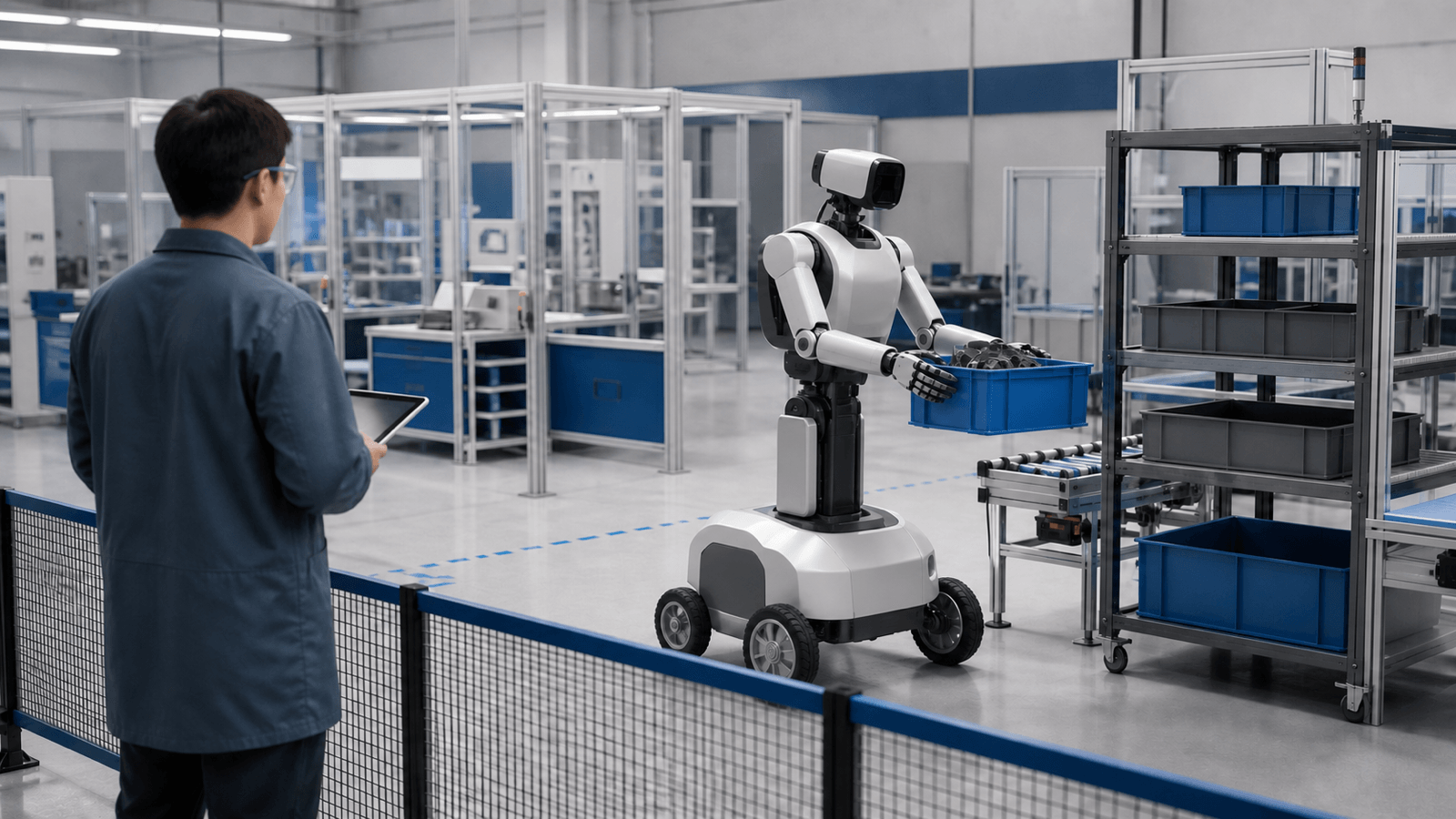
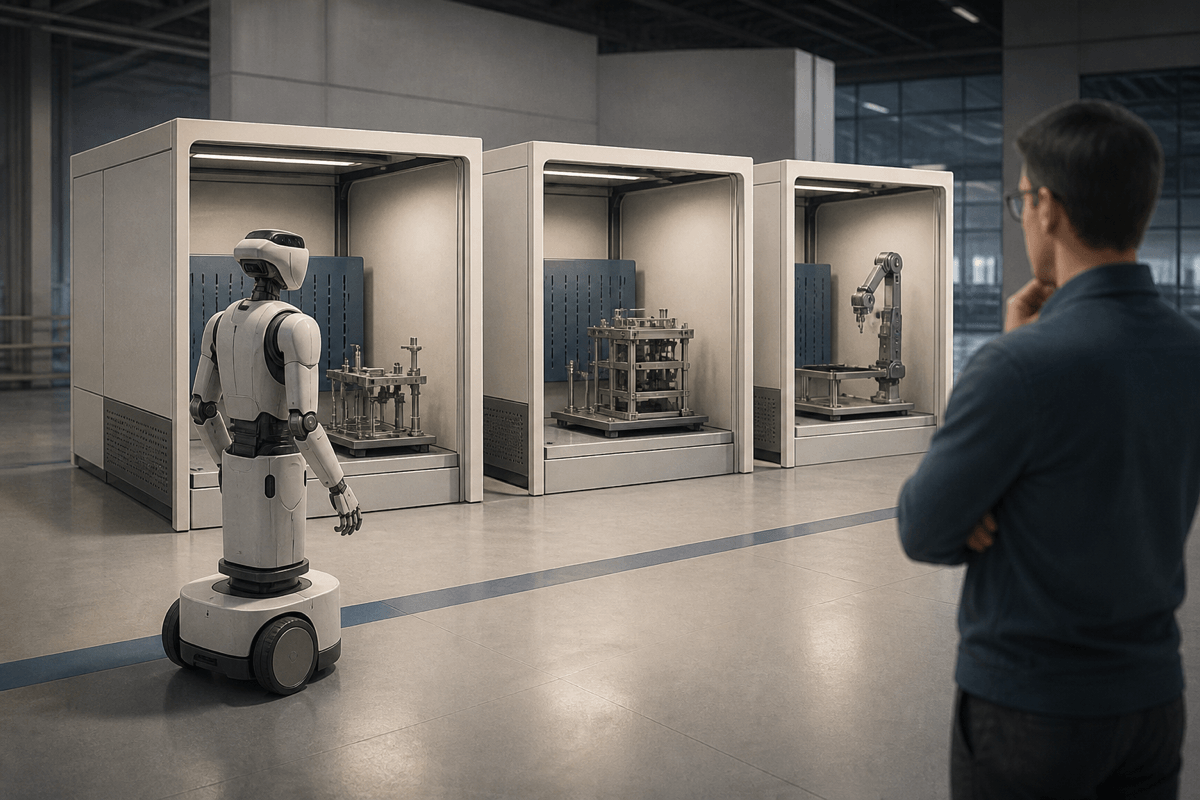
On August 19, 2026, Hexagon Robotics and Schaeffler announced that the AEON humanoid had entered Schaeffler’s “Humanoid Gym” in Germany. The dedicated facility reproduces representative industrial workstations so the robot can learn, repeat and validate factory tasks before entering production. The companies describe the process as Train → Validate → Deploy. Hexagon Robotics
The event is a training and validation milestone, not the start of the headline fleet rollout. In April, Schaeffler said it planned to deploy at least 1,000 AEON robots across its global production system by 2032. Hexagon now says the gym will support work on multiple manufacturing use cases during the next six months. Neither announcement states that the first production batch has been installed.
2. Confirmed facts
| Fact | Evidence boundary |
|---|---|
| AEON entered a dedicated Schaeffler training facility in Germany on August 19, 2026. | The city, floor area, training-unit count and facility cost were not disclosed. |
| The gym uses representative factory applications for imitation learning, repeated execution and policy validation. | The specific tasks, training demonstrations and acceptance tests were not published. |
| Hexagon says the next six months will expand AEON across multiple manufacturing use cases within Schaeffler. | This is a Company plan, not evidence that production deployment has occurred. |
| Schaeffler announced a plan for at least 1,000 AEON humanoids across its factories by 2032. | The companies did not publish annual delivery phases, binding purchase terms or installed-unit totals. |
| A 2025 pilot used AEON at a multi-machine station to load, unload and inspect parts. | No cycle time, runtime, success rate, intervention rate or quality result was released. |
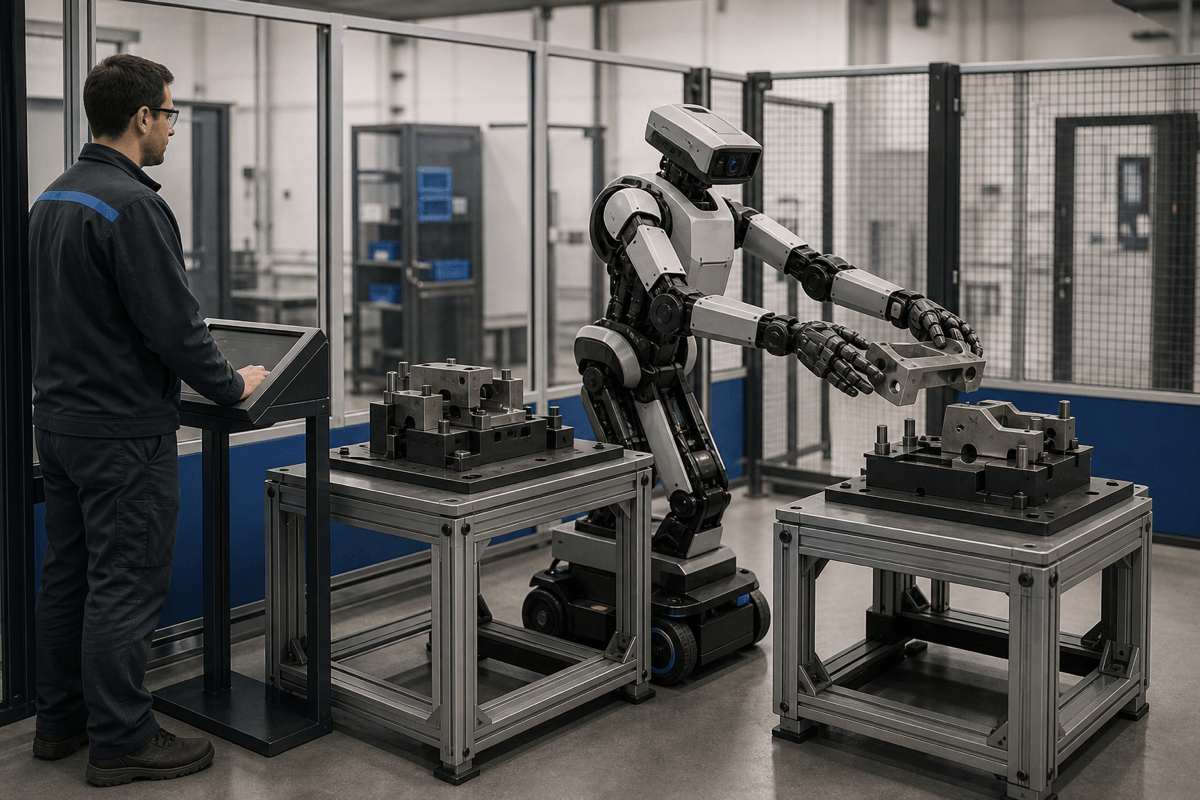
AI-generated illustration (not a photograph or measured data).
Schaeffler will also supply actuator technology for AEON. That makes the company both a prospective user and a component partner. The relationship may help engineering feedback move quickly, but it also means the two principal sources share commercial interests. Their statements confirm the program and its intended structure, not the robot’s measured performance.
3. Why it matters
The gym makes a frequently hidden deployment stage visible. A factory does not adopt a robot simply because the hardware can perform a demonstration. Engineers must define the task, collect examples, validate behavior, integrate tools and safety procedures, train operators and decide what happens when the robot stops. Moving this work away from a live line can reduce disruption while policies are still changing.
The facility also tests whether one humanoid platform can acquire several factory skills without every site becoming a new robotics research project. If validated policies transfer between similar Schaeffler workstations, later deployments could require less integration. If every task needs months of custom training, the 1,000-unit plan would face a systems-engineering bottleneck even if enough robots can be manufactured.
4. Background
Hexagon and Schaeffler announced the expanded partnership on April 22, 2026, following what they called a successful 2025 pilot. The plan covers at least 1,000 AEON units over seven years, with automated part inspection targeted to begin rolling out from the end of 2026. Those are dated intentions, not current installed-fleet figures. April partnership announcement
AEON uses wheel-based locomotion rather than a conventional walking gait. That can be practical on level factory floors, where stability and efficient movement may matter more than stepping over obstacles. The 2025 pilot reportedly involved high-precision manipulation across a multi-machine station, but the companies published no comparable operating metrics.
Independent industry analysis highlights the same gap: the gym gives the partners a controlled place to de-risk tasks, while the public record still omits task names, gym cost and quantitative pilot performance. Manufacturing Mag also warns that its article may contain AI-assisted content, so this article uses it only as secondary analysis and returns all core facts to the primary announcements. Manufacturing Mag
5. What remains unknown
- How many AEON robots are currently training in the Humanoid Gym?
- Which tasks are being taught, and what cycle times and quality thresholds must each task meet?
- How many demonstrations, repetitions and human corrections are needed before validation?
- What are autonomous runtime, task-success, intervention, fault and recovery rates?
- When will the first gym-trained AEON enter a live production line, and at which factory?
- How are safety validation, worker interaction and production-change management handled?
- How is the 1,000-unit plan phased through 2032, and what commercial conditions govern each phase?
AI-generated illustration (not a photograph or measured data).
6. Editorial analysis
AEON’s arrival at the gym changes the program from a broad purchase plan into a visible preparation activity. A named customer has built an environment for training and validation, and both partners have set near-term windows for new use cases and part inspection. That is more substantive than announcing a future order alone.
It does not show that large-scale deployment has begun. The 1,000-unit figure describes an ambition through 2032, while the August event takes place before production. Even the earlier “successful” pilot lacks public operational measurements. Readers should therefore separate three stages: a completed pilot described by the partners, current off-line validation, and a future multi-factory fleet.
The next decisive evidence is not another task video. It is a validation report stating the task, autonomous hours, completed cycles, intervention rate, quality result, safety events and production acceptance threshold. A first live-line deployment that meets those criteria would demonstrate that the gym produces deployable work. Until then, AEON is progressing through a credible industrial qualification process, but the scale promised for 2032 remains unproven.
Publishing the same measures for each new task would also reveal whether training becomes faster over time. That learning curve will determine whether the facility supports scale or repeatedly rebuilds one-off demonstrations.
7. Related reading
- Technology: Robot foundation models are learning to generalize explains the promise and limits of transferring policies across tasks.
- Explainer: From data to deployment: the robotics pipeline maps the validation stages between demonstration and repeatable production.
8. Sources & evidence
- Towards factory deployment: how AEON is trained to perform — Hexagon Robotics and Schaeffler, primary partnership announcement, August 19, 2026, accessed September 1, 2026.
- Hexagon and Schaeffler to deploy a fleet of AEON humanoids — Hexagon and Schaeffler, primary partnership announcement, April 22, 2026, accessed September 1, 2026.
- Schaeffler built a gym for robots — Manufacturing Mag, secondary analysis carrying an AI-assistance disclosure, August 23, 2026, accessed September 1, 2026.
AEON at Schaeffler Humanoid Gym — source register
- Access date: 2026-09-01
- Primary event date: 2026-08-19
| ID | Source | Type | Evidence boundary |
|---|---|---|---|
| S1 | Towards factory deployment: how AEON is trained to perform — Hexagon Robotics / Schaeffler, 2026-08-19 | Primary partnership announcement | Confirms entry into the German gym, Train–Validate–Deploy method, imitation learning, repeated execution and six-month window. No task list or metrics. |
| S2 | Hexagon and Schaeffler to deploy a fleet of AEON humanoids — Hexagon / Schaeffler, 2026-04-22 | Primary partnership announcement | Confirms 1,000-unit plan by 2032, 2025 pilot scope, actuator partnership and end-2026 part-inspection target. No quantitative pilot results. |
| S3 | Schaeffler built a gym for robots — Manufacturing Mag, 2026-08-23 | Secondary analysis | Highlights missing tasks, costs and results. Page discloses possible AI-assisted content; no core fact is accepted without primary-source support. |
Excluded or limited evidence
- Images and videos prove only visible actions and are not used for autonomy, safety or reliability claims.
- “Successful pilot” is partnership language; no published metric defines success.
- The 1,000-unit number is a 2032 deployment plan, not an installed fleet count.
- No task-level validation report, purchase schedule, factory acceptance document or independent performance dataset was found.