
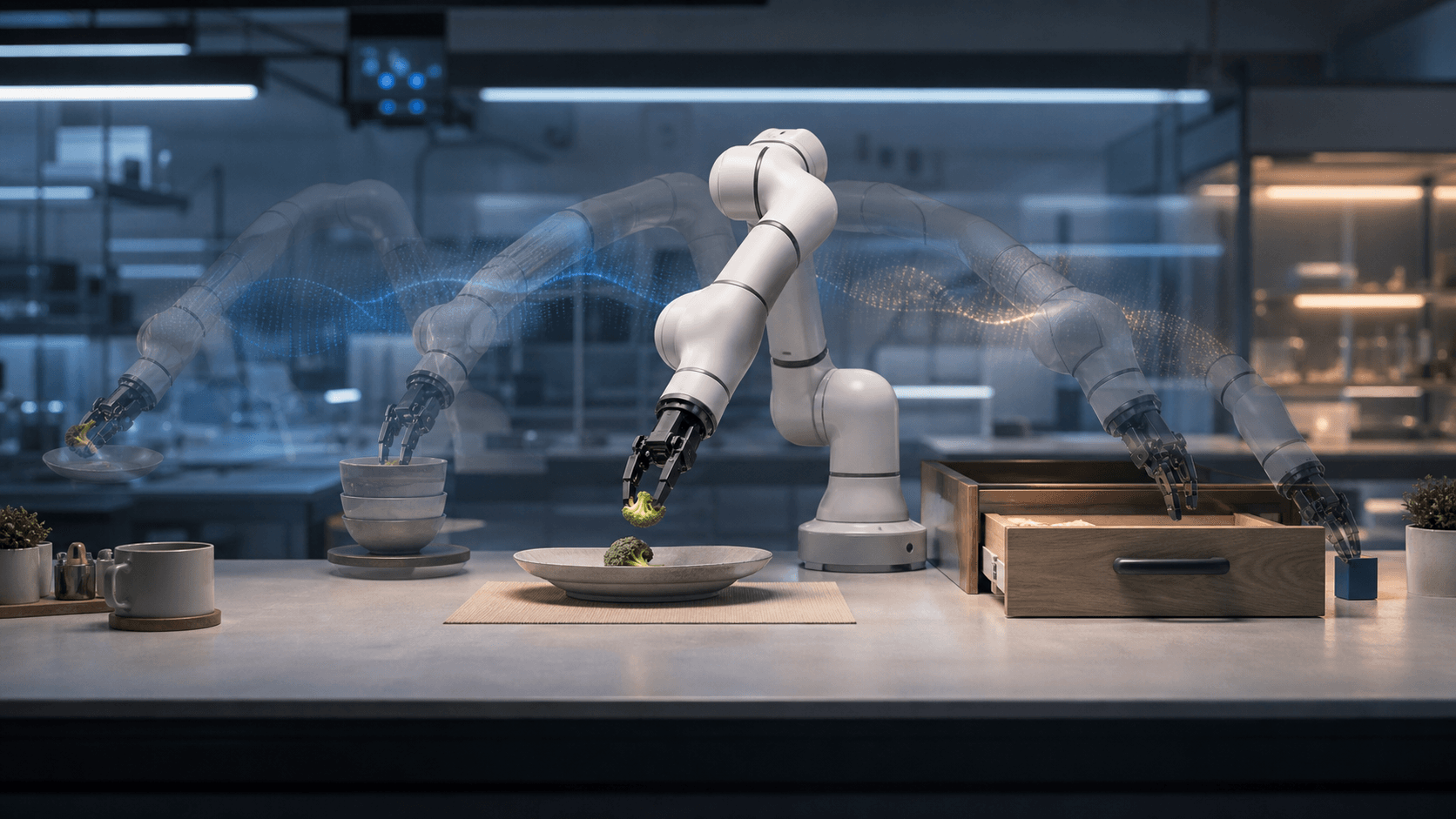
Research at a glance
Researchers from South China University of Technology and the University of Trento submitted LifelongVLA on July 16, 2026, and revised the preprint on July 21. The study addresses a practical weakness in vision-language-action policies: training on a new manipulation skill can damage performance on skills learned earlier.
LifelongVLA divides adaptation into a fast-changing pathway for the current task and a slower pathway for consolidating previous tasks. It also stores compact internal features rather than full image-rich trajectories for replay. On a ten-task sequential LIBERO experiment, the authors report higher final success and less forgetting than the tested continual-learning baselines. A five-task xArm experiment provides narrower physical-robot evidence.
What the researchers did
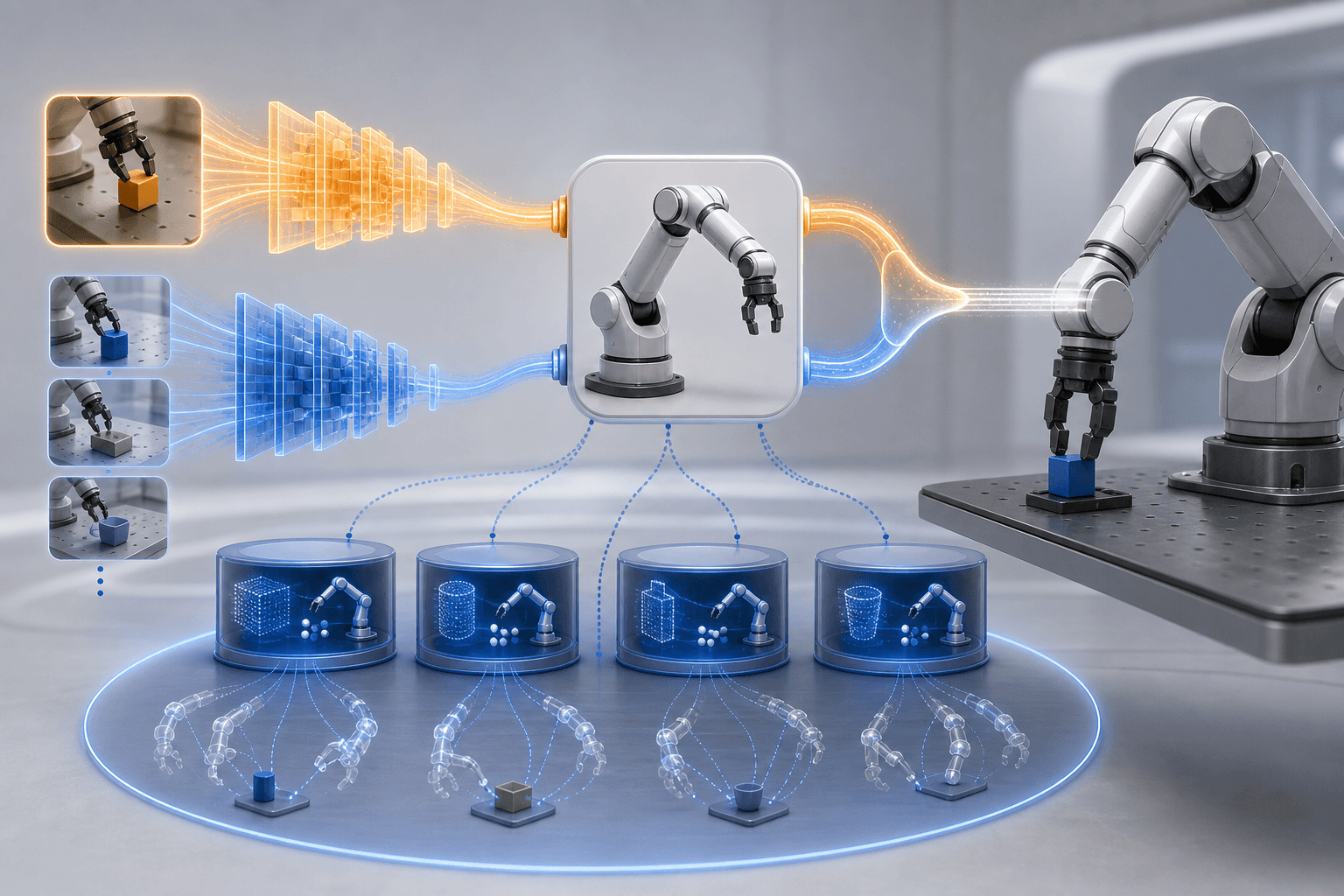
The method keeps its main PaliGemma-based VLA backbone frozen and adds two low-rank adaptation pathways. A short-term LoRA adapter learns from current-task data at a higher update rate. A long-term adapter changes more slowly and learns from replay and distillation signals associated with older tasks. A sample-dependent gate, computed from frozen prefix features, mixes the two sets of LoRA weights before a single model forward pass. The intended division is explicit: recent adaptation enters through the short-term path, while retained behavior is represented through the long-term path.
The replay system avoids storing raw images, language tokens or complete diffusion inputs. For a limited set of examples from each skill, it caches a frozen prefix feature together with robot state and target action. During replay, the method samples fresh diffusion noise and time variables, recomputes the action-side suffix with the current model, and compares predictions with a detached snapshot of the previous policy. This lets one cached prefix produce varied replay instances while reducing repeated visual encoding.
In simulation, the researchers introduced ten selected LIBERO manipulation tasks sequentially. Each lifelong method trained for 10,000 steps per task, with a cache capacity of 500 and 50 selected examples per task. Task identity was unavailable at test time. The frozen backbone used Gemma 2B with a Gemma 300M continuous decoder for seven-dimensional robot actions. Baselines included sequential fine-tuning, LwF-LoRA, experience replay, Info-VLA and AtomicVLA; joint training on all task data was treated as an upper bound rather than a lifelong method.
AI-generated illustration (not a photograph or measured data).
What they found
After all ten LIBERO tasks had been learned in sequence, LifelongVLA recorded an average success rate of 83.2% and an average forgetting rate of 11.4%. The strongest listed lifelong baseline, conventional experience replay, reached 70.2% success and 19.6% forgetting. Sequential fine-tuning and LwF-LoRA each ended at 7.8% average success, reflecting severe loss of earlier skills under this task order. Joint training, which retained all task data and did not follow the same incremental constraint, reached 89.6% success.
The ablations expose the cost trade-off. Replacing raw trajectory replay with latent replay reduced the paper’s reported memory from 167.62 MiB to 95.70 MiB per task. The full latent-replay, dual-LoRA design used 99.97 million trainable parameters and achieved 83.2% success with 11.4% forgetting. A single-LoRA version used 49.99 million trainable parameters but fell to 74.6% success and 21.78% forgetting.
For the physical experiment, the team introduced five xArm manipulation tasks sequentially, collecting 50 training episodes per task and evaluating with 50 episodes per task after each addition. The paper states that every task remained above 80% success after all five were learned, without supplying the task identity at inference.
What the result does not prove
LifelongVLA does not demonstrate indefinite or open-ended robot learning. The main comparison covers one ordered stream of ten selected simulation tasks, while the physical study covers five tasks with clear instructions. The paper itself calls for longer streams, randomized task orders, multiple runs with variance reporting, more diverse objects and richer layouts. A policy that retains five or ten skills may behave differently after dozens of heterogeneous updates.
The memory figure is also not total deployment cost. It describes replay storage per task under the authors’ representation choices; the full method doubles trainable adapter parameters relative to the single-LoRA ablation. Cached prefix features are tied to the frozen visual-language representation, which may limit adaptation if the underlying perception system must change. The work is a preprint, and no official LifelongVLA code repository was identified from the arXiv record during research.
Practical relevance
The paper makes the stability–plasticity trade-off concrete. Instead of asking one adapter to learn and remember simultaneously, it gives those objectives separate update pathways and lets the current input determine their mixture. That structure could make sequential updates easier to control and diagnose than repeatedly fine-tuning an entire VLA.
Feature-level replay also targets a real systems constraint: robot trajectories contain large visual observations that are expensive to store and re-encode. The conditional value is strongest when the backbone can remain frozen and new skills fit within lightweight adapters. It is not yet evidence that a deployed robot can autonomously decide what to learn, collect safe training data or recover from harmful updates.
What to watch next
The decisive follow-up is a longer, randomized task stream evaluated across multiple seeds and robot units. Tests should include paraphrased and ambiguous instructions, changing camera conditions, new object categories and tasks that interfere strongly with one another. Reporting both average retention and worst-task regression would reveal whether good aggregate results conceal a forgotten skill.
Public code and detailed physical-task results would enable independent reproduction. Future work should also measure training time, replay I/O, inference latency and the point at which adapter or cache growth becomes operationally significant.
Sources & evidence
- Towards Human-like Physical Intelligence: Lifelong Vision-Language-Action Learning for Robotic Manipulation — primary preprint, authorship, dates and headline contribution.
- LifelongVLA full HTML paper — primary methods, benchmark settings, result tables, physical experiment and limitations.
- LIBERO official repository — official benchmark code and dataset context.
- LIBERO: Benchmarking Knowledge Transfer for Lifelong Robot Learning — original benchmark paper and task-design background.
Sources
Primary research
-
Towards Human-like Physical Intelligence: Lifelong Vision-Language-Action Learning for Robotic Manipulation
Yao He, Gan Sun, Wenqi Liang, Fazeng Li and Yang Cong.
arXiv:2607.14852. Submitted 2026-07-16; version 2 posted 2026-07-21. Accessed 2026-09-01.
https://arxiv.org/abs/2607.14852
Supports: authorship, affiliations, dates, preprint status and research objective. -
LifelongVLA full HTML paper
Same authors and version. Accessed 2026-09-01.
https://arxiv.org/html/2607.14852
Supports: dual-timescale LoRA design, cached-prefix replay, simulation protocol, Tables 1–3, xArm evaluation and limitations.
Benchmark context
-
LIBERO official repository
Lifelong Robot Learning project. Accessed 2026-09-01.
https://github.com/Lifelong-Robot-Learning/LIBERO
Supports: official benchmark code, task-suite descriptions and dataset context. It does not independently verify LifelongVLA results. -
LIBERO: Benchmarking Knowledge Transfer for Lifelong Robot Learning
Bo Liu, Yifeng Zhu, Chongkai Gao, Yihao Feng, Qiang Liu, Yuke Zhu and Peter Stone. NeurIPS 2023 Datasets and Benchmarks Track. Accessed 2026-09-01.
https://arxiv.org/abs/2306.03310
Supports: original benchmark motivation, continual-learning setup and task structure.
Editorial source note
All LifelongVLA performance, memory and physical-robot claims are attributed to the research team’s preprint. LIBERO materials establish benchmark provenance only and are not independent reproduction of the new method.