
Research at a glance
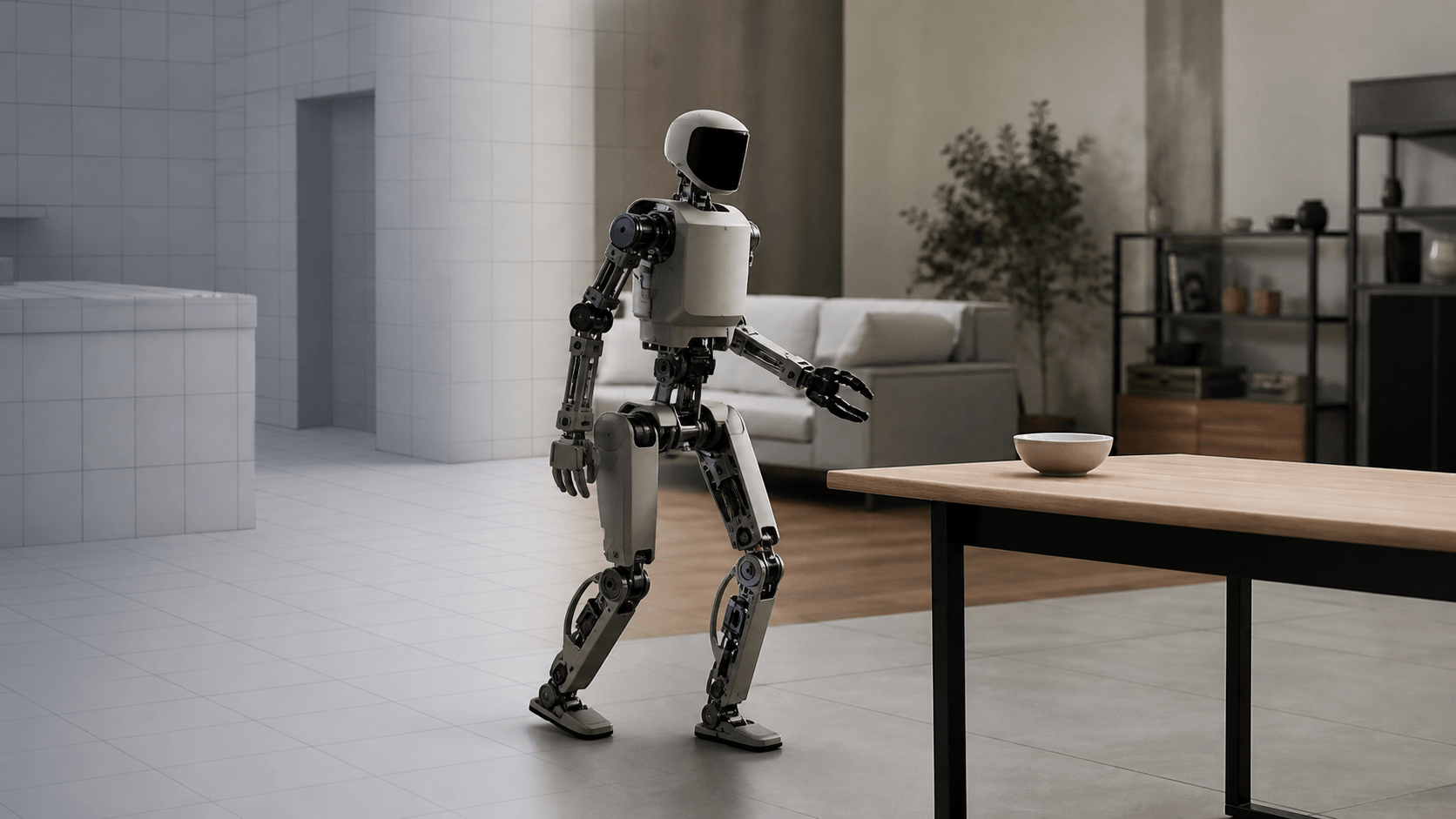
FetchMan is a research system for training a humanoid robot to walk toward an object, pick it up and carry it to a target location. The project asks whether large quantities of procedurally generated simulation data can produce a useful physical robot policy without collecting real-world demonstrations.
The researchers trained a whole-body policy for a Unitree G1 humanoid equipped with Dex1-1 grippers. Its inputs combine a head-mounted fisheye camera, wrist cameras and proprioceptive state. Its output is a 15-dimensional command sent at 10 Hz to a lower-level locomotion controller. According to the preprint, no real-world data was used during either imitation learning or reinforcement learning.
The central result is not simply that synthetic data transferred to hardware. It is that adding more demonstrations eventually stopped improving the policy, while reinforcement learning pushed it beyond that behavior-cloning plateau. On a 100-initialization simulation benchmark, full locomotion-and-manipulation success rose from 67% to 83%. In the reported physical trials, it rose from 56.7% to 73.3%.
What the researchers did
The team built scripted demonstrations inside MolmoSpaces, a simulated environment system using scenes derived from ProcTHOR-10k, Holodeck and ProcTHOR-Objaverse. A privileged demonstrator could see simulator state unavailable to the learned policy. It followed a hidden sequence—reach, descend, close and lift—while the environment randomized textures, lighting, camera placement, object pose and action noise.
For the main single-object experiment, the researchers generated 150,000 bowl-picking demonstrations, representing roughly 650 robot-hours across about 150,000 distinct scenes. The paper reports a generation rate of approximately 100 episodes per minute on one NVIDIA L40S GPU, or around 40 GPU-hours in total. Eighty percent of the episodes covered the full fetch task and 20% focused only on picking.
The learned policy used a frozen DINOv3 ViT-B/16 visual encoder, a robot-state token and a diffusion-transformer action head. It predicted chunks of 16 actions, while deployment executed the first eight before replanning. A separate SONIC controller tracked base velocity and height, allowing the learned policy to request motion without directly controlling every leg joint.
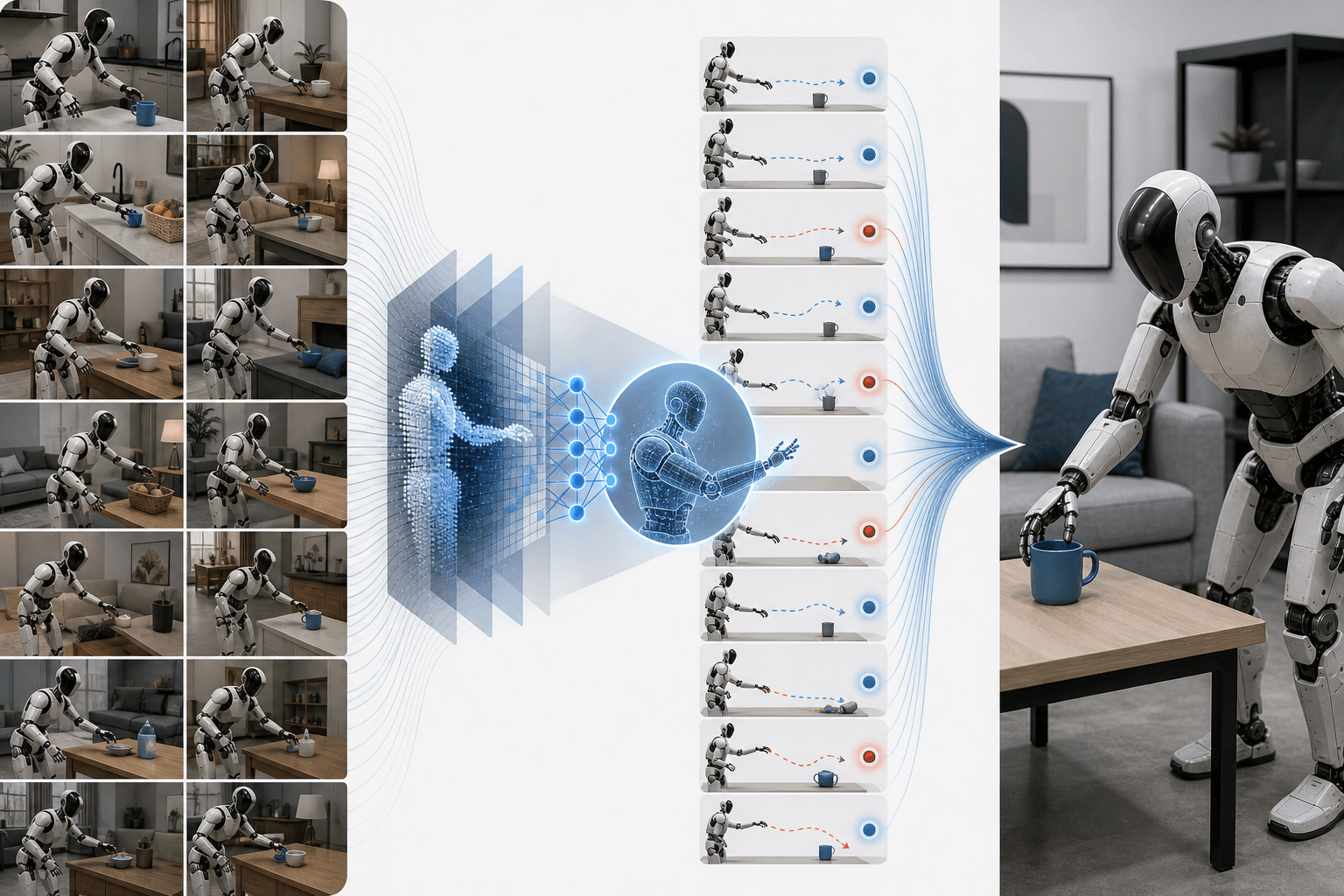
Training had two stages. First, behavior cloning reproduced the scripted synthetic demonstrations. Second, Flow-GRPO reinforcement learning refined the policy using a sparse task-success reward. This second stage did not add physical demonstrations; it searched for more successful behavior through repeated simulation experience.
What they found
Behavior cloning improved sharply as the synthetic dataset grew, but the gains did not continue indefinitely. Full locomotion-and-manipulation success in simulation increased from 40% with 5,000 demonstrations to 67% with 50,000. Expanding the dataset to 150,000 demonstrations left the score at 67%.
Flow-GRPO refinement from the 150,000-demonstration checkpoint raised simulation success to 83%. In physical testing, the paper reports that full-task success increased from 56.7% to 73.3%, while manipulation-only success moved from 72.7% to 77.2%. Those hardware figures came from 30 full-task trials and 22 manipulation trials.
The starting policy mattered. Reinforcement learning applied to the weaker 5,000-demonstration checkpoint peaked at 42% without a clear upward trend. The ablations also suggest that design choices were important: replacing DINOv3 with SigLIP produced 42% simulation success and no successful full physical trials, while absolute rather than relative actions reached 45% in simulation and likewise recorded no full physical-task success.
The researchers also trained a multi-object model on 350,000 demonstrations. Reinforcement learning raised its simulated full-task score from 40% to 62%. The paper shows qualitative zero-shot hardware examples, but describes this version as less robust and does not provide the same headline physical evaluation.
What the result does not prove
FetchMan does not establish that a humanoid can learn unrestricted household work from simulation. The evaluated behavior is a constrained reach-and-pick pipeline, and the strongest hardware evidence covers a modest number of trials. “Zero-shot” here means transfer without real-world training data or per-scene tuning; it does not mean generalization to arbitrary tasks, objects or buildings.
The policy is stateless and acts from the current observation rather than a history of previous observations. Its lower body is managed by a fixed SONIC controller, so the learned system cannot independently widen its stance, brace against a heavy object, adapt its gait or recover outside that controller’s operating envelope. The work is also a preprint and has not yet passed peer review.
Practical relevance
The study offers a useful warning for teams scaling synthetic demonstrations: more imitation data can stop producing meaningful improvement even when generation remains cheap. A second optimization stage may be necessary to discover actions that a scripted teacher does not express well or to correct compounded errors during long-horizon behavior.
It also illustrates a practical division of labor. A learned vision-and-action policy handles task-level decisions, while a specialized controller stabilizes locomotion. That separation can accelerate experimentation, although it limits the kinds of whole-body adaptation the policy can learn.
Most importantly, FetchMan treats simulation not only as a source of demonstrations but as an environment for improving a policy after imitation has saturated. The physical gains reported by the authors make that combination worth testing on broader tasks, though they are not yet evidence of a deployable general-purpose humanoid.
What to watch next
The next test is breadth. A stronger follow-up would quantify multi-object physical performance, include unfamiliar object shapes and clutter, and report results across more rooms and robot units. Longer trials would help reveal recovery behavior and failure accumulation.
Another question is whether observation history or memory can improve robustness when an object is temporarily hidden or a grasp fails. Jointly learning more of the lower-body behavior could also show whether reinforcement learning can produce useful bracing, foot placement and recovery rather than relying on a fixed locomotion envelope.
Finally, independent reproduction would clarify how much of the result depends on the specific simulator assets, visual encoder, controller and hardware configuration. The paper’s most consequential claim is a method pattern—large synthetic imitation followed by simulation-based reinforcement learning—not a finished household robot.
Sources & evidence
- FetchMan: Scaling Synthetic Data for Zero-Shot Humanoid Mobile Manipulation — primary preprint; methods, experiments, limitations and reported results.
- FetchMan full HTML paper — primary source used for implementation details, ablations and evaluation tables.
- MolmoSpaces official repository — official software and environment context for the simulation system used by FetchMan.
- MolmoSpaces research paper — primary technical background on the environment ecosystem.
- Unitree G1 official product page — manufacturer context for the physical robot platform.
- Unitree Dex1-1 official product page — manufacturer context for the gripper hardware.
Sources
Primary research
-
Rayyan, Omar; Li, Zhi; Argus, Max; Jiang, Yuxin; Yu, Chang; Jiang, Chenfanfu; Cui, Yuchen. “FetchMan: Scaling Synthetic Data for Zero-Shot Humanoid Mobile Manipulation.” arXiv:2608.17027, submitted August 17, 2026; revised August 29, 2026.
https://arxiv.org/abs/2608.17027 -
Full HTML version of the FetchMan preprint. Used for training configuration, benchmark definitions, ablations, physical trial counts and limitations.
https://arxiv.org/html/2608.17027 -
FetchMan project page, as listed by the paper.
https://www.orayyan.com/fetchman
Simulation environment context
-
Allen Institute for AI. MolmoSpaces official GitHub repository.
https://github.com/allenai/molmospaces -
“MolmoSpaces: A Large-Scale Open Ecosystem for Embodied AI.” arXiv:2602.11337.
https://arxiv.org/abs/2602.11337
Hardware context
-
Unitree Robotics. G1 humanoid official product page. Manufacturer source used only for platform context.
https://www.unitree.com/g1/ -
Unitree Robotics. Dex1-1 gripper official product page. Manufacturer source used only for hardware context.
https://www.unitree.com/Dex1-1/
Source hierarchy note
The FetchMan paper is the controlling source for all research claims and reported results. MolmoSpaces and Unitree materials provide official technical context but do not independently verify the paper’s performance claims.