
Research at a glance
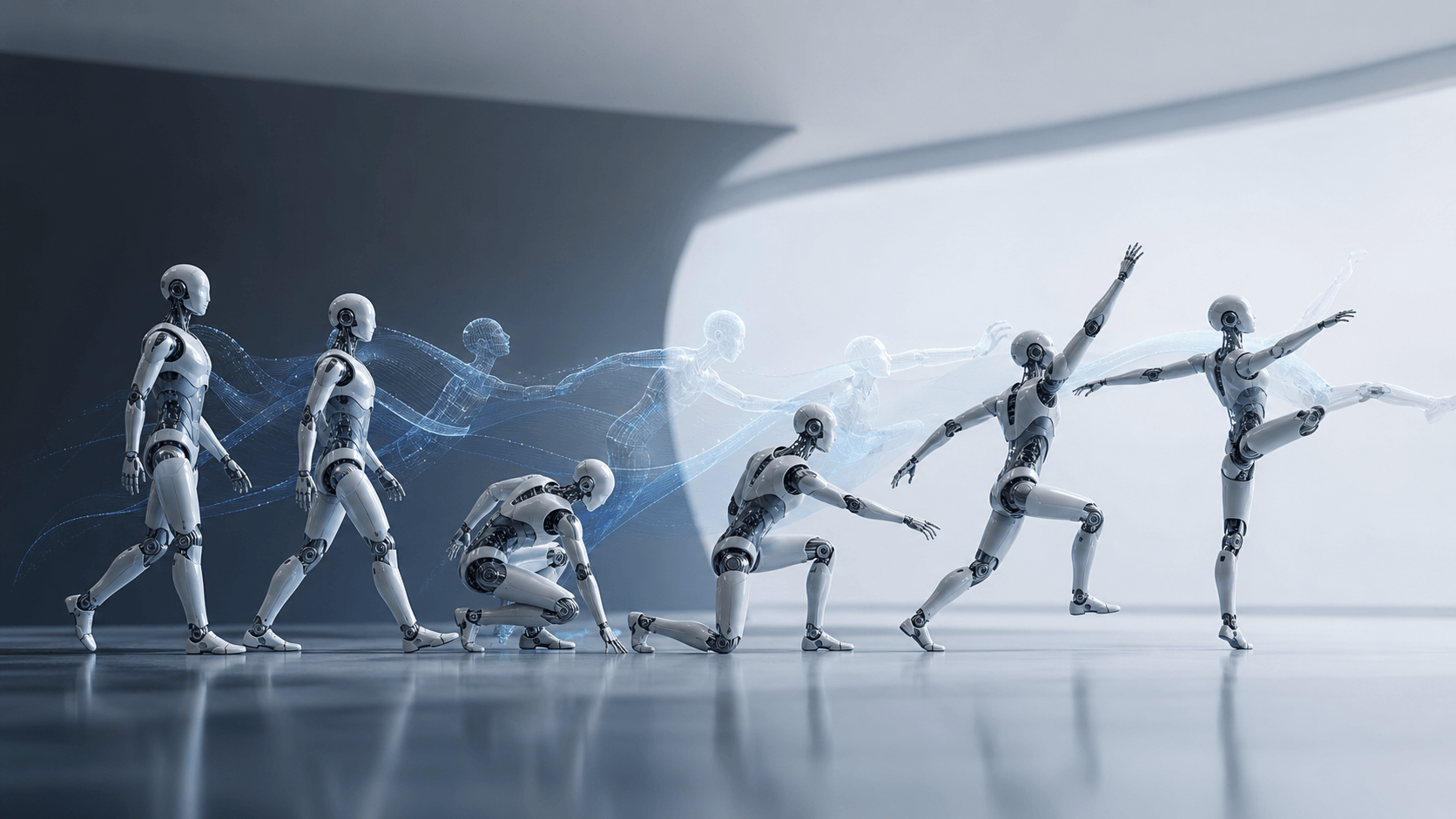
SONIC is a whole-body motion controller built to test a straightforward question: does humanoid control improve predictably when researchers increase model size, motion data and training compute? The work treats motion tracking—the ability to make a robot reproduce a reference movement—as a foundational task that can sit beneath teleoperation, autonomous planning and learned task policies.
The researchers trained SONIC for a 29-joint Unitree G1 humanoid. Across their scaling study, models ranged from 1.2 million to 42 million parameters, training data grew from 4 million to 100 million motion frames, and compute increased from 2,000 to 21,000 GPU-hours. The largest system was trained on more than 600 hours of filtered motion data spanning walking, dancing, sports and other whole-body behaviors.
The strongest result is evidence of consistent improvement within those tested ranges. On a held-out content split, the 42-million-parameter model reached 99.6% simulated tracking success and 23.8 millimeters of local mean per-joint position error, compared with 98.0% and 27.7 millimeters for the 1.2-million-parameter model. This is not a universal law of humanoid intelligence, but it is a measured scaling trend for a clearly defined control problem.
What the researchers did
The team converted human and robot motion into a shared representation and trained a single policy to track reference sequences. The dataset combined different motion sources, then filtered and retargeted them to the G1 body. The final training collection contained more than 100 million frames sampled at 50 Hz—about 611 hours—from 317,000 clips covering 33 broad categories.
Three experiment series varied one resource at a time. The model study compared policies with 1.2 million, 16 million and 42 million parameters. The data study used 4 million, 10 million, 22 million and 100 million frames. The compute study used approximately 2,000, 9,000 and 21,000 GPU-hours. Scaling results were evaluated six times, with the paper reporting means, standard deviations and Welch t-tests.
The researchers also tested whether the motion tracker could become a common action interface. Human motion, robot motion and hybrid commands were represented in the same token space. That let input systems—including virtual reality, video-derived motion, text- or music-conditioned generation and a vision-language-action model—request movements while SONIC handled low-level tracking on the robot.
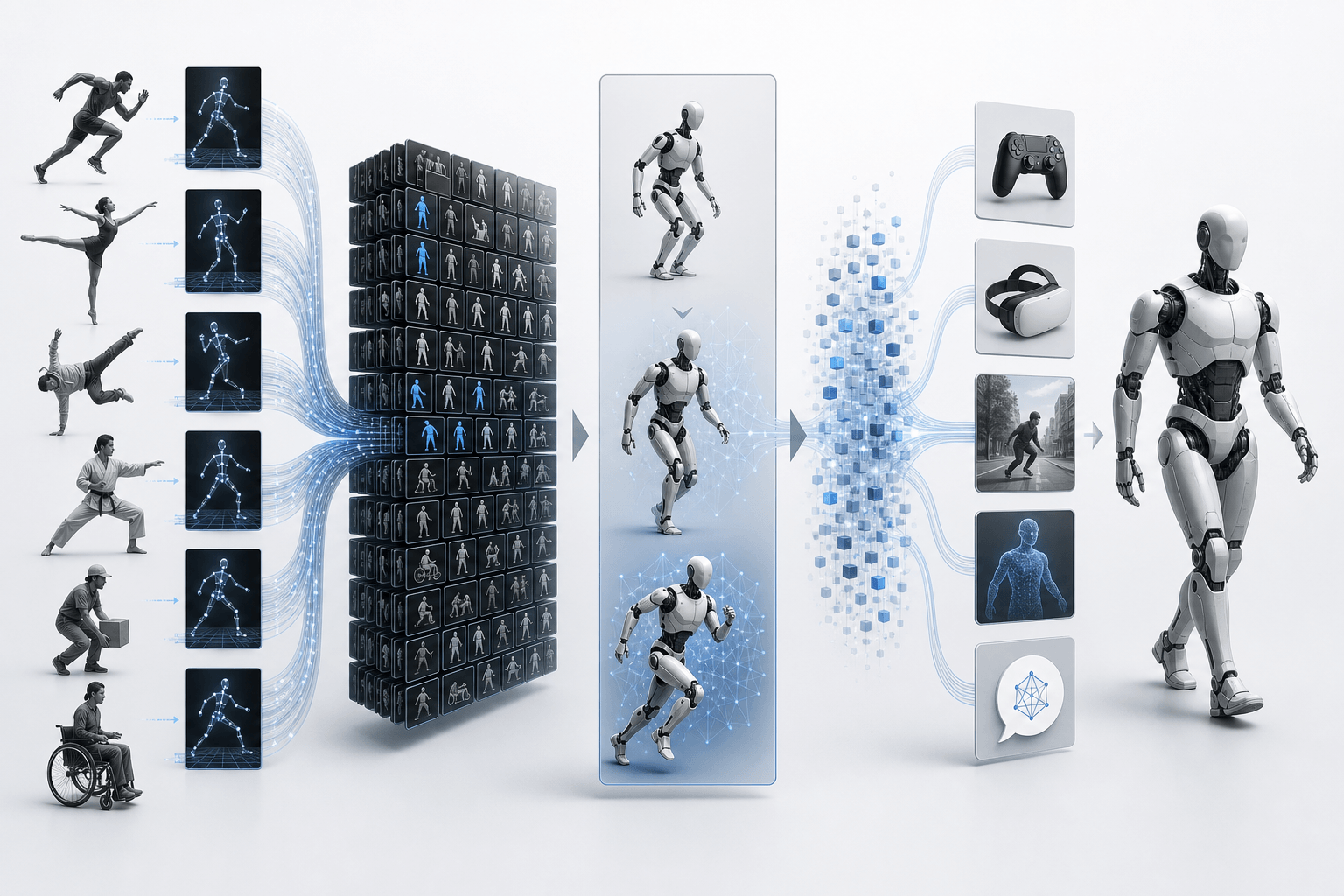
AI-generated illustration (not a photograph or measured data).
What they found
Performance improved along all three tested axes. The paper reports statistically significant gains for model size, data and compute, with P values no greater than 0.011 in the reported comparisons. On the held-out content split, the largest model’s 99.6% success rate exceeded the smallest model’s 98.0%, while its joint-position error was lower. The numerical change in success is small because the benchmark is already near saturation, but the error reduction indicates more precise tracking.
The authors then selected 124 motions for physical testing. All 124 succeeded in simulation, and 123 completed on the real robot, with one trial per motion. In a separate velocity-tracking comparison, SONIC survived 197 of 200 evaluation runs, or 98.5%, while the specialist OpenHomie baseline survived 86, or 43.0%, under the authors’ test conditions.
SONIC also served as the controller for five reported vision-language-action tasks. In an action-representation ablation, a discrete token interface averaged 68% success, compared with 27% for explicit SMPL pose commands. The largest difference appeared in a soda-can disposal task: 60% versus 0%. Each task was evaluated over only 10 to 20 trials, so these results are evidence for the interface design rather than a broad autonomy benchmark.
What the result does not prove
SONIC does not demonstrate a general-purpose autonomous humanoid. Its main achievement is reference-motion tracking, and the downstream systems still need another source—an operator, generator, planner or VLA model—to decide what motion should happen. The experiments use one robot embodiment, so the scaling trend has not been shown to transfer across different humanoid bodies.
The physical-motion set includes one attempt per sequence, which does not measure repeatability over long deployments. The paper also identifies balance failures during extreme motions and does not formally evaluate safety, energy consumption or extended operation. Results from the authors’ simulator and hardware should therefore remain attached to those conditions.
Practical relevance
Humanoid developers often build separate controllers for walking, reaching, dancing or recovering posture. SONIC suggests that a sufficiently broad motion tracker can instead act as reusable control infrastructure. A planning system could issue a common motion representation while the tracker converts it into stable joint actions.
That separation may also make high-level robot learning easier. A VLA policy would not need to produce every motor command directly; it could operate through a learned motion vocabulary. The reported TensorRT deployment ran policy inference in roughly one to two milliseconds on a Jetson Orin, indicating that the large controller was fast enough for the team’s 50 Hz control loop.
The broader research implication is more cautious: scaling resources can improve humanoid control before researchers invent a new controller for every behavior. The paper supplies quantitative evidence for that claim, not proof that scale alone resolves perception, planning, safety or commercial reliability.
What to watch next
The clearest follow-up is cross-embodiment testing. If similar trends appear on robots with different proportions, actuators and hands, SONIC’s scaling argument would become more general. Independent reproduction using the released code and public BONES-SEED motion subset would also reveal which gains depend on data curation, simulator design or proprietary training resources.
Longer physical evaluations should measure repeated success, falls, recovery, power use and thermal limits. More demanding downstream tasks could test whether the shared token space remains useful when manipulation requires precise contact, environmental feedback and rapid replanning. Finally, scaling beyond 42 million parameters and 100 million frames may show whether the reported curves continue, flatten or encounter a new bottleneck.
Sources & evidence
- SONIC: Supersizing Motion Tracking for Natural Humanoid Whole-Body Control — peer-reviewed journal record and controlling publication source.
- SONIC official project page — official videos, system overview and links to paper resources.
- SONIC full paper on arXiv — primary source for methods, scaling experiments, evaluation details and limitations.
- GR00T Whole-Body Control repository — official public code release.
- BONES-SEED dataset — public motion-data subset associated with the work.
- SONIC research archive — archived code snapshot and tabulated figure data.
Sources
Primary publication
-
Luo, Zhengyi; Yuan, Ye; Wang, Tingwu; et al. “SONIC: Supersizing Motion Tracking for Natural Humanoid Whole-Body Control.” Science Robotics, Vol. 11, Issue 117, 2026. DOI: 10.1126/scirobotics.aed4592. Controlling source for publication status and the reported research results.
https://www.science.org/doi/abs/10.1126/scirobotics.aed4592 -
SONIC full HTML paper, arXiv:2511.07820v4. Used for methods, dataset composition, scaling configurations, statistical reporting, physical evaluations, action-space ablations and limitations.
https://arxiv.org/html/2511.07820v4 -
SONIC arXiv record. Used for version history, abstract and author list.
https://arxiv.org/abs/2511.07820
Official research materials
-
NVIDIA GEAR Lab. SONIC official project page. Used for the official system summary, media context and artifact links.
https://nvlabs.github.io/GEAR-SONIC/ -
NVIDIA Research. SONIC publication record. Used for institutional and publication context.
https://research.nvidia.com/labs/dair/publication/sonic2026/ -
NVIDIA. GR00T Whole-Body Control official GitHub repository. Public implementation resource.
https://github.com/NVlabs/GR00T-WholeBodyControl -
BONES Studio. BONES-SEED dataset. Public motion-data subset with SOMA and G1 representations.
https://huggingface.co/datasets/bones-studio/seed -
SONIC research archive on Zenodo. Archived code snapshot and tabulated figure data. DOI: 10.5281/zenodo.21273312.
https://doi.org/10.5281/zenodo.21273312
Source hierarchy note
The peer-reviewed Science Robotics paper and its full author manuscript control all technical and performance claims. Official project, code, dataset and archive pages provide implementation and artifact context; they do not constitute independent validation of the reported results.