
1. Core conclusion
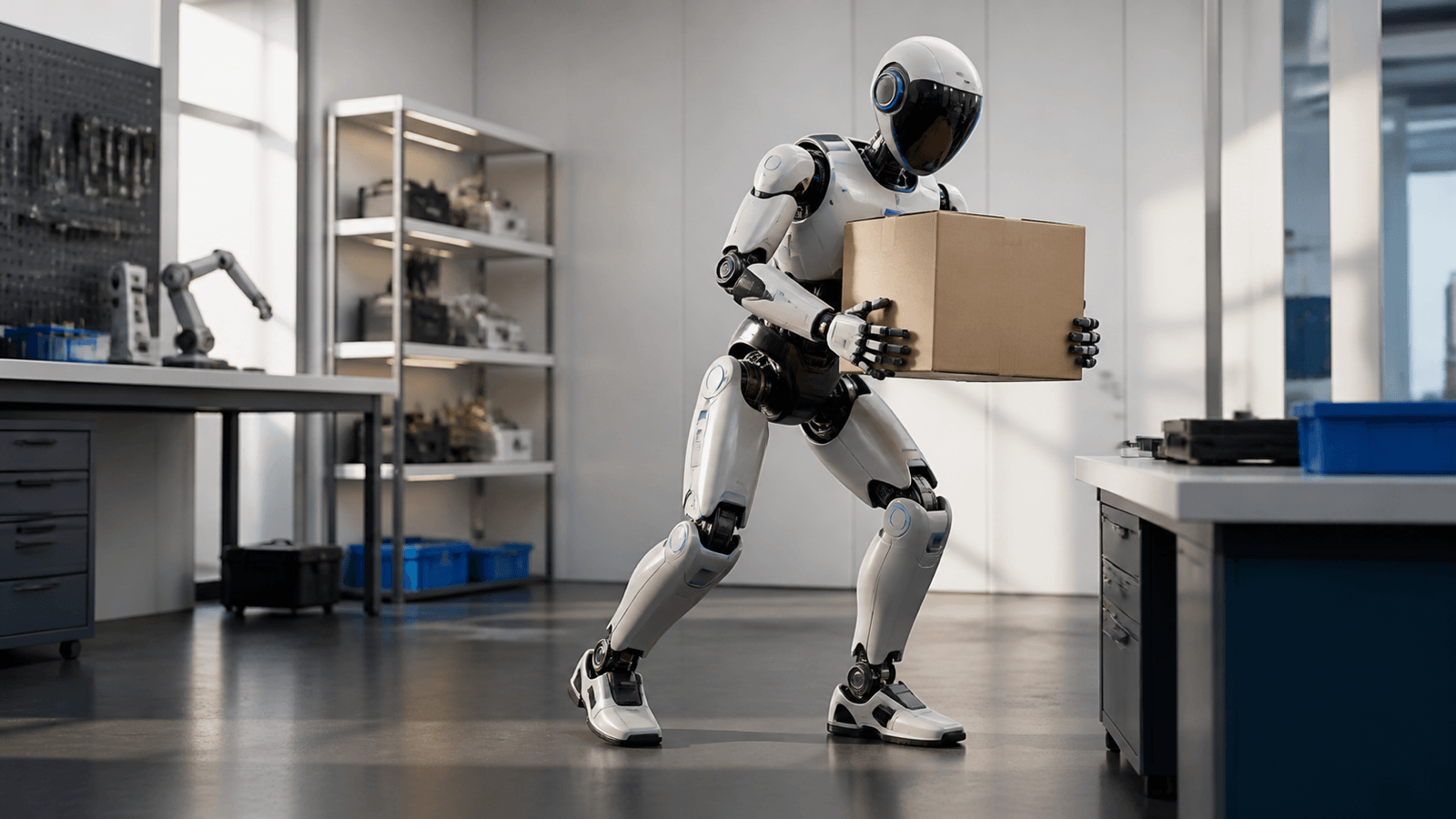
Humanoid loco-manipulation is shifting from a convenient software division—an upper body that manipulates while a lower body follows coarse walking commands—toward policies that represent the robot as one coupled physical system. The change matters whenever reaching, carrying, pushing or using a foot alters balance and locomotion at the same time. Recent systems unify control in different ways: a multimodal policy distilled from motion tracking, a single whole-body policy trained from deliberately separated motion-data roles, or a world-action model that predicts shared motion tokens for legs, torso and hands. Their results show better coordination within selected tasks and embodiments, but not a universal humanoid controller. Data quality, perception, real-time inference, contact safety and hardware transfer remain decisive limits.
2. The problem
The upper-body–lower-body split is attractive because it isolates two hard problems. A high-level policy can command the arms and hands, while a proven locomotion controller keeps the robot upright and tracks a base velocity. For tasks performed from a stable stance, this can work well. The difficulty appears when manipulation changes the body’s feasible motion. Reaching into a low shelf may require bending the knees and pitching the torso. Carrying a large box changes the center of mass. Opening a heavy door couples hand force, foot placement and body orientation. Kicking an object makes the foot part of the task rather than a passive support.
Separate controllers can issue locally sensible but globally inconsistent commands. The arms may reach beyond the support polygon while the legs continue following a generic gait. A base controller may preserve stability by moving away from the pose needed for the hand to maintain contact. Interfaces that expose only forward velocity, turning and height prevent the task policy from using the full lower body. The problem is not merely smoother animation. It is a mismatch between the robot’s physical coupling and the action space exposed to learning.
Training a unified controller introduces its own conflicts. Large human motion-capture datasets contain expressive upper-body motion, but their locomotion may be too aggressive or poorly matched to a robot. Stable walking clips are cleaner but offer little manipulation diversity. Rewards for hand tracking, balance, velocity, contact and motion style can compete. A policy must also bridge privileged simulation state and noisy onboard sensing without losing the fast response needed to keep a biped upright.
3. How it works
A whole-body policy receives robot proprioception—joint positions, velocities and inertial measurements—plus a task signal. Depending on the system, that signal may be a dense reference motion, target hand poses, desired velocity and height, a sparse object goal, language or egocentric vision. Instead of producing an arm action and a separate base command, the learned representation generates coordinated targets for many joints through one policy or one shared latent action space.
Motion data usually enters through retargeting: converting human motion into trajectories feasible for a robot with different proportions, joints and strength. Physics-aware retargeting uses simulation and contact constraints to avoid poses that look plausible kinematically but cannot be executed. A privileged teacher can learn to track those references with full state information. A student policy is then distilled to operate with the observations available on hardware.
“Unified” does not mean every ingredient must be mixed. CWI, for example, intentionally separates how upper- and lower-body data are used, then trains one deployed whole-body policy. ULTRA unifies dense references and sparse task goals through shared tokens and modality masks. MotionWAM unifies the output representation itself: motion tokens jointly encode locomotion, torso position, height, foot interaction and hand manipulation. These choices place coordination at different points in the learning pipeline.
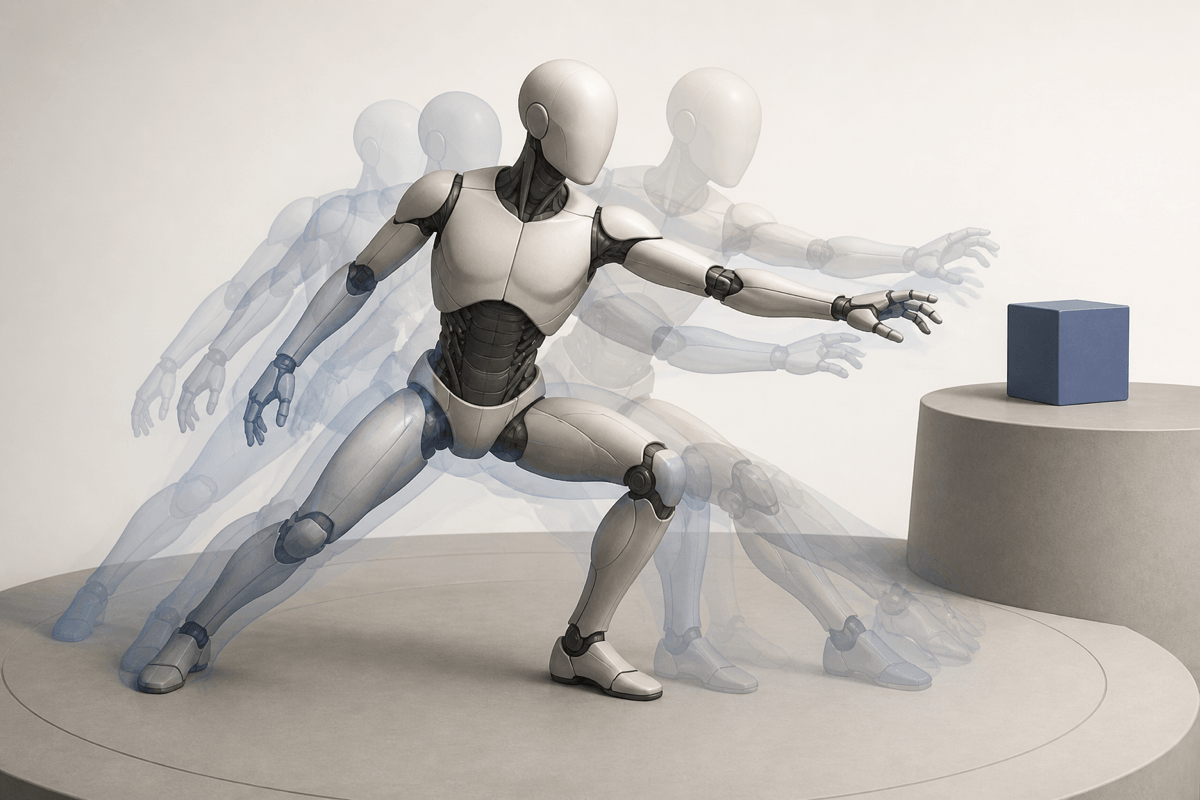
AI-generated illustration (not a photograph or measured data).
4. Representative approaches
ULTRA unifies control modes and available sensing. Its pipeline first uses a physics-driven neural retargeting policy to convert human–object motion into executable humanoid trajectories. A privileged teacher tracks those trajectories; a multimodal student is distilled with an availability mask so the same policy can accept dense references, sparse long-horizon goals, accurate object state or egocentric point clouds. A variational skill bottleneck and reinforcement-learning fine-tuning expand closed-loop behavior beyond replay. This approach aims to preserve precise tracking when references exist while generating behavior from partial perception and sparse intent when they do not. The authors evaluate simulation and real Unitree G1 tasks, but also report failure under severe point-cloud occlusion, marker occlusion and physically inconsistent operator goals.
CWI separates motion-data roles while deploying one policy. It retains broad AMASS motion-capture data for upper-body manipulation, but uses curated walking and squatting clips to guide lower-body style through two adversarial motion-prior discriminators. A multi-critic architecture reduces interference among locomotion, upper-body tracking and style objectives. Teacher–student distillation yields a whole-body controller driven by bimanual hand poses plus velocity and height commands, enabling VR teleoperation without a full-body motion-capture suit. This is an important nuance: CWI rejects separate runtime controllers without claiming that all training data should be treated identically.
MotionWAM gives the full body one learned action vocabulary. It conditions on intermediate features from a video world model rather than waiting for a complete generated video. A three-stage process adapts video dynamics to egocentric views, grounds them across humanoid embodiments and fine-tunes on target real-robot demonstrations. The policy predicts unified motion tokens that include locomotion, torso motion, height, feet and hands. On nine Unitree G1 tasks designed to require active whole-body coordination, the paper reports 76.1% overall success against 43.9% for its strongest baseline, GR00T-N1.7, with 20 trials per task and the same final demonstration set and action interface. This comparison supports the architecture on that suite; it does not establish that world-action models will dominate across other robots or workloads.
5. Real-world applications
Whole-body control matters most where mobility and manipulation cannot be scheduled independently. Examples in the reviewed work include squatting to retrieve objects, carrying boxes, opening doors, loading a cart, wiping a board, handling laundry and deliberately contacting an object with a foot. CWI’s hardware demonstrations on the full-size LimX Oli include door opening, bottle-cap twisting, small-part assembly and a multi-stage pick-carry-place sequence under human teleoperation. ULTRA reports autonomous goal-conditioned behaviors on a Unitree G1 using egocentric perception as well as reference-driven modes. MotionWAM evaluates nine autonomous G1 tasks from one head-mounted camera.
These remain research systems. CWI demonstrates a practical teleoperation interface rather than a high-level autonomous planner. ULTRA and MotionWAM add perception-driven autonomy, but their environments, object sets and task definitions are bounded. None of the papers establishes safe operation around untrained members of the public, reliable performance for a work shift, or transfer across arbitrary commercial humanoid platforms.
6. How it is evaluated
Whole-body evaluation needs multiple measures because staying upright is not enough. ULTRA reports success for humanoid-only and humanoid-plus-object tracking, along with global and local pose errors, jitter, object position and rotation errors, and goal-conditioned success. Its simulation comparison includes in-distribution and out-of-distribution motion. The published table reports different results for the multimodal student, privileged teacher and tracking policies, underscoring how sensing assumptions affect performance. Real-world G1 demonstrations test the student under onboard perception and other available control modes.
CWI evaluates a 31-degree-of-freedom LimX Oli in IsaacLab and on hardware. Simulation metrics include balance-and-tracking success, key-body position and orientation error, commanded velocity, yaw-rate and base-height error. Its ablations examine the multi-critic, teacher–student distillation, separate adversarial priors and AMASS upper-body data. The deployment evidence is qualitative across several teleoperated tasks. The paper states that CWI achieves the strongest overall metric trade-off, while one reimplemented baseline has a success rate higher by less than 0.1%. Because the baselines were reimplemented with unified observations, rewards and gains, these are framework comparisons inside the authors’ setup rather than reproduced native-system results.
MotionWAM uses nine physical tasks, 20 trials per task and five baselines. All policies receive the same egocentric RGB, language goals and proprioception, are fine-tuned on the same Stage 3 demonstrations, and emit through the same SONIC interface. The reported 76.1% average is 32.2 percentage points above GR00T-N1.7’s 43.9%. The paper also reports a 4.9 Hz chunk-generation rate on one NVIDIA A100, compared with 6.5 Hz for GR00T-N1.7 in its efficiency table. Real-time balance depends on the surrounding low-level interface as well as this chunk rate.
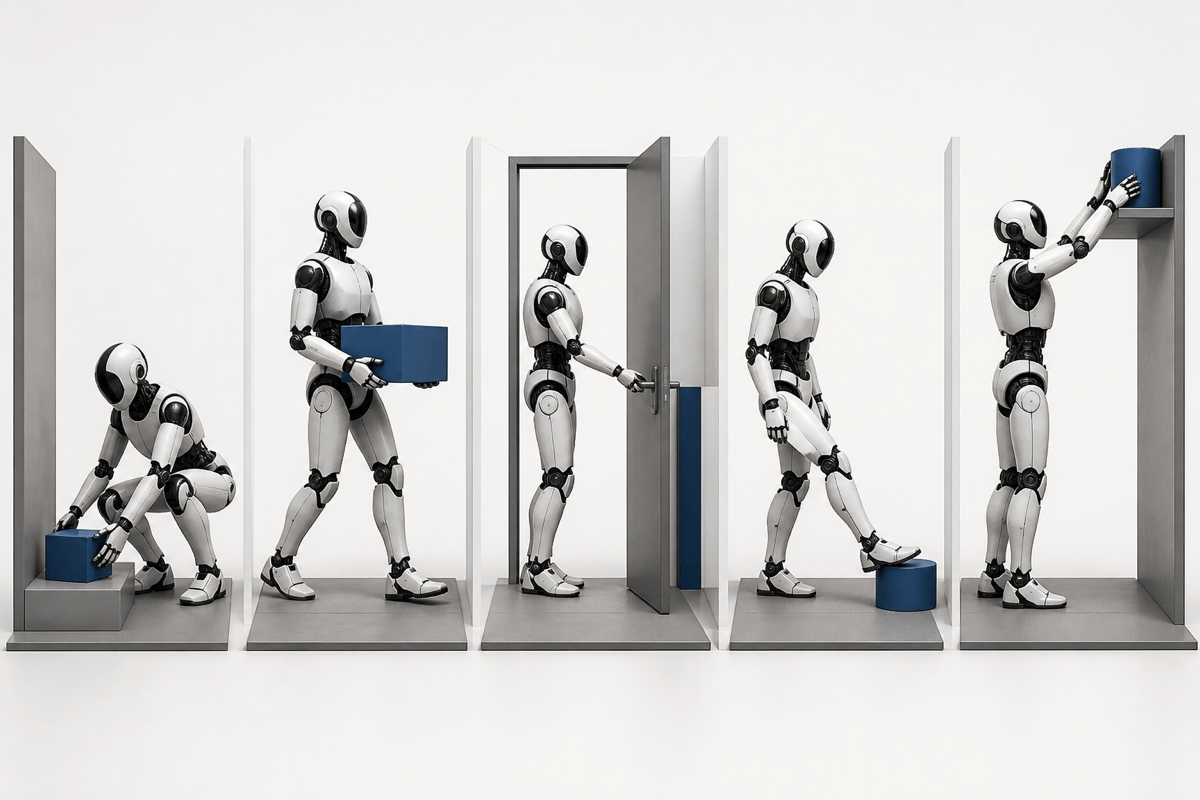
AI-generated illustration (not a photograph or measured data).
7. Current limitations
Unified control increases the consequence of an error. A mistaken task representation can affect feet, torso and hands simultaneously. Safety therefore depends on low-level limits, fall mitigation, contact monitoring and conservative operating regions that may sit outside the learned policy. Whole-body demonstration data are also difficult to collect and retarget. Human bodies and robot bodies differ in mass distribution, joint ranges, actuation and contact geometry; simulation can enforce approximate physics without reproducing every floor, object or actuator behavior.
The systems remain embodiment-specific at critical stages. ULTRA’s deployment centers on Unitree G1, CWI on LimX Oli and MotionWAM’s final evaluation on a modified G1 setup. Each depends on its own command space, controller interface and sensing. CWI explicitly cannot accept arbitrary whole-body joint or contact commands, such as intentionally pressing a pedal with the foot. ULTRA reports sensitivity to severe point-cloud and motion-capture marker occlusion. MotionWAM relies on target demonstrations and a substantial inference stack; its nine-task suite is not an endurance or cross-site test.
Benchmarks also emphasize success and tracking more than consequence. A controlled kick or box lift proves that the lower body can participate in a task, not that the policy will choose safe contacts near people. Comparisons across papers are especially weak because tasks, humanoid dimensions, low-level controllers, data and reset rules differ. Broader claims need matched evaluations across robots, unseen terrain, payload changes, sensor faults and long-duration sequences.
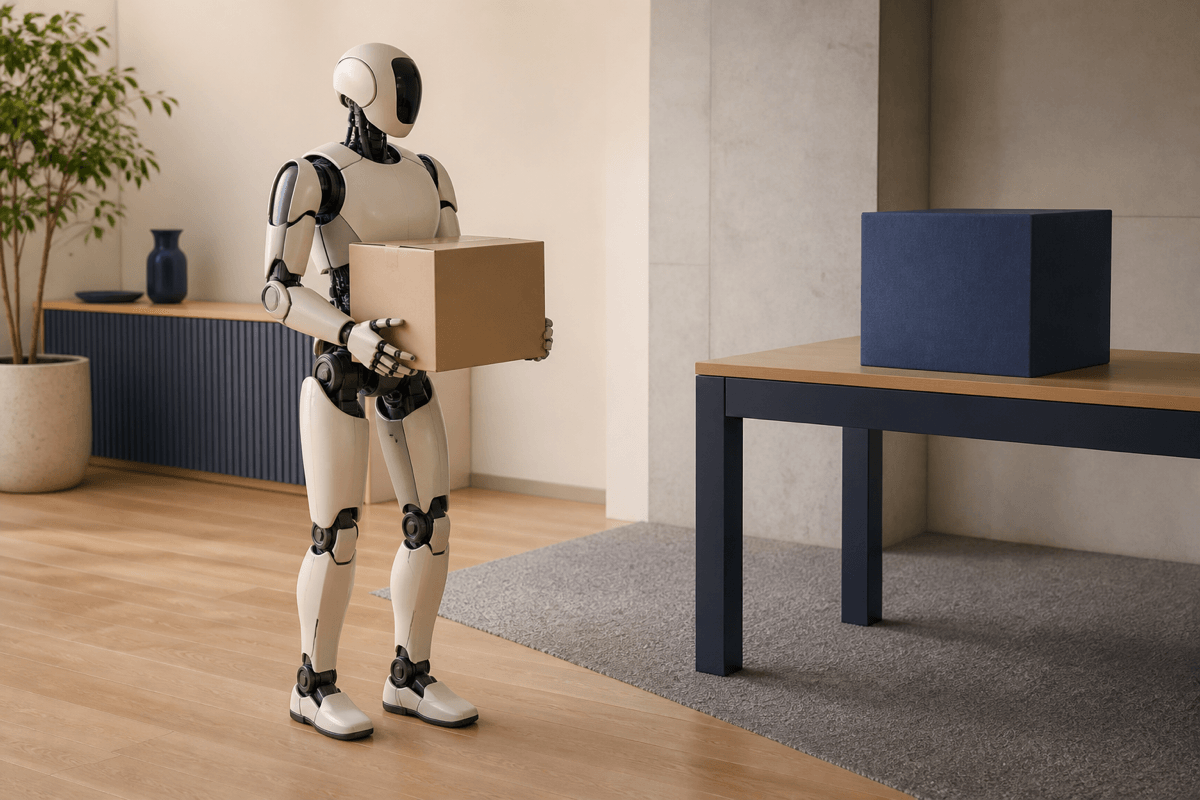
AI-generated illustration (not a photograph or measured data).
8. Why it deserves attention
Humanoid form is useful only if the body’s many degrees of freedom become a coordinated resource. Treating legs as a balance appliance wastes the reach, posture and contact options that distinguish a humanoid from a mobile manipulator on wheels. The recent work is notable because it moves unity from a slogan into concrete design choices: shared motion latents, physics-aware data, modality masking, composite objectives and task-driven foot behavior.
The next convincing evidence would be standardized tests that preserve identical hardware and low-level safety controls while comparing split and unified policies. Results should include falls, interventions, contact forces, energy use, payload variation and recovery—not just task success. Cross-embodiment transfer without retraining, sustained operation under onboard compute and safe behavior around changing human activity would show that unified whole-body control is becoming a deployable capability rather than a collection of laboratory skills.
9. Sources & evidence
- Xialin He et al., “ULTRA: Unified Multimodal Control for Autonomous Humanoid Whole-Body Loco-Manipulation,” arXiv, 3 March 2026.
- ULTRA authors, “ULTRA project page,” 2026.
- Wenqi Ge et al., “CWI: Composite Humanoid Whole-Body Imitation System for Loco-manipulation,” arXiv, 26 June 2026.
- CWI authors, “CWI project page,” 2026.
- Jia Zheng et al., “MotionWAM: Towards Foundation World Action Models for Real-Time Humanoid Loco-Manipulation,” arXiv, 8 June 2026.
All numerical results and demonstrations are attributed to their authors and remain limited to the reported embodiments, training data, sensors, baselines, task definitions and trial protocols.
Sources — Unified humanoid whole-body control
-
ULTRA: Unified Multimodal Control for Autonomous Humanoid Whole-Body Loco-Manipulation
- Authors: Xialin He, Sirui Xu, Xinyao Li, Runpei Dong, Liuyu Bian, Yu-Xiong Wang and Liang-Yan Gui
- URL: https://arxiv.org/abs/2603.03279
- Published: 2026-03-03
- Accessed: 2026-09-01
- Type: Primary paper
- Supports: Physics-driven neural retargeting, privileged-teacher/student pipeline, modality masking, sparse goal conditioning, simulation metrics, G1 deployment and stated failure conditions.
-
ULTRA project page
- Institution: ULTRA research team
- URL: https://ultra-humanoid.github.io/
- Published: 2026
- Accessed: 2026-09-01
- Type: Official project documentation
- Supports: Real-world demonstration scope and control modes.
-
CWI: Composite Humanoid Whole-Body Imitation System for Loco-manipulation
- Authors: Wenqi Ge, Junde Guo, Zhen Fu, Shunpeng Yang, Jiayu Chen and Hua Chen
- URL: https://arxiv.org/abs/2606.27676
- Published: 2026-06-26
- Accessed: 2026-09-01
- Type: Primary paper
- Supports: Decoupled motion-data roles, dual AMP discriminators, multi-critic training, teacher–student distillation, simulation evaluation and LimX Oli deployment limitations.
-
CWI project page
- Institution: LimX Dynamics and university collaborators
- URL: https://cwi-ral.github.io/CWI-RAL-Webpage/
- Published: 2026
- Accessed: 2026-09-01
- Type: Official project documentation
- Supports: 31-DoF platform, VR teleoperation interface, real-world task examples and qualitative demonstrations.
-
MotionWAM: Towards Foundation World Action Models for Real-Time Humanoid Loco-Manipulation
- Authors: Jia Zheng, Teli Ma, Yudong Fan, Zifan Wang, Shuo Yang and Junwei Liang
- URL: https://arxiv.org/abs/2606.09215
- Published: 2026-06-08
- Accessed: 2026-09-01
- Type: Primary paper
- Supports: Intermediate video-denoising features, unified motion latent, three-stage training, nine-task Unitree G1 evaluation, 20 trials per task, success rates and inference frequency.