
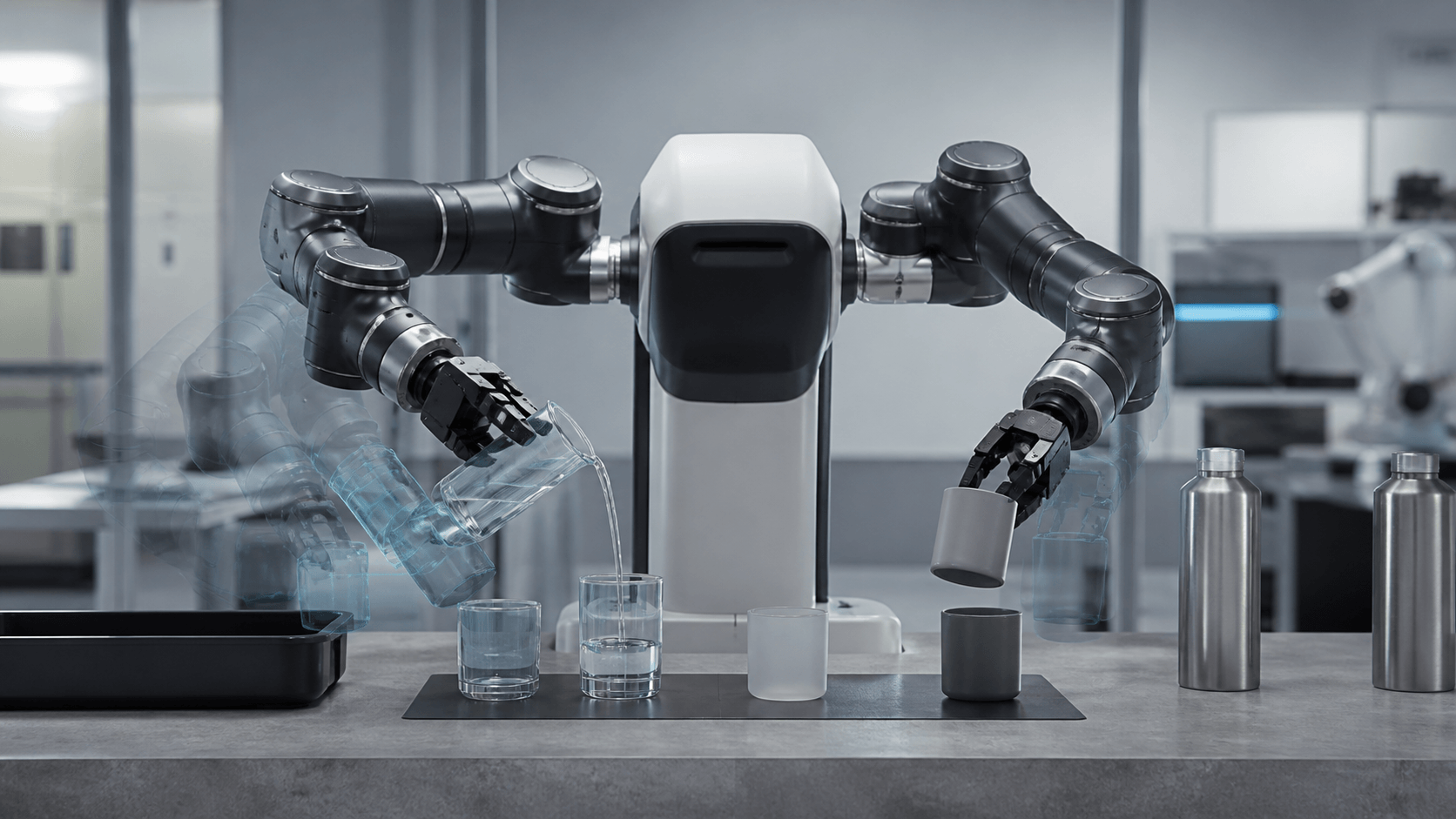
Research at a glance
TemporalFlow-VLA is a preprint released on August 27, 2026, by researchers from the Hong Kong University of Science and Technology (Guangzhou), Zhejiang University, Simon Fraser University, and AgiBot. The team asks a deceptively simple question: when a robot sees the current scene, can it also understand what its immediately preceding actions changed?
That distinction matters in multi-stage manipulation. A cup may look nearly identical before a failed grasp and after a successful repositioning. A gripper at the same location may be approaching an object, carrying it, or recovering from an error. The paper’s central result is that a compact representation trained to encode recent physical motion improved performance most clearly on tasks with several sequential stages.
What the researchers did
The researchers added a parallel temporal pathway to a pretrained vision-language-action policy based on π0.5. The standard policy still receives the current image, language instruction and robot state. The new pathway also receives head-camera observations from 15 and eight steps earlier. Because the policy predicts 16-step action chunks, those frames roughly represent the beginning and midpoint of the previous chunk.
Instead of giving every historical image patch directly to the action model, TemporalFlow-VLA compresses history into two learned queries. One describes the recent interval from step minus eight to the present; the other covers the longer interval from step minus 15. During training, recorded joint states, the robot’s geometry and calibrated camera parameters are used to calculate how visible robot surfaces moved across the image. This “robot-surface temporal flow” supervises the two queries. The action model can read the queries, but not the old image patches themselves.
The geometric pipeline is training-only. At deployment, the model retains the historical images or their cached visual features, the two temporal queries and the action generator; it does not render robot geometry or reconstruct flow. The team evaluated the system on four LIBERO suites, 12 RoboTwin 2.0 tasks under clean and randomized conditions, and two physical three-stage tasks on an AgiBot A3. All main policies were trained on eight NVIDIA H100 GPUs. RoboTwin training used 50 clean and 500 randomized demonstrations per task, while each physical task used 280 demonstrations.
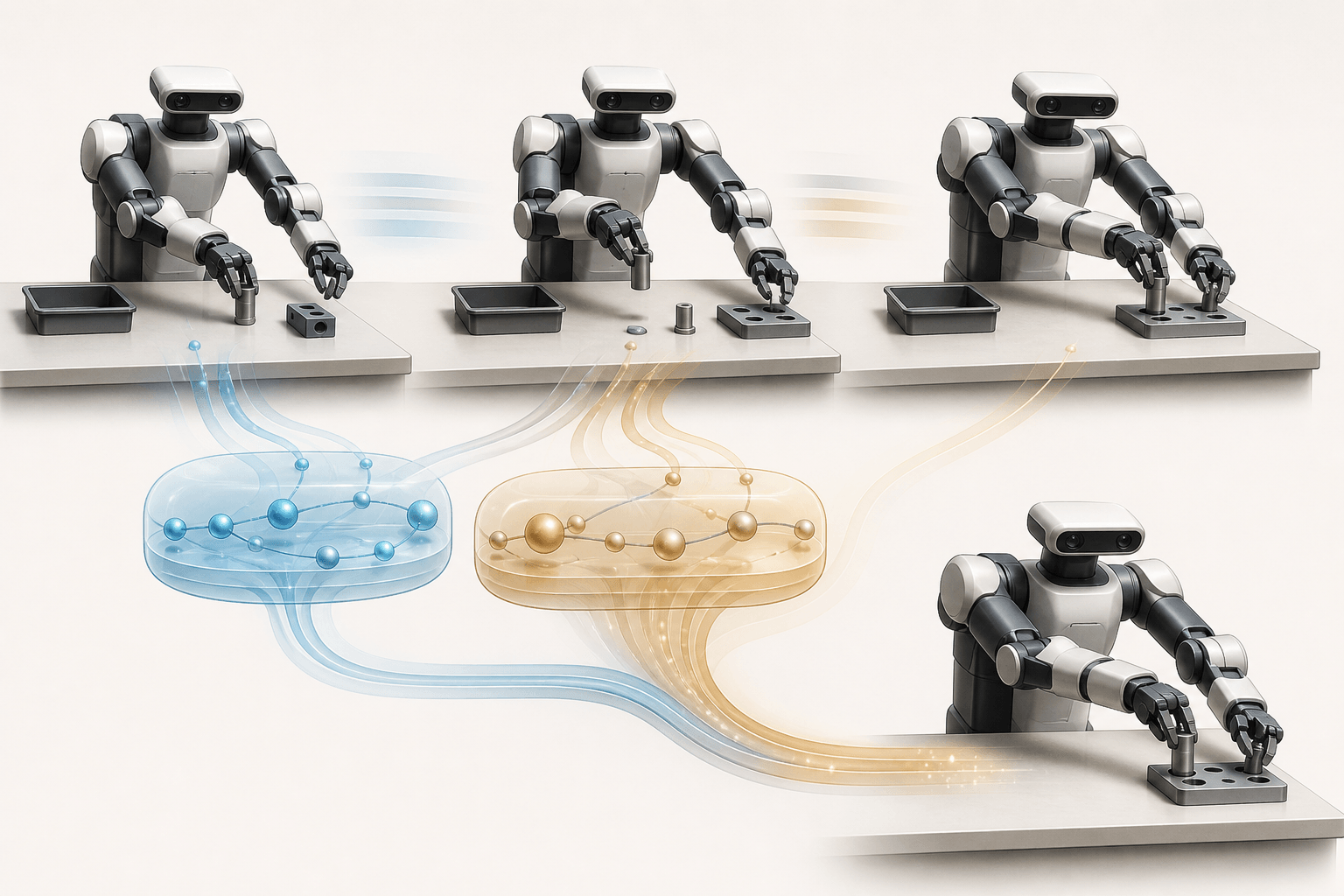
AI-generated illustration (not a photograph or measured data).
What they found
On LIBERO, TemporalFlow-VLA reported an average success rate of 97.63 ± 0.26% across three seeds, using 500 rollouts per suite and seed. Its clearest result appeared on LIBERO Long: 96.60 ± 0.87%, 2.1 percentage points above the strongest prior mean listed in the paper. The shorter suites were already close to saturation, leaving less room for a history-aware method to separate itself.
On 12 RoboTwin tasks, each evaluated over 100 rollouts in clean and randomized settings, the model averaged 85.5% and 84.2% success. The advantage grew with task length. In the three-stage group, randomized success reached 87.5%, 14.5 points above the runner-up group average reported in the comparison. An ablation also found that two flow-supervised queries outperformed both raw multi-frame input and two unsupervised query slots overall.
The physical test covered Three-Cup Stacking and Two-Bottle Packing. Across three rounds of 15 trials per task and method, cup-stacking success increased from 57.8% for the baseline to 77.8% for TemporalFlow-VLA. Bottle-packing success increased from 86.7% to 97.8%. In a separate RTX 4090 timing test on matched successful LIBERO Long rollouts, asynchronous history caching reduced mean server-side sampling time from 68.10 to 62.78 milliseconds per replan.
What the result does not prove
The study does not show that the model has general episodic memory or understands an entire task history. It uses two fixed historical intervals inside a short, predefined window. The authors did not exhaustively test how different frame counts or temporal spacing affect performance.
The physical evidence is encouraging but narrow: two tasks, one AgiBot A3 setup, 280 demonstrations per task and 45 evaluation trials per method and task. It does not establish transfer to other robots, homes, factories, moving people, extended operation or recovery from unrestricted failures. The paper is also a preprint, and its reported comparisons are not an independent reproduction.
Practical relevance
Many robot policies repeatedly decide from a current camera frame. That works when the scene visibly reveals task progress, but it becomes brittle when two visually similar states require different next actions. TemporalFlow-VLA offers one practical design: train a small memory interface to encode a specific physical quantity, then remove the label-generation machinery during deployment.
The caching result also addresses a systems constraint. Historical conditioning is less useful if every replan requires repeatedly encoding old images. Precomputing those features while the robot executes its current action chunk keeps most of that work off the synchronous control path. Whether the same benefit survives real network, sensor and onboard-compute constraints remains conditional on future deployment tests.
What to watch next
The most important next evidence would vary history length and sampling intervals across different task families, rather than fixing two offsets. Independent reproduction should test whether the benefit persists with other VLA backbones, camera configurations and robot embodiments.
Longer physical evaluations should also include interrupted tasks, failed grasps, moved objects and deliberate disturbances. Those tests would reveal whether the temporal queries support genuine recovery or mainly improve progression through familiar multi-stage sequences. Publishing implementation details and training code would make it possible to separate the value of physical-flow supervision from the surrounding model and training recipe.
Sources & evidence
- TemporalFlow-VLA paper and version record, Jiarui Yang et al., August 27, 2026.
- TemporalFlow-VLA full paper, including method, benchmark tables, ablations, latency measurements and physical-robot evaluation.
- RoboTwin 2.0 official project, background on the simulated bimanual benchmark, task suite and domain randomization.
- LIBERO official project, background on the manipulation benchmark suites used in the paper.
Sources — TemporalFlow-VLA
Access date for all web sources: 2026-09-01.
-
TemporalFlow-VLA: Learning Physically Grounded Execution History for Long-Horizon Robot Manipulation — Jiarui Yang, Yehao Lu, Yuning Su, Yu Zhong, Yufeng Xie, Yazhou Zhang, Haiyu Lan, Kaixiang Lu, Peiwen Lin, Chuang Wang, Junwei Liang and Enyu Li. Submitted August 27, 2026. https://arxiv.org/abs/2608.26821
- Supports title, authors, affiliations, publication status, abstract-level contribution and version date.
-
TemporalFlow-VLA full paper, arXiv HTML — Yang et al. Version 1, August 27, 2026. https://arxiv.org/html/2608.26821
- Supports method details, fixed temporal offsets, training-only flow supervision, benchmark setup, tables, ablations, latency test, AgiBot A3 evaluation, limitations and future work.
-
RoboTwin 2.0: A Scalable Data Generator and Benchmark with Strong Domain Randomization for Robust Bimanual Robotic Manipulation — official project page. https://robotwin-platform.github.io/
- Supports background on RoboTwin’s simulation framework, task library, five embodiments and domain-randomization axes. It does not independently validate TemporalFlow-VLA’s results.
-
LIBERO: Benchmarking Knowledge Transfer in Lifelong Robot Learning — official project page. https://libero-project.github.io/
- Supports background on the LIBERO robot-learning benchmark used by the paper. It does not independently validate TemporalFlow-VLA’s results.
Availability note
The paper is a preprint. No separate TemporalFlow-VLA project page, released code repository or released model checkpoint was identified as a source for this article. All reported performance numbers therefore remain author-reported paper results.