
1. What happened
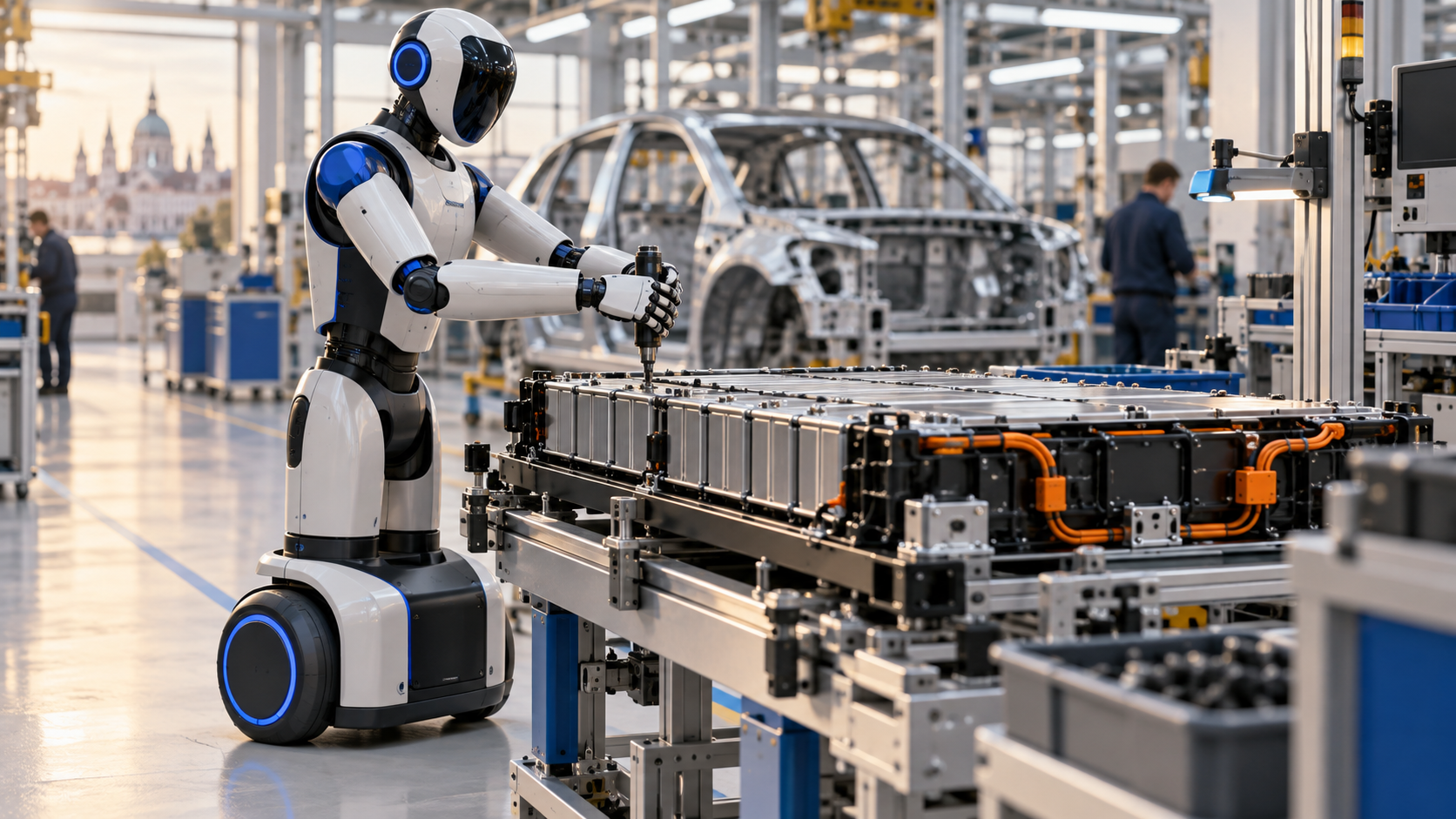
BMW Group says it has introduced Hexagon Robotics’ AEON humanoid into production at its Leipzig plant, describing the programme as the first use of humanoid robots in BMW production in Germany. The pilot focuses on high-voltage battery-module assembly and component manufacturing, where the robot can move materials, use interchangeable tools and perform selected handling tasks.
The September update matters because it places AEON beyond a launch-stage demonstration. BMW describes a sequence that began with theoretical evaluation and laboratory tests, followed by an initial plant deployment in December 2025, another integration test from April 2026 and the full pilot phase beginning in summer 2026.
AEON is not a conventional walking humanoid. Its upper body follows a human-oriented layout, but the platform moves on wheels. That choice trades the ability to step over obstacles for a stable, efficient base suited to smooth factory floors.
2. Confirmed facts
BMW identifies Hexagon Robotics as its partner and says AEON is being used at Plant Leipzig. BMW lists the robot at 1.65 metres tall, 60 kilograms and capable of moving at up to 2.5 metres per second. The body can accept different hands, grippers and scanning tools.
The public deployment sequence is also specific. The first plant test occurred in December 2025. A further test beginning in April 2026 was intended to complete integration before the summer pilot. BMW’s September report shows AEON in battery-module assembly and describes material delivery and obstacle navigation as part of its role.
These statements confirm that a robot is present in the production environment and assigned to defined work. They do not establish the number of production hours, the share of motion performed autonomously or whether the system has achieved a target throughput.
3. Why it matters
Automotive plants are becoming a central test bed for humanoid robotics. Their workflows combine structured production lines with human tools, carts, racks and variable material-handling tasks. A humanoid body can potentially use this infrastructure without rebuilding an entire station, while a mobile base allows one system to move between tasks.
BMW’s staged process is more informative than a one-day demonstration. It suggests that the work includes plant IT, safety, tooling and process integration—not only robot control. If AEON can move between material supply, scanning and assembly-support tasks, its value may come from flexible reuse rather than outperforming dedicated automation at one operation.
The deployment also provides a European counterpart to BMW’s earlier humanoid work in Spartanburg, South Carolina. Different robot designs can now be evaluated inside one manufacturing group, although BMW has not published a direct comparison.
4. Background
Hexagon introduced AEON in June 2025 as a robot for industrial use. The platform combines a humanoid torso with a wheeled base and supports interchangeable end effectors. Hexagon’s wider business in sensors, metrology and industrial software gives the robotics division access to factory data and digital engineering tools that may help integration.
BMW has framed humanoid deployments as part of “physical AI,” in which software models perceive and act through machines in production. That phrase is broad. In practice, a useful factory system also requires deterministic control, task planning, safety functions, reliable localisation, recovery procedures and connections to manufacturing systems.
Plant Leipzig is an important environment for this experiment because it produces vehicles and high-voltage battery modules. Battery work includes repetitive handling and inspection tasks, but it also creates strict requirements for quality, traceability and safe interaction with parts and people.
5. What remains unknown
BMW and Hexagon have not published the number of AEON units in the pilot, cumulative operating hours, throughput, task success rate or human intervention rate. They have not described how much of the battery-module task is performed by the robot, how frequently tools are changed or what recovery procedure follows a failed grasp or navigation stop.
The companies also have not disclosed an application-level safety assessment, the robot’s permitted operating envelope near workers or the degree to which its perception and planning are learned rather than conventionally programmed.
Commercial terms are not public. There is no disclosed purchase volume, price, expansion decision or schedule for deployment beyond the pilot.
6. Editorial analysis
The strongest part of the AEON story is the integration timeline. A robot that returns to a plant through laboratory, interface and production stages provides more evidence than a choreographed showcase. BMW’s public description also identifies real task areas instead of relying only on general claims about future factory work.
The missing performance data prevents a conclusion about commercial readiness. “Introduced in production” can describe a pilot inside a live facility without meaning that the system is responsible for sustained production output. The next threshold is not another video; it is measured work over time, including interruptions, human assistance, maintenance and effects on line performance.
AEON’s wheeled base may be a practical advantage in Leipzig. Factory floors are predictable, and wheels can offer speed, energy efficiency and stable manipulation. The design also narrows where the robot can operate. That is not a weakness if the selected tasks match the platform. It is a reminder that industrial usefulness depends on fit, not on resemblance to a person.
7. Related robot, technology, and company
- AEON at Schaeffler’s Humanoid Gym: another industrial validation environment for the same platform.
- Schaeffler’s AEON validation programme: company-side context on structured testing and workforce interaction.
- Whole-body control: technical background on coordinating a mobile base, torso and arms during manipulation.
8. Sources & evidence
BMW Group’s September 21 report is the principal source. Hexagon Robotics’ deployment page provides manufacturer context. All performance gaps described here reflect information not publicly reported in those materials, rather than a conclusion that the robot failed to meet them. The source list below provides the citations and evidence notes.
Sources
- BMW Group. “BMW Group introduces humanoid robots – a first in Germany.” September 21, 2026. https://www.bmwgroup.com/en/news/general/2026/humanoid-robot-in-leipzig.html
- Hexagon Robotics. “BMW deploys the humanoid robot AEON in production sites in Germany.” 2026. https://robotics.hexagon.com/bmw-deploys-aeon-hexagon-robotics-humanoid/
- BMW Group PressClub. Corporate communication attachment on AEON at Plant Leipzig. 2026. https://www.press.bmwgroup.com/global/article/attachment/T0455864EN/644966
Evidence note
The pilot, task areas, dimensions and timeline are reported by BMW and Hexagon. No public independent production-performance dataset was identified in the cited materials.