
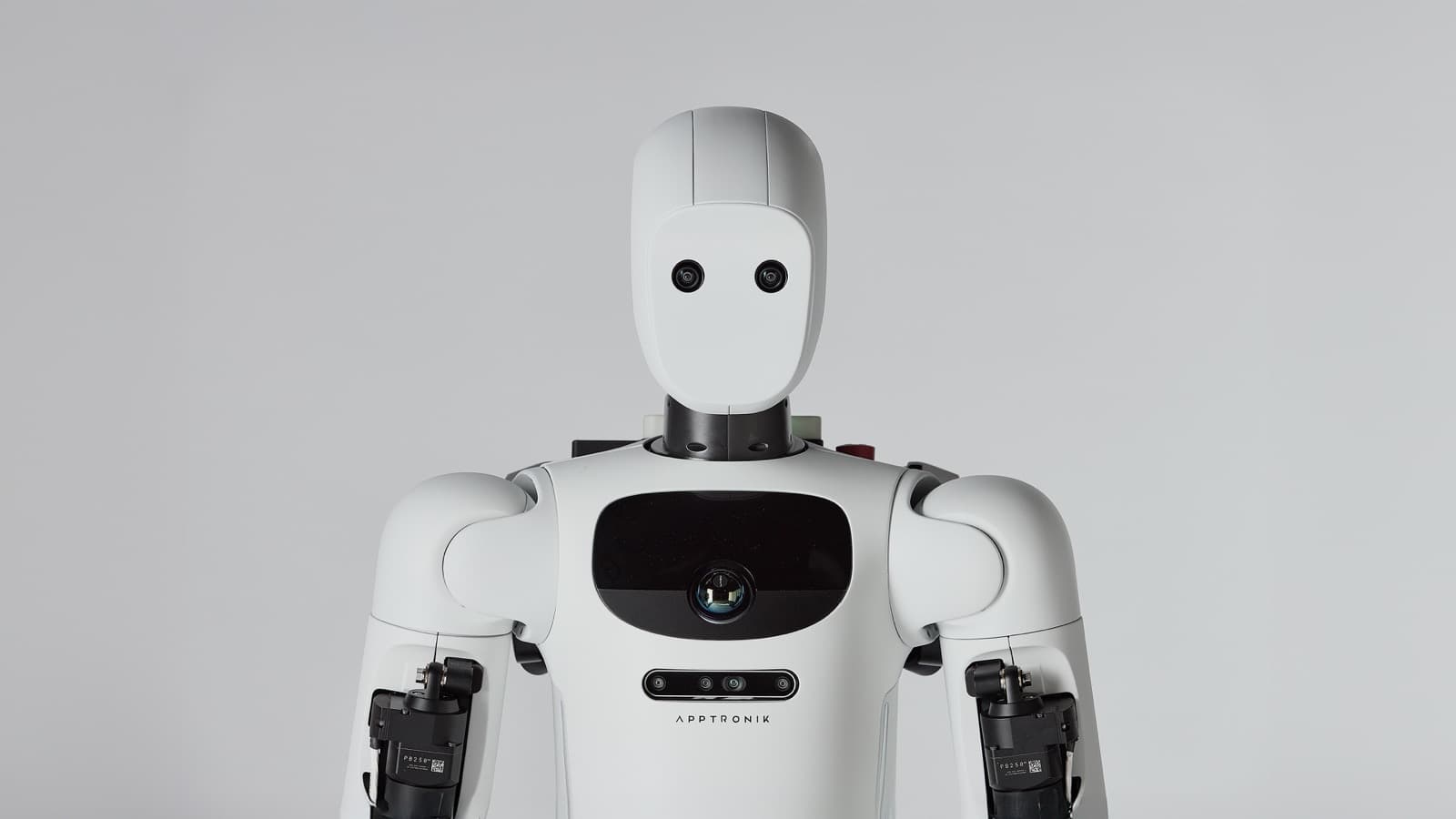
1. Identity and current status
Apollo 2 is the current humanoid development platform from Austin-based Apptronik. The company publicly unveiled it on June 30, 2026 alongside an expanded Robot Park training facility. It is offered in two mobility configurations: a biped for spaces and movements designed around people, and a wheeled base intended to provide greater stability and efficiency in repetitive industrial workflows. Apollo 2 product page Robot Park announcement
As of September 1, 2026, the appropriate status is Pilot. Apptronik says fleets have operated for more than a year at its own Robot Park and at customer and partner sites. Reuters reported that the company had built “hundreds” of Apollo 2 robots, while the CEO said pilots would continue through 2026 and production versions would follow in 2027 and beyond. Those facts establish a real fleet and active field programs, but not general commercial availability or sustained production use. Reuters
Version discipline matters. The original Apollo unveiled in 2023—now identified by Apptronik as Apollo 1—had published dimensions, weight, payload and runtime. Apptronik has not republished those figures for Apollo 2. This profile therefore does not carry Apollo 1’s specifications into the new machine. It also does not treat Apollo 2 as the final commercial product: Apptronik explicitly says its data and operational lessons are feeding Apollo 3.
2. Core specifications
| Field | Apollo 2 specification | Evidence boundary |
|---|---|---|
| Height | Not publicly disclosed | Apollo 1’s 5 ft 8 in figure is not transferred |
| Weight | Not publicly disclosed | Apollo 1’s 160 lb figure is not transferred |
| Degrees of freedom | Not publicly disclosed | A demonstrated third-party SharpaWave hand has 22 DoF; that is not total robot DoF |
| Payload | Not publicly disclosed | Apollo 1’s 55 lb lift rating is not transferred |
| Speed | Not publicly disclosed | Google DeepMind says movement speed still needs improvement |
| Runtime | Not publicly disclosed | Swappable batteries and 7×22 operating intent are stated; per-pack runtime is absent |
| Sensors | Cameras, speech/listening hardware, impact-zone and perimeter-zone sensing are described | Sensor models, counts, ranges and coverage are not published |
| Compute | Not publicly disclosed | Apptronik describes Artemis software and Gemini Robotics integration, not onboard compute hardware |
| Battery | Swappable; opportunity charging and tethered power supported | Capacity, voltage, charging time and pack life are not published |
| Product version | Apollo 2, bipedal or wheeled-base configuration | Development/data platform preceding planned Apollo 3 commercial fleet |
Apptronik also claims its actuator platform exceeds 90% energy efficiency and is designed for maintainability, manufacturability and supply-chain resilience. These are Company specifications without a public test protocol. Likewise, 7×22 describes the intended operating schedule enabled by battery swaps; it is not evidence that one robot has completed 22 hours of work on each of seven days. Apollo 2 product page
3. Product position
Apollo 2 is positioned less as a finished catalog robot than as the physical layer in a training and operations system. Apptronik names three parts: Apollo 2 hardware; Artemis, which coordinates perception, planning, controls, safety, task execution and human interaction; and Fleet Connect, which monitors robots, assigns work, manages deployments and collects operational data. The product is therefore meant to turn physical work into both task output and training data.
The modular base is central to that role. Wheels can reduce the balancing problem and fit higher-throughput, relatively structured operations. Legs preserve access to environments designed around human movement and let Apptronik develop whole-body control. The shared upper body allows data collection across both configurations, but a result on the wheeled platform does not automatically verify bipedal reliability.
Robot Park makes this positioning unusually explicit. Apptronik describes Apollo 2 as the current “workhorse” used to build the data and models intended for Apollo 3. Buyers assessing Apollo 2 should therefore view it as a partner-access pilot platform and learning fleet, not assume it is the company’s promised volume-production endpoint.
4. Publicly claimed capabilities
Company claim: Apollo 2 can perform logistics, manufacturing, retail and other customer-defined activities through a combination of teleoperation and autonomous execution. The product page presents dexterous object handling, real-world mobility, speech, listening and human-readable status communication. An LED mouth, coordinated lighting and chest display are intended to show status, battery, charging and task progress. Robot Park announcement Apollo 2 product page
Apptronik also describes two hardware-level safety areas. An impact zone is intended to pause motion when an object enters a defined radius; a configurable perimeter zone changes behavior as people, equipment or obstacles approach. These descriptions explain the design intent, not certification, measured stopping distance or safe performance for every payload and speed.
The intelligence claim rests heavily on the Google DeepMind partnership. Robot Park data is used to train Gemini Robotics models, and Apollo 2 is presented as a platform for general action, reasoning, interaction and manipulation. Those goals should not be read as a claim that every deployed Apollo 2 already performs every task autonomously.
5. Verified capabilities
Google DeepMind provides the strongest evidence outside Apptronik’s own demonstrations. In July 2026 it reported Gemini Robotics 2 controlling Apollo 2’s full body for a task that required walking to a table, picking up a watering can, moving to shelving and placing the object in a lower bin. It also published task-level results for Apollo 2 with Inspire hands and with five-fingered SharpaWave hands. Google DeepMind
Those results are informative because they include failure rates. With Inspire hands, reported success was 68.4% for table pickup, 45.7% for floor pickup and 76.3% for shelf pickup. SharpaWave results varied sharply: 92% for unscrewing a bulb, but 36% for screwing it, 44% for tying a trash bag, 32% for dustpan use and 40% for sealing a zip bag. DeepMind characterized multi-finger manipulation as still challenging and said movement speed needs improvement. These are controlled research evaluations, not customer throughput or safety studies.
Reuters independently confirmed the existence of Robot Park, the two configurations and a company-reported fleet numbering in the hundreds. It did not publish uptime, intervention rate, units at each customer, task throughput or economic performance. The evidence therefore verifies working hardware and research progress while leaving industrial reliability unresolved.
6. Software and developer access
Apollo 2 uses Apptronik’s proprietary Artemis orchestration layer and Fleet Connect operations system. The company describes teleoperation, autonomous execution, simulation, task management, status monitoring, deployment management and data collection. Google DeepMind’s Gemini Robotics stack supplies experimental vision-language-action and embodied-reasoning capabilities.
No public Apollo 2 SDK, API documentation, simulator download, low-level controller access, developer pricing or self-service purchase path was located in the reviewed materials. Gemini Robotics 2 VLA and on-device models are available to early-access partners, not as open Apollo software. Unknown: what interfaces a customer receives, which behaviors run locally, how models are updated, what data leaves a facility, and which functions require Apptronik or Google involvement.
7. Pricing and availability
Apollo 2 has no public price, lease rate, order page or standard delivery schedule. Access appears to be negotiated through Apptronik’s sales contact and partnership programs. Reuters reported continued pilots during 2026 and production versions beginning in 2027 or later. That schedule is a company forecast, not a purchase guarantee.
Older Apollo agreements cannot establish Apollo 2 pricing. The 2024 Mercedes-Benz announcement concerned the earlier Apollo program and published no commercial terms. The clearest present description is therefore: not generally available; pilot and partner access only; price not publicly disclosed.
8. Deployment evidence
Apptronik says Apollo 2 fleets operate at its nearly 90,000-square-foot Austin Robot Park and in data-collection workflows at Google DeepMind, Mercedes-Benz and GXO locations. Within Robot Park, bipedal and wheeled robots practice logistics, manufacturing and retail activities using teleoperation and autonomous execution. The company also says the platform has worked there for more than a year. Robot Park announcement
This is meaningful pilot evidence, but the disclosure is aggregate. No source reviewed provides the number of Apollo 2 units at each external site, hours worked, autonomous share, human interventions, incidents, maintenance, throughput, task accuracy or return on investment. Mercedes and GXO are named as data-collection locations, not documented full-production deployments. Apptronik’s own Robot Park is a training facility, not an independent customer operation.
9. Editorial assessment
Apollo 2’s strongest feature is not a headline payload figure; it is an integrated learning loop connecting modular hardware, fleet operations and a frontier robotics model partner. The wheeled and bipedal options let Apptronik collect useful work data while developing the harder locomotion problem. DeepMind’s published task results add rare quantitative texture and show both progress and substantial remaining failure rates.
The evidence gap is equally clear. Apptronik withholds nearly every conventional hardware specification, publishes no price, and reports deployments without operational metrics. The company has also defined Apollo 2 as a bridge to Apollo 3, so customers must distinguish participation in a development program from buying a mature product.
Apollo 2 is best understood as a credible, scaled pilot and data platform—not yet a proven general-purpose industrial worker. Evidence that would change this assessment includes Apollo 2 configuration-specific specifications, independent safety validation, named-site task metrics over several months, intervention and downtime data, commercial terms, and a clear account of which capabilities transfer into Apollo 3.
10. Update history
- 2026-09-01: Profile created. Status set to Pilot because a multi-site fleet and measured research tasks exist, while general availability and production-grade operating metrics remain absent.
- 2026-07-30: Google DeepMind published Gemini Robotics 2 whole-body and dexterity results on Apollo 2.
- 2026-06-30: Apptronik publicly unveiled Apollo 2 and the expanded Robot Park, identifying bipedal and wheeled configurations.
- 2025-03-12: Google DeepMind showed Gemini Robotics adapted to the earlier Apollo platform; this is background evidence, not Apollo 2 verification.
- 2024-03-15: Apptronik announced the original Apollo pilot agreement with Mercedes-Benz; Apollo 2 was not yet publicly identified.
11. Sources & evidence
- Apollo 2 — Apptronik, primary live product page, undated, accessed 2026-09-01.
- Welcome to Robot Park — Apptronik, primary announcement, 2026-06-30, accessed 2026-09-01.
- Apptronik launches robot training hub — Reuters, independent reporting, 2026-06-30, accessed 2026-09-01.
- Gemini Robotics 2 brings whole body intelligence to robots — Google DeepMind, primary research announcement, 2026-07-30, accessed 2026-09-01.
- Gemini Robotics brings AI into the physical world — Google DeepMind, primary research announcement, 2025-03-12, accessed 2026-09-01.
- Apptronik and Mercedes-Benz enter commercial agreement — Apptronik, primary partnership announcement, 2024-03-15, accessed 2026-09-01.
- Apptronik unveils Apollo — Apptronik, primary Apollo 1 announcement, 2023-08-23, accessed 2026-09-01.
Apptronik Apollo 2 — sources
- Article slug:
apptronik-apollo-2 - Access date for all web sources: 2026-09-01
S1. Apollo 2
- Publisher: Apptronik
- URL: https://apptronik.com/apollo/apollo-2
- Publication date: Undated live page
- Source type: Primary product page
- Supports: current product identity; bipedal and wheeled mobility; human-interface design; actuator, battery and charging claims; Artemis and Fleet Connect; safety-zone descriptions.
- Boundary: the page does not publish conventional dimensions, payload, speed, runtime, compute, full sensor or price specifications; capability language is promotional.
S2. Welcome to Robot Park
- Publisher: Apptronik
- URL: https://apptronik.com/news-collection/welcome-to-robot-park-where-apptroniks-apollo-goes-to-work
- Publication date: 2026-06-30
- Source type: Primary launch and deployment announcement
- Supports: Apollo 2 public unveiling; two configurations; nearly 90,000-square-foot facility; more than one year of operation; teleoperation and autonomous execution; named Google DeepMind, Mercedes-Benz and GXO data workflows; Apollo 3 succession.
- Boundary: fleet counts and site activity are company claims; no site-level uptime, intervention, safety, throughput or economic metrics are disclosed.
S3. Apptronik launches robot training hub
- Publisher: Reuters, syndicated by WHBL
- URL: https://whbl.com/2026/06/30/apptronik-launches-robot-training-hub-unveils-apollo-2-humanoid-robot/
- Publication date: 2026-06-30
- Source type: Independent reporting and executive interview
- Supports: Robot Park opening; current Apollo 2 identity and configurations; more than one year as a data platform; company-reported hundreds built; 2026 pilot and 2027-plus production timeline.
- Boundary: Reuters reports company figures but does not independently count units or test sustained customer operations.
S4. Gemini Robotics 2 brings whole body intelligence to robots
- Publisher: Google DeepMind
- URL: https://deepmind.google/blog/gemini-robotics-2-brings-whole-body-intelligence-to-robots/
- Publication date: 2026-07-30
- Source type: Primary research announcement with task results
- Supports: Apollo 2 whole-body control demonstration; Inspire-hand pickup results; SharpaWave 22-DoF hand and task results; stated movement-speed and multi-finger limitations; partner availability boundary.
- Boundary: the developer is a research partner, not an independent product-testing laboratory; tasks are controlled evaluations rather than customer throughput studies.
S5. Gemini Robotics brings AI into the physical world
- Publisher: Google DeepMind
- URL: https://deepmind.google/blog/gemini-robotics-brings-ai-into-the-physical-world/
- Publication date: 2025-03-12
- Source type: Primary research announcement
- Supports: original Apptronik–Google DeepMind technical partnership; Gemini Robotics and Gemini Robotics-ER roles; adaptation to the earlier Apollo embodiment.
- Boundary: this source predates the public Apollo 2 unveiling and is treated as program background, not proof of Apollo 2 specifications.
S6. Apptronik and Mercedes-Benz enter commercial agreement
- Publisher: Apptronik
- URL: https://apptronik.com/news-collection/apptronik-and-mercedes-benz-enter-commercial-agreement
- Publication date: 2024-03-15
- Source type: Primary partnership announcement
- Supports: historical Apollo pilot, intended kitting and tote-delivery applications, and first-generation dimensions and payload.
- Boundary: predates Apollo 2; first-generation specifications and deployment claims are not assigned to Apollo 2.
S7. Apptronik unveils Apollo
- Publisher: Apptronik
- URL: https://apptronik.com/news-collection/apptronik-unveils-apollo
- Publication date: 2023-08-23
- Source type: Primary Apollo 1 launch announcement
- Supports: first-generation Apollo identity, specifications, batteries and initial industrial position.
- Boundary: used only to enforce version separation; none of its numbers are presented as Apollo 2 specifications.