
1. What happened
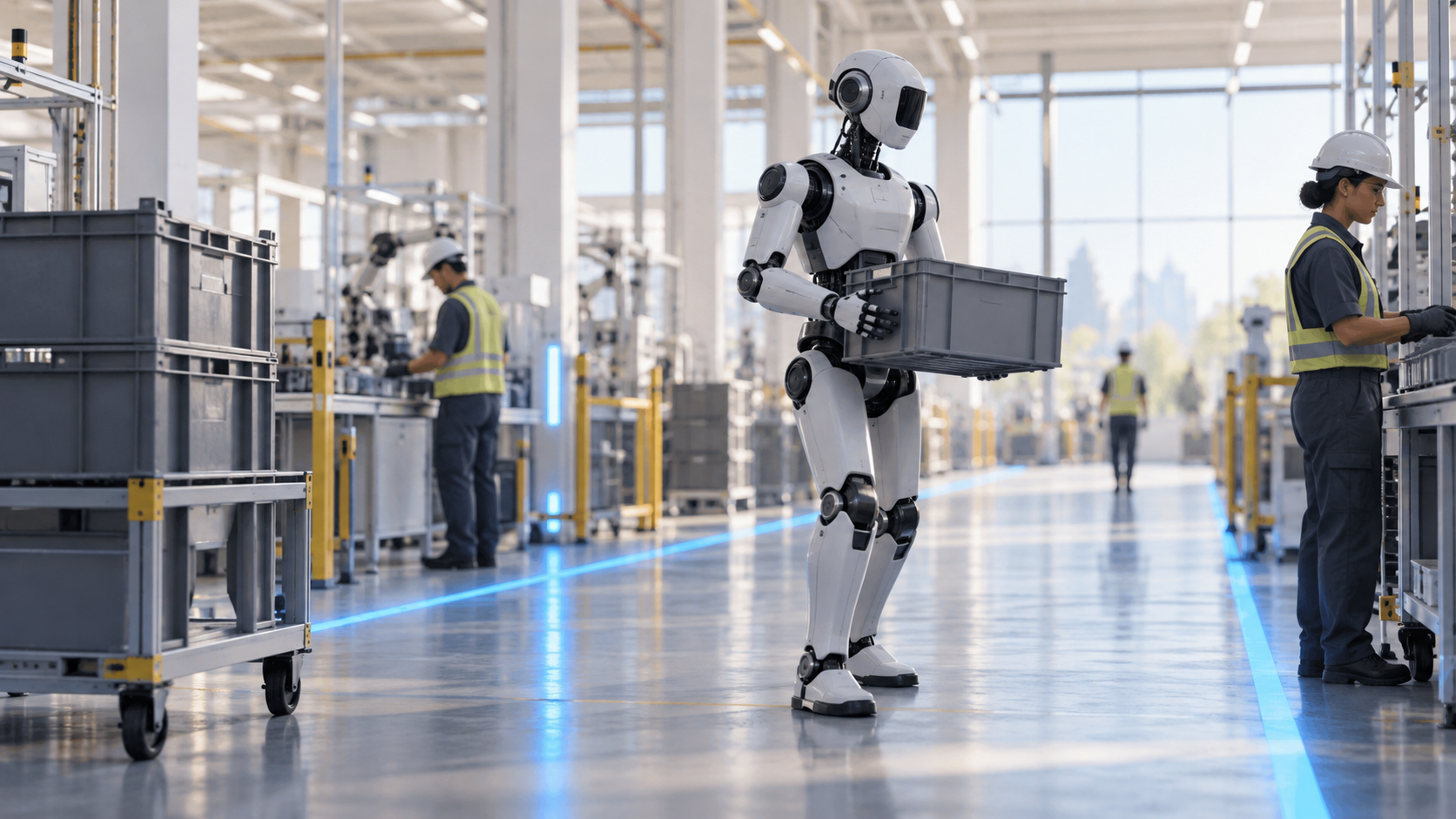
Agility Robotics unveiled Digit 5 on September 15, presenting the fifth-generation humanoid as a machine designed for work near people and for a broader range of industrial tasks than its predecessor. The new robot increases its rated payload, adds faster charging, supports interchangeable end effectors and introduces a safety architecture intended to reduce dependence on fenced-off work cells.
The company calls this approach “cooperatively safe.” It says the robot can detect people, communicate motion intent through visual and audible cues, and use an independent safety controller to slow, stop or adopt a seated posture when a person enters an unsafe area. Agility also said it had more than $300 million in multi-year Digit 5 orders as of May 2026, subject to contractual milestones.
That makes the launch more than a cosmetic update. It links new hardware to a safety proposition and a commercial demand figure. Yet each part needs to be read at the right level of certainty: the product is newly announced, the orders are conditional, and general availability is not expected until the end of 2027.
2. Confirmed facts
Digit 5 stands 1.81 metres tall, weighs 129 kilograms and is specified to lift loads of up to 22.7 kilograms. Agility states that its 90-minute battery can charge in nine minutes, improving the run-to-charge ratio from 2:1 on Digit 4 to 10:1. An ISO-standard mounting interface supports swappable grippers and tools.
The safety architecture described at launch includes human detection using multiple sensors, cues that indicate the robot’s intended motion, and a separate safety controller. Agility is a launch partner for NVIDIA’s Halos for Robotics platform and says Digit 5 combines NVIDIA IGX Thor hardware with the Halos safety framework. The company is also contributing to two standards projects addressing dynamically stable robots: ANSI/A3 TR R15.108 and ISO 25785-1.
The evidence base behind the new product comes mainly from Digit 4. Agility reports more than 65,000 operating hours across customer sites and says Digit handled 100,000 totes at a GXO facility with approximately 98 percent accuracy while on task. These are company-reported deployment figures, not an independent audit of Digit 5.
3. Why it matters
Industrial humanoids are often promoted for their ability to use spaces and equipment designed for people. That advantage weakens if the robot must operate inside a large permanent cage or if nearby workers repeatedly stop its task. A system that can share an aisle, signal intent and manage proximity without creating unacceptable risk could fit existing facilities more naturally.
Digit 5 also tests whether experience from a narrow workflow can support a broader product. Digit 4’s best-documented commercial task is repetitive tote handling. Agility now describes a path toward depalletising, machine tending, kitting, inspection and palletising. Moving between those tasks requires more than stronger legs: it requires reliable manipulation, tool changes, fleet coordination and site-specific safety engineering.
The $300 million order figure is commercially important because humanoid deployments have often been announced as trials rather than purchases. However, the conditions attached to those orders matter. They should not be read as recognised revenue, shipped units or proof that customers will scale every planned deployment.
4. Background
Digit has progressed through several generations built around a bipedal body, backward-bending legs and arms designed for logistics work. Agility’s approach differs from humanoid programmes that begin with a general demonstration and search for a workplace later. Digit has been tested and deployed around a relatively specific material-handling problem, giving the company operational data on uptime, charging, interventions and integration.
That history provides useful evidence, but it does not automatically transfer to the new architecture. A heavier payload changes forces and stopping distances. New tools introduce pinch, impact and dropped-object hazards. More varied workflows add different people, layouts and failure modes. Safety therefore belongs to the complete application—including robot, tool, payload, software, environment and operating procedure—not only to the base machine.
Agility plans early access in the first half of 2027 and wider availability by the end of that year. It also plans deployment in the European Union and United Kingdom, where market access will depend on the relevant conformity and regulatory processes.
5. What remains unknown
Agility has not publicly supplied a full independent test report for the Digit 5 safety system, detailed stopping performance across payloads, or field data showing how frequently the robot slows or stops around workers. It is also unclear how the safety controller handles perception uncertainty, occlusion and combinations of moving people, vehicles and equipment in a busy facility.
The order announcement does not disclose the number of customers, robots, deposits, cancellation rights or milestones that convert commitments into delivered systems. It therefore indicates customer interest without revealing a shipment schedule or unit economics.
Finally, the proposed expansion from tote handling to complete facility workflows is a roadmap. Public evidence does not yet show one Digit 5 completing that full chain in sustained customer production.
6. Editorial analysis
Digit 5 is a credible product step because it addresses constraints exposed by real deployments: payload, charging, reach, tool flexibility and interaction with people. Those changes are more relevant to scale than a new demonstration skill. The company’s operating-hour history also gives it a stronger starting point than a robot that has only appeared in controlled videos.
The wording around safety still requires discipline. “Cooperatively safe” is Agility’s product description, not a universal certification category proving that every Digit 5 application is safe beside people. The machine may provide safety-rated components and behaviours, while the integrator and operator remain responsible for risk assessment of the actual task.
The most useful evidence over the next year will be operational: independent assessment, application-level validation, intervention rates, uptime with the new battery cycle, safe throughput around people and the conversion of conditional orders into deployed robots. Digit 5 makes a stronger industrial promise than Digit 4. The proof will come from whether its expanded capability can be sustained without weakening safety or reliability.
7. Related robot, technology, and company
- Agility Digit: the robot profile records specifications, commercial status and deployment history.
- Agility Robotics: the company profile covers the manufacturer, its production strategy and customer relationships.
- Robot policy evaluation: broader success rates need to be accompanied by intervention, failure and recovery measurements.
8. Sources & evidence
The principal source is Agility Robotics’ September 15 product announcement. Context on humanoid safety standards is drawn from A3 and NIST materials. Product specifications, order value and deployment metrics are vendor-reported unless explicitly stated otherwise. The source list below provides the citations and evidence notes.
Sources
- Agility Robotics. “Agility Unveils Digit 5 Humanoid Robot Built for Cooperatively Safe Work at Scale.” September 15, 2026. https://www.agilityrobotics.com/content/agility-unveils-digit-5-humanoid-robot-built-for-cooperatively-safe-work-at-scale
- Association for Advancing Automation. “Safety by Design: How Humanoid Robots Must Evolve to Depart the Walled Garden.” 2026. https://www.automate.org/robotics/blogs/safety-by-design-how-humanoid-robots-must-evolve-to-depart-the-walled-garden
- National Institute of Standards and Technology. “Characterizing Task-Based Human-Robot Collaboration Safety in Manufacturing.” February 27, 2015. https://www.nist.gov/publications/characterizing-task-based-human-robot-collaboration-safety-manufacturing
Evidence note
Specifications, operational hours, customer names, order value and availability dates originate with Agility Robotics. The article treats them as company statements and distinguishes present evidence from forward-looking plans.