
1. Core conclusion
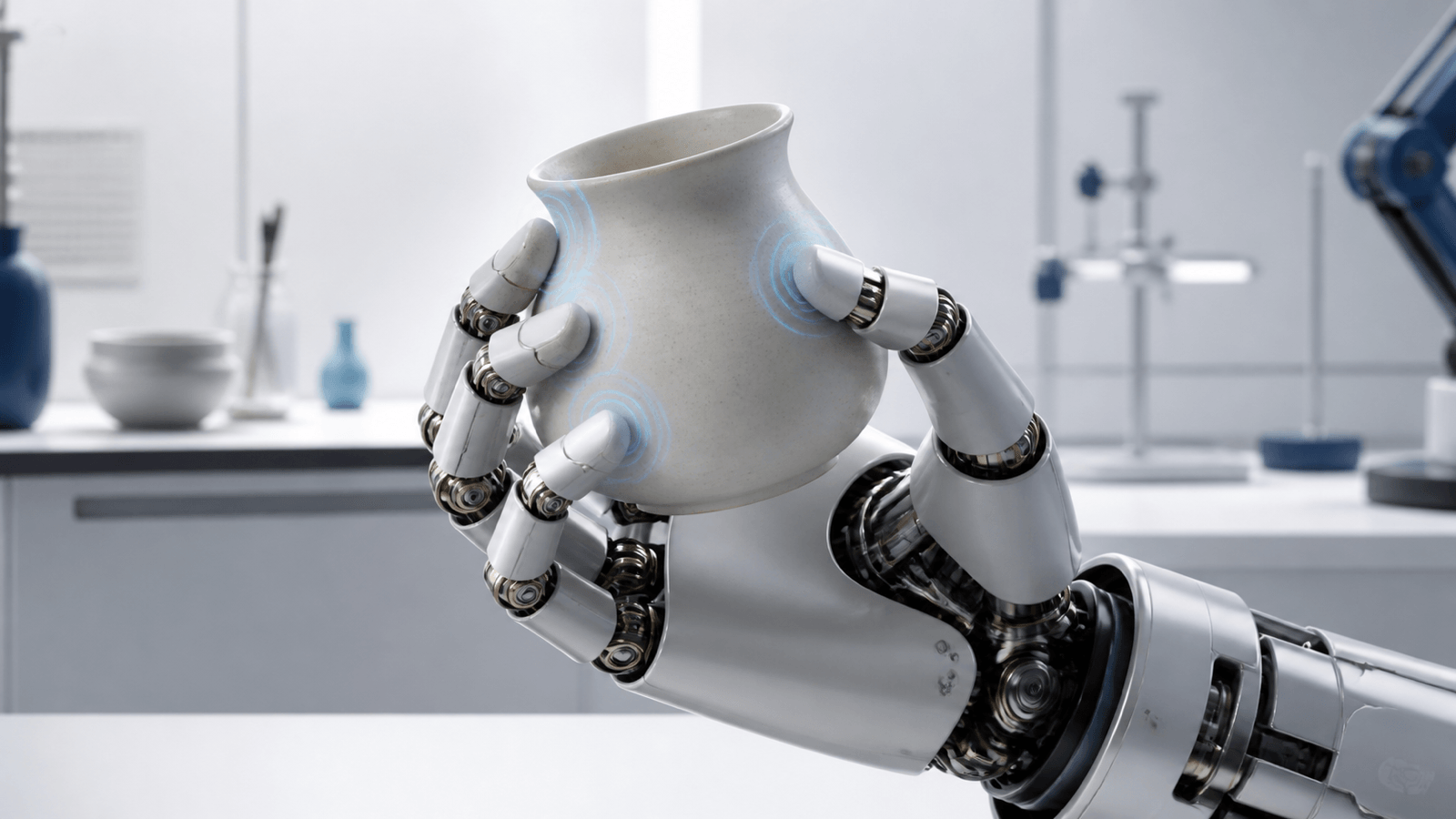
Adding touch to a vision-language-action model is not simply a matter of supplying another sensor stream. Language and vision can help a robot decide what contact should accomplish; tactile feedback must detect what is happening at the contact surface quickly enough to change motion before an object slips, jams or breaks. Recent systems split these jobs across semantic planning, nominal action generation and fast residual control. This hierarchy is promising, but results remain tied to small task sets, specific sensors and carefully integrated hardware.
2. The problem
Cameras reveal objects, geometry and visible motion. They are much less reliable once a gripper closes around an object, a plug enters a socket or one hand passes something to another. Contact can be hidden by the robot’s own fingers. A video frame does not directly reveal normal force, shear, incipient slip or whether two surfaces are aligned under pressure.
Vision-language-action models inherit this gap. A VLA can connect an instruction such as “insert the connector gently” with visual features and a sequence of actions. Yet “gently” is a physical constraint, not just a semantic modifier. The policy needs to detect resistance, distinguish a correct fit from a jam and alter its trajectory while contact is unfolding.
The timing problem is fundamental. High-level reasoning can operate at a relatively slow rate because task intent does not change every millisecond. Contact state can change quickly. If tactile data must pass through a large multimodal model before every correction, the loop may respond too late. If a low-level controller reacts without semantic context, it may preserve a grasp while violating the task. Current research is therefore exploring where tactile information should enter the stack.
3. How it works
Tactile sensors convert deformation, pressure, magnetic changes or optical patterns at a fingertip into signals. A robot policy can use raw sensor arrays, compact features or language-like descriptions derived from touch. Proprioception—joint position, velocity and motor state—adds information about how the body is moving.
One design fuses tactile signals into the main VLA. The model receives vision, language and touch together, then proposes actions or reasoning steps. Tactile-VLA follows this direction and pairs the learned model with hybrid position-force control. The VLA can use semantic knowledge about physical interaction, while the controller translates intent into constrained motion and force.
A second design preserves the base VLA and adds tactile modules around it. VLA-Touch uses a pretrained tactile-language model to produce semantic feedback for high-level planning. A diffusion-based controller separately refines VLA actions from tactile input. The base VLA is not fine-tuned, which can preserve its learned capabilities and lower adaptation cost.
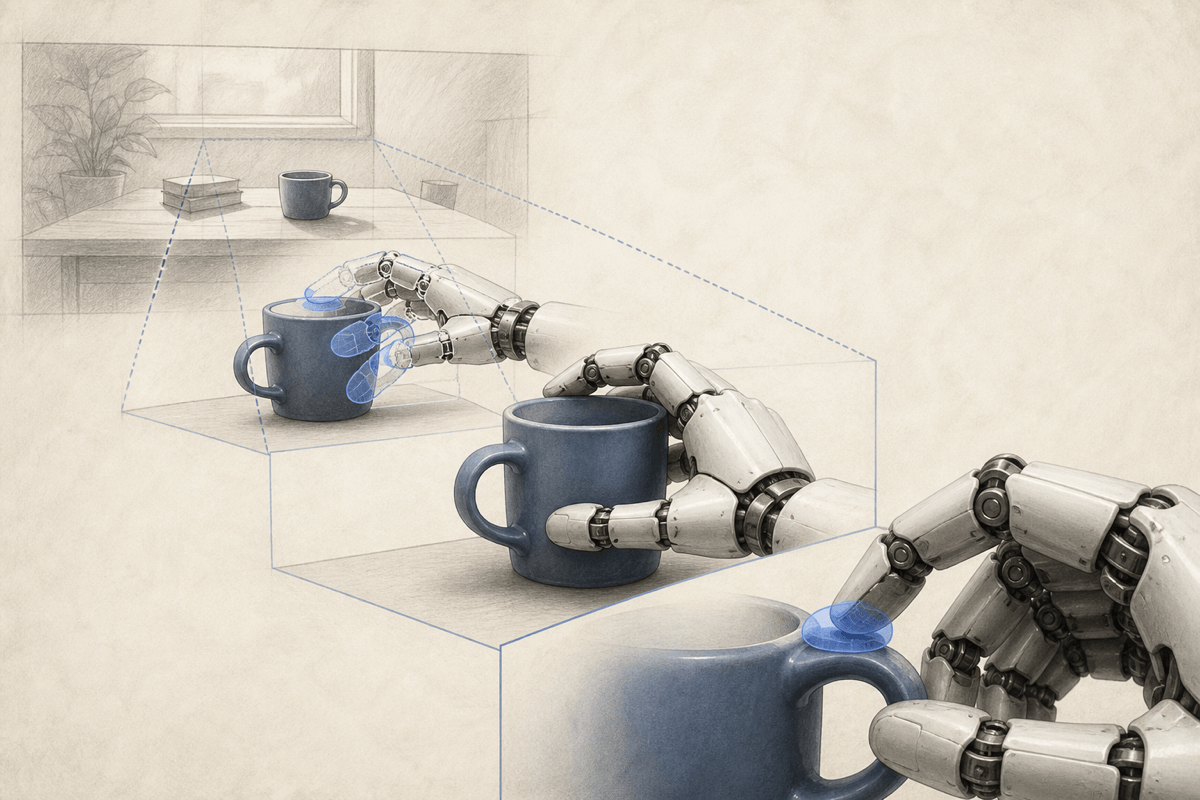
A third design makes the timing hierarchy explicit. TouchWorld separates vision-language subtask planning, tactile-world prediction, nominal visuo-tactile action chunks and high-frequency residual correction. The slow layer predicts a desired tactile future; the fast layer compares recent touch and proprioception with that goal and adjusts locally. Touch becomes both a planned outcome and a feedback signal.
AI-generated illustration (not a photograph or measured data).
4. Representative approaches
Tactile-VLA: fuse touch with physical reasoning. Tactile-VLA combines vision, language, action and tactile sensing, then uses a reasoning module plus hybrid position-force control. The authors organize evaluation around tactile-aware instruction following, tactile commonsense and adaptive reasoning. They argue that a pretrained vision-language model already contains semantic knowledge about physical interaction and that a small number of demonstrations can connect this knowledge to tactile sensors. The claim concerns the reported tasks; it does not show that arbitrary sensors or force regimes can be added with equally little data.
VLA-Touch: add touch without modifying the base policy. VLA-Touch keeps the generalist VLA fixed. A tactile-language model informs planning at a semantic level, while a tactile-conditioned diffusion controller refines execution. This modularity can make an existing policy easier to adapt and isolates rapid control from large-model reasoning. Its effectiveness depends on the tactile-language model correctly summarizing contact and the residual controller remaining within safe authority.
TouchWorld: predict contact and react locally. TouchWorld asks the planner to produce subtasks and tactile subgoals. A visuo-tactile policy produces nominal action chunks, and a high-frequency refinement policy uses recent tactile and proprioceptive history. Across six long-horizon, contact-rich dexterous tasks, the authors report 65.0% success in a clean setting and 53.7% under human perturbations—15.7 and 18.5 percentage points above their strongest baseline. Those results support the hierarchy on that benchmark, not a general reliability rate.
MoDE-VLA: specialize within dexterous manipulation. MoDE-VLA targets bimanual, in-hand operation. It injects force and tactile features into a pretrained VLA through a mixture of dexterous experts and residual adaptation. Its companion IMCopilot uses reinforcement-learned atomic skills both to assist teleoperation data collection and to execute low-level operations. The authors report doubled success over their baseline across four tasks of increasing complexity. The integrated pipeline mixes improvements in data collection, skill primitives and sensory fusion, so the abstract alone cannot isolate each contribution.
5. Real-world applications
Insertion is an obvious use case. A robot can use vision to approach a port, touch to detect first contact and force-aware correction to search for alignment. Similar feedback matters when closing a lid, turning a tight control, handling flexible material or maintaining pressure during wiping.
Dexterous hands expand the need. In-hand rotation and bimanual transfer create contacts that are frequently occluded and change across several fingers. MoDE-VLA and TouchWorld treat touch as part of a broader dexterity stack rather than a final safety check. Their tasks remain research demonstrations, but the architecture matches a real deployment need: slow task decisions above faster local stabilization.
Touch can also improve robustness when the visible scene is unchanged. A cup may look identical whether it is secure or beginning to slip. A tactile residual controller can adjust grip without asking the planner to reinterpret the whole task. This separation resembles established robotics practice, where high-level planning and low-level force control run at different rates.
6. How it is evaluated
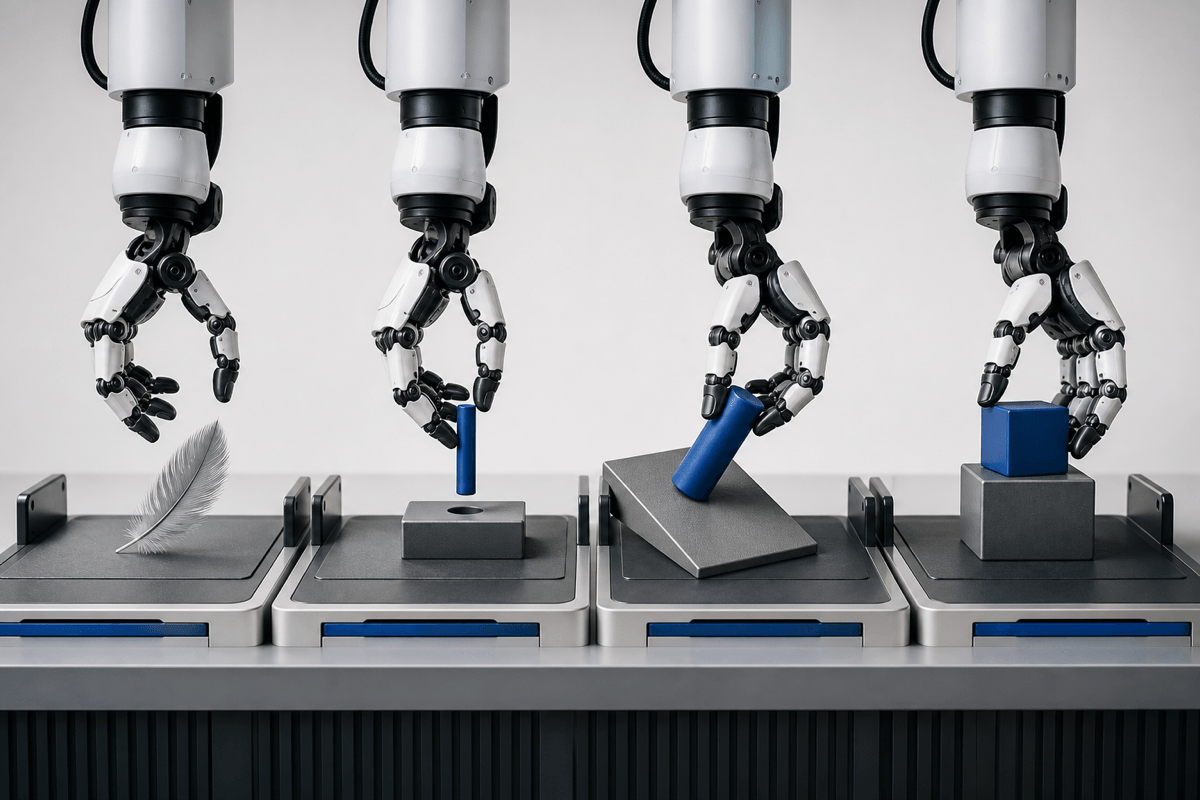
Evaluation must distinguish perception, planning and control. At the perception level, a system can be tested on whether it recognizes contact states, material properties, slip or force-related instructions. At the planning level, researchers can measure whether tactile feedback causes the model to select an appropriate subtask or strategy. At the control level, success depends on force regulation, placement precision, slip recovery and task completion.
The four papers use different architectures, sensors and task suites, so their headline results are not directly comparable. TouchWorld reports clean and human-perturbed success across six tasks. MoDE-VLA reports a relative success improvement over a baseline across four escalating tasks. Tactile-VLA emphasizes zero-shot generalization with few demonstrations, while VLA-Touch emphasizes improved planning efficiency and execution precision without base-VLA fine-tuning.
A stronger common protocol would report sensor type and sampling rate, controller frequency, number of demonstrations, unseen objects and materials, force limits, intervention rules and trial counts. It should include conditions where vision is occluded, friction changes, the object shifts unexpectedly and tactile readings contain noise. Task success should be accompanied by peak force, slip events, object damage, recovery rate and completion time.
Generalization needs special care. Testing a new object with the same tactile sensor and gripper is different from moving the policy to a new sensor technology, hand geometry or calibration. A paper can demonstrate one form without supporting the others.
AI-generated illustration (not a photograph or measured data).
7. Current limitations
Tactile datasets are small and fragmented. Vision models benefit from internet-scale images. Touch requires physical interaction, sensor installation and calibration. Data from one fingertip may not transfer cleanly to another design.
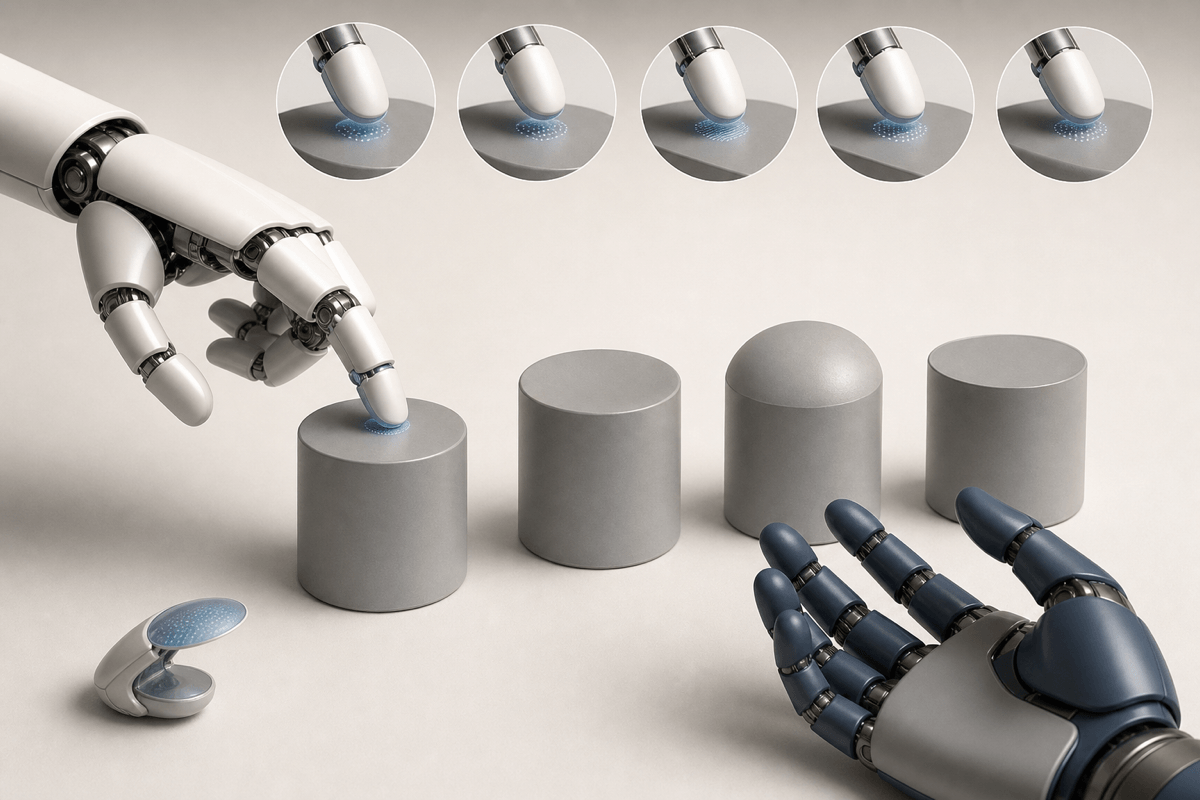
Sensors measure different phenomena. Pressure arrays, magnetic skins and vision-based tactile sensors produce different signals, resolutions and failure modes. A model trained on one representation does not automatically understand another.
Calibration drifts. Soft materials wear, temperature changes and sensor mounting varies. A policy can mistake drift for contact change unless the system detects and compensates for it.
Fast feedback can conflict with slow intent. A residual controller must react strongly enough to prevent slip but not so strongly that it overrides the planned motion. Defining that authority boundary is a safety and control problem.
Contact success can hide excessive force. Completing an insertion or grasp does not prove that forces stayed within safe limits. Evaluation must penalize unstable, damaging or unnecessarily forceful behavior even when the final object state is correct.
Semantic knowledge is incomplete physics. A VLM may know that glass is fragile, but that does not supply the friction coefficient, object mass, contact location or actuator response needed for a specific grasp.
AI-generated illustration (not a photograph or measured data).
8. Why it deserves attention
Touch closes an important gap between recognizing the world and physically interacting with it. If VLAs are to progress beyond visible pick-and-place tasks, they need signals that remain informative after contact begins. The most convincing recent work does not ask one large model to handle everything. It gives semantic reasoning, nominal action and rapid correction different roles.
The next decisive evidence will be broader cross-sensor and cross-hand testing, longer deployments with calibration drift, transparent force and failure metrics, and comparisons that hold the base VLA and demonstrations constant. Systems should also report how often touch changes the plan, how often the residual controller intervenes and whether those interventions prevent failure or merely mask an unstable policy.
A robot that can describe contact is not necessarily a robot that can control it. Progress will be measured by safe, repeatable physical adaptation at the speed contact demands.
9. Sources & evidence
- Tactile-VLA: Unlocking Vision-Language-Action Model’s Physical Knowledge for Tactile Generalization — Huang et al., primary paper, July 12, 2025, accessed September 1, 2026.
- VLA-Touch: Enhancing Vision-Language-Action Models with Dual-Level Tactile Feedback — Bi et al., primary paper, revised July 29, 2025, accessed September 1, 2026.
- TouchWorld: A Predictive and Reactive Tactile Foundation Model for Dexterous Manipulation — Zhou et al., primary paper, revised July 9, 2026, accessed September 1, 2026.
- Towards Human-Like Manipulation through RL-Augmented Teleoperation and Mixture-of-Dexterous-Experts VLA — Tang et al., primary paper, March 9, 2026, accessed September 1, 2026.
Tactile feedback in VLA control — source register
- Research date: 2026-09-01
- Article slug:
tactile-feedback-vla-control
| ID | Source | Type | Supported evidence and boundary |
|---|---|---|---|
| S1 | Tactile-VLA — Jialei Huang et al., 2025-07-12 | Primary research paper | Supports deep multimodal fusion, reasoning module, hybrid position-force controller and few-demonstration tactile generalization claim. Abstract does not provide full task metrics. |
| S2 | VLA-Touch — Jianxin Bi et al., v2 2025-07-29 | Primary research paper | Supports frozen base VLA, tactile-language feedback and tactile-conditioned diffusion refinement. Reported improvements remain tied to the authors’ real-world protocol. |
| S3 | TouchWorld — Jianyi Zhou et al., v2 2026-07-09 | Primary research paper | Supports hierarchical predictive/reactive design and reported results across six clean and perturbed tasks. Does not establish cross-sensor deployment. |
| S4 | MoDE-VLA — Tutian Tang et al., 2026-03-09 | Primary research paper | Supports RL-assisted teleoperation, mixture of dexterous experts, residual multimodal injection and reported relative improvement on four tasks. Components are evaluated as an integrated pipeline. |
Evidence boundaries
- Task success does not by itself establish safe force, low slip, low damage or robust recovery.
- Zero-shot generalization within one hardware stack does not establish transfer to other tactile sensors or hands.
- Paper-reported results apply to the authors’ sensors, tasks, controllers, demonstrations and trial protocols.
- Semantic tactile understanding does not provide complete contact mechanics.
- None of the reviewed sources establishes long-duration commercial reliability.