
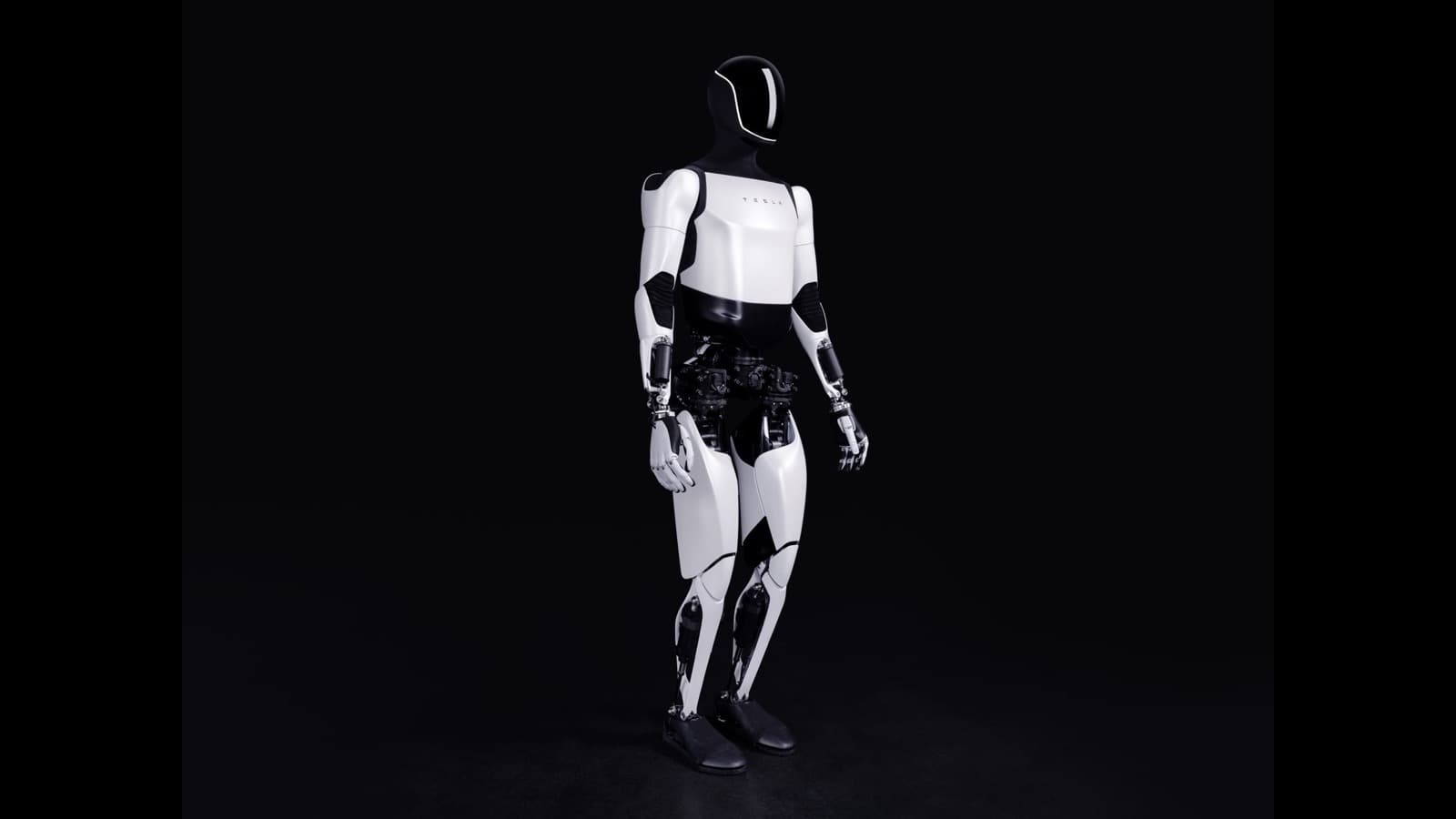
1. Identity and current status
Optimus is Tesla’s general-purpose bipedal humanoid robot program. On its AI & Robotics page, Tesla says its long-term objective is an autonomous machine that can perform work considered unsafe, repetitive, or boring. That is a product ambition, not a description of a customer-ready robot. As of September 1, 2026, the most accurate status is Prototype: Tesla has shown multiple physical generations and is installing manufacturing lines, but it has not published a current production specification, opened customer orders, or reported a commercial deployment.
The version history is unusually difficult to follow. Tesla publicly introduced Optimus Gen 2 in December 2023. In its January 2026 investor update, the company said a Gen 3 design—described as its first design intended for mass production—was planned for a first-quarter unveiling. By the end of August, no official product page or specification sheet documenting that Gen 3 release could be located. Tesla’s July update instead referred to “first-generation” Optimus production lines and initial builds intended for an internal training program. This profile therefore treats Optimus as one evolving program and does not mix earlier prototype specifications into an undocumented production design.
2. Core specifications
| Field | Current public information | Evidence boundary |
|---|---|---|
| Height | Not publicly disclosed | Tesla has not published a current production-design specification |
| Weight | Not publicly disclosed | The Gen 2 video claimed a 10 kg reduction, not a current absolute weight |
| Total degrees of freedom | Not publicly disclosed | Gen 2 was shown with 11-DoF hands; this cannot be assigned to the planned production design |
| Payload | Not publicly disclosed | No current official load rating or test method is public |
| Speed | Not publicly disclosed | Gen 2 was described as walking 30% faster, without a current absolute speed |
| Runtime | Not publicly disclosed | No current duty-cycle or battery-runtime figure is public |
| Sensors | Tesla-designed sensors; Gen 2 showed foot force/torque sensing and tactile sensing on all fingers | Exact current sensor suite and redundancy are not public |
| Compute | Not publicly disclosed | Tesla discusses shared AI infrastructure but does not publish the robot’s onboard computer specification |
| Battery | Not publicly disclosed | Capacity, chemistry, charging method, and swap capability are not public |
| Product version | Publicly shown: Gen 2 and later event prototypes; planned production design: Gen 3 | Tesla’s current version naming and final configuration remain unresolved |
3. Product position
Tesla positions Optimus as a general-purpose labor platform rather than a research kit or single-task industrial machine. Its official AI page emphasizes the software required for balance, navigation, perception, and physical interaction. In 2026, however, the company’s concrete near-term use is narrower: the Q2 update says the first builds from its new lines are intended for an internal “Optimus Academy” that collects training data and develops functionality.
That makes Tesla itself the initial user and test environment. Factories offer repeatable routes, known objects, controlled access, and staff who can intervene—conditions far easier to manage than homes or public spaces. The editorially relevant comparison is therefore not a hypothetical household assistant, but other humanoids being evaluated for material handling, parts movement, and repetitive factory work. Unlike developer platforms such as Unitree G1, Optimus has no public purchase path or documented third-party programming interface.
This position ties the robot’s value to Tesla’s vertical integration. The company can design actuators, train perception and control models, build a manufacturing line, and deploy early units inside facilities it already operates. That could shorten feedback cycles, but it also makes outside evaluation harder: the robot, task design, operating environment, data, and performance reporting all remain under one company’s control. For readers, the important question is not whether Tesla has enough resources to build robots; it is whether those resources produce repeatable work that can be measured beyond a curated demonstration.
4. Publicly claimed capabilities
Company claim: Tesla describes the end goal as an autonomous humanoid able to handle unsafe, repetitive, or boring tasks. The company’s software framing includes balance, navigation, perception, planning, and interaction with the physical world. These are program objectives; Tesla does not publish a capability matrix showing which functions operate autonomously today, under what conditions, or for how long.
Tesla’s Gen 2 video showed a robot walking, turning, squatting, balancing, moving its fingers, and handling an egg. It also listed Tesla-designed actuators and sensors, an actuated neck, foot force/torque sensing, articulated toes, 11-degree-of-freedom hands, and tactile sensing on every finger. Those demonstrations establish that Tesla built a functioning prototype with increasingly integrated hardware. They do not establish production reliability, task success rates, recovery behavior, or unsupervised operation over a working shift.
At the October 2024 “We, Robot” event, Optimus units walked among attendees, danced, served drinks, and held conversations. Independent reporting later found that many guest interactions relied on remote human assistance. That distinction matters: teleoperation can be useful for collecting demonstrations and supervising a prototype, but it does not prove that the robot independently understood requests or planned the corresponding actions.
5. Verified capabilities
The strongest externally supported capability is basic bipedal mobility. Reporting after “We, Robot” indicated that the machines could walk using their own control system even while remote employees assisted many higher-level interactions. Multiple physical units also operated in the same event environment without a reported collapse. This supports a narrow conclusion: Tesla has working humanoid prototypes capable of controlled walking and public demonstration.
Manipulation is less firmly verified. Tesla’s own videos show object sorting and delicate handling, but the company has not released trial protocols, unedited runs, success rates, intervention rates, or independent evaluations. The evidence supports “demonstrated under selected conditions,” not “reliably autonomous.” There is also no public evidence that an Optimus fleet has completed a named production task for a measured period with disclosed throughput, uptime, safety performance, and human intervention.
Safety and recovery remain separate evidence gaps. A robot can complete a grasp in a video while still being unsuitable for continuous work near people. Tesla has not published a current safety architecture, stopping-distance test, force limit, ingress rating, fault-response procedure, fall-management method, or applicable certification for Optimus. No public test shows how the current robot handles an obstructed path, dropped object, sensor failure, depleted battery, communication loss, or unexpected human contact over repeated trials. Those omissions do not prove the robot is unsafe; they mean safety readiness cannot yet be independently assessed.
6. Software and developer access
Tesla has not released a public Optimus SDK, API, simulator package, model checkpoint, programming manual, or low-level control interface. External developers cannot currently buy the robot and reproduce Tesla’s demonstrations. The official AI page describes the engineering disciplines behind the program, while company updates refer to internal data collection and functionality development.
The “Optimus Academy” language suggests a training loop built around Tesla-operated robots, people, and compute infrastructure. Tesla’s Q2 update also says its Texas AI compute supports both vehicle and humanoid autonomy. What remains undisclosed includes the onboard inference hardware, model architecture, teleoperation stack, data-governance rules, safety API, fleet-management interface, licensing terms, and degree of access a future customer would receive.
7. Pricing and availability
The current price is Not publicly disclosed. Tesla does not offer a preorder, deposit, configurator, sales region, delivery estimate, warranty, service plan, or published commercial terms for Optimus. Executive statements about possible future pricing are forecasts, not an available offer, and are therefore not treated as a product price in this profile.
Tesla’s July 2026 update said construction was underway for Optimus manufacturing in California and Texas, with production anticipated later in the year. It also said the first Fremont builds would go to Tesla’s internal Academy. Independent reporting noted that Tesla removed earlier language about Optimus reaching volume production in 2026. The evidence supports production preparation and internal builds—not mass production or customer availability.
8. Deployment evidence
There is no named external customer deployment in the public record reviewed for this profile. Tesla has previously shown Optimus in its own facilities and at corporate events, but it has not disclosed a customer, site, paid contract, fleet size, working hours, task throughput, failure rate, or intervention rate. Event appearances are demonstrations, not commercial deployments.
Company claim: Tesla’s July update says the initial production-line builds will be used in Optimus Academy for training-data collection and further functionality development. This is meaningful because it defines a real internal purpose for the first units. It also confirms the robot is still in a learning and engineering phase. Until Tesla publishes operational results, the Academy should not be described as productive factory deployment.
9. Editorial assessment
Optimus is best understood today as a well-funded prototype program moving toward an internal manufacturing and data-collection fleet. Tesla’s strongest advantage is not a publicly verified robot skill; it is the company’s ability to design hardware, build factories, fund AI compute, and operate its own industrial test sites. If those capabilities transfer effectively, Tesla could iterate across robot hardware, data, models, and manufacturing without waiting for external customers.
The largest gap is evidence of dependable autonomy. Public videos show selected behaviors, event interactions involved human assistance, and Tesla has not disclosed the operational metrics needed to judge useful work. The most consequential next evidence would be a fixed production design, a current specification sheet, unedited autonomous task trials, measured intervention and failure rates, safety documentation, and a sustained deployment with a clearly defined task. Until then, Optimus should not be treated as a commercial worker or near-term household product.
10. Update history
- 2026-09-01: Profile created. Status set to Prototype after reviewing Tesla’s July manufacturing update and the absence of public customer availability or a current production specification.
- 2026-07-22: Tesla reported Optimus-line construction in California and Texas and said initial Fremont builds would support Optimus Academy data collection and functionality development.
- 2026-01-28: Tesla said Gen 3 was intended for mass production and planned production before the end of 2026, while describing one million units per year as eventual planned capacity.
- 2024-10-10: Optimus prototypes appeared at Tesla’s “We, Robot” event; subsequent reporting identified remote human assistance in many interactions.
- 2023-12-13: Tesla published its Optimus Gen 2 demonstration video.
11. Sources & evidence
- AI & Robotics — Tesla, primary product/program page, undated, accessed 2026-09-01.
- Q2 2026 Update — Tesla, primary investor update, 2026-07-22, accessed 2026-09-01.
- Q4 2025 Update — Tesla, primary investor update, 2026-01-28, accessed 2026-09-01.
- Optimus — Gen 2 — Tesla, primary demonstration video, 2023-12-13, accessed 2026-09-01.
- Tesla spending skyrockets as production timelines shift — TechCrunch, independent reporting, 2026-07-22, accessed 2026-09-01.
- Tesla Optimus bots were controlled by humans during “We, Robot” — TechCrunch, independent reporting, 2024-10-14, accessed 2026-09-01.
- Tesla’s Optimus Gen 2 demo and its evidence limits — Ars Technica, independent analysis, 2023-12-13, accessed 2026-09-01.
- Tesla’s factory investment and initial Optimus production expectations — Reuters via MarketScreener, independent reporting, 2026-01-28, accessed 2026-09-01.
Tesla Optimus — sources
- Article slug:
tesla-optimus - Access date for all web sources: 2026-09-01
S1. AI & Robotics
- Publisher: Tesla, Inc.
- URL: https://www.tesla.com/en_in/AI
- Publication date: Undated live page
- Source type: Primary product/program page
- Supports: official Optimus identity; general-purpose bipedal goal; intended unsafe, repetitive, or boring tasks; balance, navigation, perception, and physical interaction as required software capabilities.
- Boundary: describes an intended end state, not a current capability specification.
S2. Q2 2026 Update
- Publisher: Tesla, Inc.
- URL: https://ir.tesla.com/_flysystem/s3/sec/000162828026049213/tsla-20260722-gen.pdf
- Publication date: 2026-07-22
- Source type: Primary investor update
- Supports: California and Texas Optimus capacity listed as construction; Model S/X lines decommissioned; first-generation Optimus lines being installed at Fremont; production anticipated in 2026; initial builds intended for Optimus Academy data collection and functionality development; Cortex 2 supports vehicle and humanoid autonomy software.
- Boundary: forward-looking statements and company descriptions are not independent deployment verification.
S3. Q4 2025 Update
- Publisher: Tesla, Inc.
- URL: https://ir.tesla.com/_flysystem/s3/sec/000162828026003837/tsla-20260128-gen.pdf
- Publication date: 2026-01-28
- Source type: Primary investor update
- Supports: Tesla’s plan to unveil Gen 3 in Q1 2026; reference to version 2.5 and a latest hand design; Gen 3 described as the first mass-production-intended design; start of production planned before end-2026; eventual planned capacity of one million robots per year.
- Boundary: plans and capacity targets must be labeled company claims and cannot be written as completed production.
S4. Optimus — Gen 2
- Publisher: Tesla, Inc.
- URL: https://www.youtube.com/watch?v=cpraXaw7dyc
- Publication date: 2023-12-13
- Source type: Primary demonstration video
- Supports: physical Gen 2 prototype; Tesla-designed actuators and sensors; actuated neck; foot force/torque sensing; articulated toes; 10 kg claimed weight reduction; 30% claimed walking-speed improvement; 11-DoF hands; tactile sensing on all fingers; demonstrated walking, squatting, balance, and egg handling.
- Boundary: edited company video does not establish repeatability, autonomy, reliability, or current production specifications.
S5. Tesla spending skyrockets as production timelines shift
- Publisher: TechCrunch
- URL: https://techcrunch.com/2026/07/22/tesla-spending-skyrockets-as-cybercab-semi-megapack-production-timeline-slips/
- Publication date: 2026-07-22
- Source type: Secondary independent reporting
- Supports: Tesla removed earlier volume-production language for Optimus; manufacturing lines remained under construction; Musk described Optimus as unusually difficult to scale; Model S/X space was being repurposed.
- Boundary: reporting partly interprets Tesla’s shareholder materials and earnings call.
S6. Tesla Optimus bots were controlled by humans during “We, Robot”
- Publisher: TechCrunch
- URL: https://techcrunch.com/2024/10/14/tesla-optimus-bots-were-controlled-by-humans-during-the-we-robot-event/
- Publication date: 2024-10-14
- Source type: Secondary independent reporting
- Supports: remote human assistance for many attendee interactions; robots reportedly walked using AI without external control.
- Boundary: the report does not quantify which individual actions were autonomous or teleoperated.
S7. Tesla’s Optimus Gen 2 demo and its evidence limits
- Publisher: Ars Technica
- URL: https://arstechnica.com/information-technology/2023/12/teslas-latest-humanoid-robot-optimus-gen-2-can-handle-eggs-without-cracking-them/
- Publication date: 2023-12-13
- Source type: Secondary technical reporting
- Supports: accurate transcription of Gen 2 video claims and independent caution about treating a promotional video as practical validation.
S8. Tesla factory investment and initial Optimus production expectations
- Publisher: Reuters, republished by MarketScreener
- URL: https://www.marketscreener.com/news/tesla-to-invest-2-billion-in-musk-s-xai-startup-ce7e5bded889ff23
- Publication date: 2026-01-28
- Source type: Secondary independent reporting
- Supports: factory-space conversion, capital investment, expected slow initial production, and warning that significant volume was not expected until late 2026.
- Boundary: includes executive forecasts that may change.